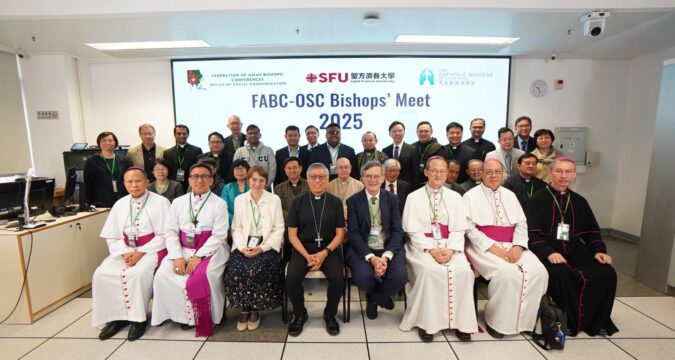
HONG KONG (RVA News): The 30th FABC-OSC Bishops’ Meet concluded on December 12 at St. Francis University, Hong Kong, with a call for the Church in Asia to respond wisely and pastorally to the rapid rise of artificial intelligence.
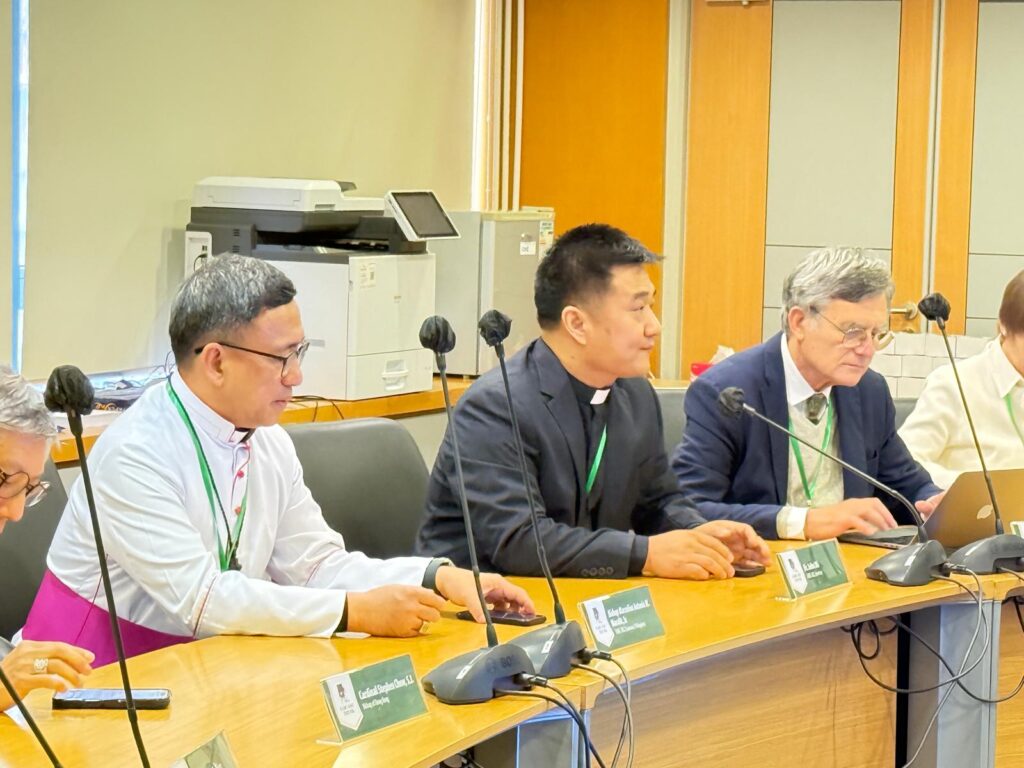
The December 10-12 gathering, organised by the Office of Social Communications of the Federation of Asian Bishops’ Conferences (FABC-OSC), brought together over 30 bishops, priests, religious, and lay media professionals from across the region.
The meeting ended with a closing Mass presided over by Bishop Marcelino Antonio M. Maralit Jr., chairperson of the FABC-OSC, who encouraged the participants to bring the fruits of their reflections to their dioceses and ministries.
He stressed the importance of the Church staying present and discerning as rapid technological change reshapes cultures, relationships, and pastoral life in Asia.
Statement on AI and Pastoral challenges in Asia
At the conclusion of the gathering, participants released a statement summarising their collective reflections, concerns, and commitments around the theme “Artificial Intelligence and Pastoral Challenges in Asia.” Described as the fruit of “prayer, discernment, and dialogue,” the statement presents both hope and caution as AI becomes increasingly embedded in daily life.
The statement reads:
Our shared conviction
Amid rapid technological change, the Church in Asia reaffirms her unchanging mission: to proclaim Christ, uphold human dignity, and foster authentic communion. Artificial intelligence, an expression of human creativity, offers both promise and peril. The Church does not reject or fear AI but seeks to engage it with prudence and an incarnational vision rooted in human relationships.
Pope Francis, in his Address to the G7 Session on Artificial Intelligence (Borgo Egnazia, 14 June 2024), reminded the world that AI is “above all a tool,” whose ethical value depends on its human creators and users. In Asia’s diverse religious and cultural landscape, this calls us to ensure that AI serves fraternity, justice, and the relational harmony integral to our traditions.
Artificial intelligence, an expression of human creativity, offers both promise and peril. The Church does not reject or fear AI but seeks to engage it with prudence and an incarnational vision rooted in human relationships

General insights and opportunities
Participants noted that well-guided AI can support evangelisation, pastoral care, catechesis, and education. It can broaden access to knowledge, strengthen research, aid teachers and catechists, and enhance the Church’s digital mission. Collaboration must reflect Asia’s cultural richness, relational communication style, and interreligious context. Young people, already fluent in digital life, are key partners, while families require formation for responsible engagement.
Pope Leo XIV, in his message to the Builders AI Forum 2025, described AI as a “participation in the divine act of creation,” calling for systems that advance Catholic education, compassionate healthcare, and evangelisation through a “dialogue between faith and reason” [Antiqua et Nova, 83]. In Asia, AI can bridge rural digital divides, support minority Christian communities, and foster intergenerational wisdom. As Antiqua et Nova (66) notes, AI can enhance expertise, create opportunities for innovation, and open new horizons in Asia’s dynamic labour markets.
Concerns and emerging risks
The assembly expressed serious concerns about illusions of intimacy, simulated presence, deepfakes, biased content, and the erosion of truth in the digital environment. Excessive reliance on machines risks weakening human relationships, diminishing prayer and reflection, and reducing the irreplaceable presence of teachers, pastors, and parents.
Intelligence itself is never artificial; only machines are. Human beings, endowed with spiritual, moral, emotional, and relational depth, cannot be reduced to algorithms
There is particular unease about AI-generated religious content that may distort doctrine, manipulate sacred realities, or create “fake intimacy” with artificial personas. Environmental, ethical, and cultural impacts, especially in regions where Christians are minorities, require vigilance.
Pope Leo XIV, addressing the AI for Good Summit 2025, stressed that AI cannot replicate moral discernment or genuine relationships, and may deepen inequalities. In Asia, these risks include discriminatory algorithms and the weakening of authentic interfaith dialogue.
Theological and anthropological foundations
The reflections stressed that intelligence itself is never artificial; only machines are. Human beings, endowed with spiritual, moral, emotional, and relational depth, cannot be reduced to algorithms. AI compels us to ask anew: What does it mean to be human? The Church affirms the God-given dignity of each person, whose worth cannot be captured by data or computation. God’s communication is incarnational, rooted in presence, encounter, and community.
Technology must never replace genuine human engagement or blur the line between reality and simulation. The Church must therefore guard truth, protect the human face, and preserve spaces for contemplation, discernment, and authentic relationships.
AI is neither an existential threat nor a ready-made solution, but a new pastoral frontier calling for wisdom, vigilance, and hope
As Antiqua et Nova (31) teaches, human intelligence grows organically through embodied experience, unlike AI’s disembodied “logical-mathematical framework”, a crucial distinction in Asia’s family-centred cultures. Pope Leo XIV, in his Message to the International Congress of the Pontifical Academy for Life, recalled the “ontological dignity” of every person (Dignitas Infinita), insisting that AI must always enhance, not diminish, human relationships.
Practical commitments
The meeting proposes the following orientations for the Church in Asia:
- Develop Catholic AI tools grounded in Scripture, Church teaching, and Asian cultural contexts.
- Digitise Church resources to ensure accurate and responsible use in AI systems.
- Integrate AI literacy with pastoral, ethical, and relational formation in seminaries, dioceses, schools, and families.
- Support families and intergenerational learning by uniting digital competence with lived wisdom.
- Encourage youth engagement in mission-oriented digital innovation.
- Promote digital evangelisation marked by human oversight and pastoral accountability.
- Engage in public policy and encourage dioceses and episcopal conferences to study AI and craft contextual guidelines.
- Foster regional collaboration, especially through FABC-OSC and national communication offices, to ensure pastoral presence in digital spaces.
The Bishops’ Meet affirms that AI is neither an existential threat nor a ready-made solution, but a new pastoral frontier calling for wisdom, vigilance, and hope. As Antiqua et Nova (113) urges the pursuit of “true wisdom,” the Church in Asia commits to forming consciences, safeguarding dignity, promoting truth, supporting families and youth, and nurturing communities of authentic encounter. Through responsible innovation and collaboration across the region, AI can become a means that strengthens the Church’s mission and promotes integral human and spiritual growth.
Excessive reliance on machines risks weakening human relationships, diminishing prayer and reflection, and reducing the irreplaceable presence of teachers, pastors, and parents
A Marian reflection on the Feast of Our Lady of Guadalupe
As the meeting coincided with the Feast of Our Lady of Guadalupe, the statement concluded with a reflection on Mary’s inculturation of the gospel. “As we celebrate the feast of Our Lady of Guadalupe today [December 12], may we recall that Mary spoke to the Nahua widower, Juan Diego, in his own language and appeared in attire adorned with indigenous symbols. It is by inculturating the Word that she helped anchor the Catholic faith in the brave “New World.” Through her intercession, the Church in Asia may be strengthened to speak to the natives of this new digital world, in their language of AI, and, through a pedagogy rooted in Catholic anthropology, promote faith, authentic communion, and genuine human relationships.”