
Denis Chang
Even before the election in May 2025 of Pope Leo XIV, the first Augustinian to become pope, there had been a discernible growth of interest in the Augustinian model of dialogue and “way of wisdom”. Sino-Vatican relations provide a real-world context within which to understand and explore the Augustinian Way.
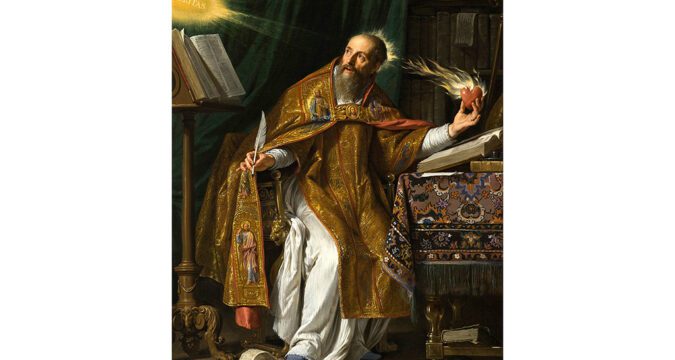
It was Pope Francis who early in his papacy, began invoking the method of “listening with the ear of the heart” [auris cordis]. It became the highlight of his 2022 World Communications Message where he quoted Augustine: “Do not have your heart in your ears but your ears in your heart”.
A recent sign of increased interest in Augustine was provided by the visit to Beijing of scholars from Leuven Centre for Augustinian Studies in March 2025 on “Engaging with Augustine across Civilisations” featuring seminars on Augustine’s De Magistro and his dialogical methods and related topics. Peking University, Renmin University and the Chinese Academy of Social Sciences were involved in arrangements for the visit.
Pope Francis died on April, 21, some seven months after the Sino-Vatican Provisional Agreement on Appointments of Bishops had been renewed for four years from 22 October, 2024. This was the third renewal, the first and second being for two years each.
The Vatican side has always called for ‘respectful and constructive dialogue’ in seeking common ground whilst preserving differences and remaining true to the Church’s own doctrinal position
Shortly after becoming pope, Leo XIV appointed Monsignor Joseph Lin Yuntuan [林運團 ] auxiliary bishop of Fuzhou in June 2025, a significant event. Bishop Lin, previously an “underground” bishop, is now recognised also by the Chinese authorities within the Agreement’s framework.
In September he appointed Joseph Wang Zhengui [王振貴] as bishop of the newly created diocese of Zhangjiakou, and Monsignor Joseph Ma Yanen [馬彥恩] as auxiliary [previously an “underground” bishop]. Bishop Augustine Cui Tai [崔泰], another previously “underground” bishop, was recognised by the Chinese authorities but was assigned an emeritus position because of age.
It should be added that Bishop Ma and Bishop Cui were bishops of the dioceses of Xuanhua and Xiwanzi originally erected in 1946 by Pope Pius XII. In technical canonical language, and as announced by the Vatican’s Bulletin dated September 20, these two dioceses were “suppressed” by the pope to erect the Diocese of Zhangjiakou, with a total population of over four million of which some 85,000 are Catholics, served by 89 priests.
As regards the Father Ignatius Wu Jianlin [吳建林], who was elected episcopal candidate by the Chinese local assemblies during the sede vacante [papal vacancy], Pope Leo appointed him auxiliary bishop of Shanghai, duly followed by public consecration on October 15.
As for Father Francis Li Jianlin [李建林] the Vatican announced his consecration as bishop of Xinxiang on December 5, stating at the same time that on August 11 the pope had appointed him as bishop of the Apostolic Prefecture of Xinxiang, having approved his candidature in accordance with the Agreement and accepted “the resignation from the pastoral care of the same Apostolic Prefecture presented by Bishop Joseph Zhang Weizhou”. Bishop Zhang was the “underground” titular bishop who was asked to retire.
The Augustinian Way yields principles of engagement that require, among other things, a good sense of history, and knowledge of the self and others, as well as enormous patience and true humility in the seeking and working out of worthy solutions
The dynamics of episcopal appointments in the Chinese Mainland context can be complicated and challenging. The Vatican side has always called for “respectful and constructive dialogue” in seeking common ground whilst preserving differences and remaining true to the Church’s own doctrinal position.
As taught in De Magistro [The Teacher] and other works, such as Augustine’s Cassiciacum Dialogues and the Soliloquies, the Augustinian Way includes both internal and external dialogues. They cannot, at core, be severed from each other nor from what is called the Augustinian “wisdom of the heart” which has deep biblical roots. When Jesus tells his disciples to be both wise as serpents and innocent as doves [Matthew 10:16-25], he is asking them not to be naïve and yet to be without guile.
There is in the Augustinian method an “inner teacher” that leads the learner to critical self-reflection and transformative understanding [illumination] in a tripartite process sometimes called the ARP— Aporia, Reflection and Plausibility.
Aporia, originally a Greek word, does not mean ignorance but rather a state of puzzlement when faced with a problem with no obvious solution. Augustine reconfigures the Platonic approach of dialectical reasoning and Socratic questioning.
As developed by Augustine, the second stage is Reflection or the inward turn. Critical reflection facilitates discernment but that does not necessarily yield certainty immediately. Taking his cue from Cicero, Augustine, calls the third stage probabile, a plausible solution that is worthy of approval, at least provisionally.
Sino-Vatican relations provide a real-world context within which to understand and explore the Augustinian Way
The Augustinian Way yields principles of engagement that require, among other things, a good sense of history, and knowledge of the self and others, as well as enormous patience and true humility in the seeking and working out of worthy solutions. It should be noted that the Vatican, when it announced the third extension of the Agreement, described it as one reached “for the benefit of the Catholic Church in China and of the Chinese people as a whole.”
Both internally and in its external manifestations the method stresses the need for utmost sincerity—analogous to what in the Confucian canon is called “Cheng” [誠]. Despite such sincerity, progress may still be painfully slow and the solution a “provisional” one.
This should not be too surprising. Augustine himself in The City of God speaks of the two cities, the City of Man and the City of God, existing side by side on earth. He stresses that the denizens belonging to the City of God, whilst on pilgrimage to the Heavenly Jerusalem, will find that there is “inter-mingling “ or “entanglement” between the two cities.
He says, however, that they should not neglect or “despise” what may be called “social” or “secular” goods such as those of civic order and of human law and justice They should instead work towards their perfection and maintaining what Augustine calls “pax civitatis” or civil peace.
The Vatican side has always called for ‘respectful and constructive dialogue’ in seeking common ground whilst preserving differences and remaining true to the Church’s own doctrinal position
Thus Vatican diplomacy appears to have so far focussed principally on (i) relationship-building rather than reaching an immediate comprehensive definitive agreement (ii) upholding respect for state sovereignty on the one hand as well as the Church’s proper sphere of competence and spiritual and moral authority on the other and (iii) adopting a humble and sincere willingness to continue dialogue not limited to episcopal appointments.
Bridge-building extends beyond dialogue between two sovereign parties to other manner of relevant exchanges between people and institutions including between the Church in Mainland China and the Church in the Hong Kong SAR.
The role of the Church in Hong Kong as a “bridge” church is not new but is strengthened in the light of the increasing importance placed by the universal Church on “synodality”— with the whole People of God “walking together” in prayerful listening, dialogue and discernment under the guidance of the Holy Spirit and in union with the pope.
*Denis Chang, SC, KC, Hon. LLD, is a lay member of the governing board of the Holy Spirit Study Centre and a member of the Academic Advisory Board of Tripod. He is also a practising Senior Counsel and Head of his Chambers. He writes this article in a personal capacity.