Elizabeth Scalia, OSV News
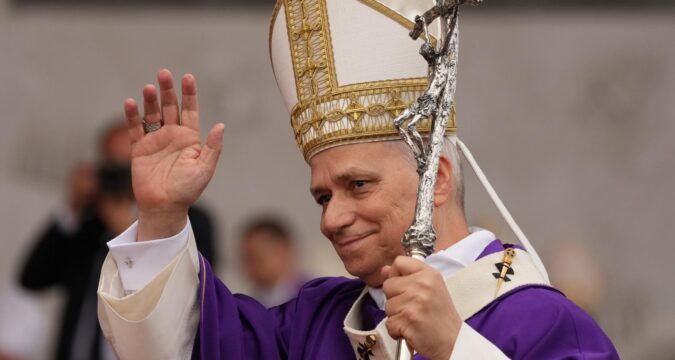
Nine months into the papacy of Pope Leo XIV—the first American to hold the office—the world is watching a pope defined by quiet discernment, gentle gestures, and a refusal to be rushed by punditry or public demand. His embrace of a grieving Lebanese woman, widely shared on social media, has come to symbolise a broader yearning for compassion in an era troubled by technological upheaval, economic uncertainty, and rapid social change.
As observers debate whether Pope Leo will follow in the activist footsteps of his predecessors or chart a new course, his measured approach is winning cautious praise. His choice of the historic name “Leo” hints at ambitions to address the complex moral questions of the modern age—ranging from artificial intelligence and surveillance to the challenges of global trust and techno-addiction.
Yet, much about Leo remains enigmatic: rooted in Augustinian reflection, he has offered the faithful only glimpses of his vision, preferring thoughtful engagement over hasty declarations. In a time of strident voices, his papacy is emerging as a quietly resonant presence—an acoustic guitar amid the brass bands—inviting the world to listen more closely to what comes next.
Here are my top 5 “Pope Leo Moments” for 2025.
1) His first interview and the messages contained in it
In his inaugural interview, Pope Leo XIV highlighted issues like inequality, marginalisation, the environment, and migration, but emphasised his primary role is not to “be the solver of the world’s problems,” but to root the Church’s voice in the gospel.
The values that the Church will promote in dealing with some of these world crises don’t come out of the blue, they come out of the gospel.
Pope Leo
Rather, the new pope means to root the voice of the Church firmly to its source: “The values that the Church will promote in dealing with some of these world crises don’t come out of the blue, they come out of the gospel.” It goes back, he added “to the very basic things of respecting one another, respecting human dignity …”
Month by month, Leo demonstrated this approach: issuing an exhortation on love for the poor, by praying with the leader of a historic persecutor of the Church, addressing polarisation and marginalisation, and using digital media to connect with youth.
All of that added up to a great beginning for this infant papacy, but Leo’s slow revelation ended in Lebanon, where we saw a candle of steady light, burning with a full and compassionate heart for the suffering, a vigorous and deep uplifting faith and a humble yet firm sense of occasion.
2) Visit to Turkey and, especially, Lebanon
In considering the top five moments of this papacy thus far, Pope Leo’s visit to Turkey and Lebanon is an obvious standout. The photos from Leo’s pilgrimage to Iznik were breathtaking: standing above the ruins of the ancient Basilica of Saint Neophytos, the bishop of Rome joined in prayer with the Ecumenical Patriarch of Constantinople and representatives of Eastern Churches, both Catholic and other Orthodox, and helped the one, apostolic Church breathe with both lungs.
Month by month, Leo demonstrated this approach: issuing an exhortation on love for the poor, by praying with the leader of a historic persecutor of the Church, addressing polarisation and marginalisation, and using digital media to connect with youth
He visited Istanbul’s Blue Mosque, respectfully observing local traditions but, in a departure from his three predecessors, politely declining to join in prayer.
In Lebanon that beleaguered nation’s estimated 1.3 million Catholics were demonstrably overjoyed to meet their new pope. Leo became the first pontiff to visit the shrine of St. Charbel Makhlouf, stressing the importance of interfaith respect. He underlined that people of all faiths can unite through dialogue.
He addressed challenges of technology and relationships with Lebanese youth, comforted victims’ families of the 2020 explosion, and celebrated Mass for 150,000, calling Lebanon to be a sign of peace and justice. “Lebanon, stand up,” he said. “Be a home of justice and fraternity! Be a prophetic sign of peace for the whole of the Levant.”
3) Meeting—and praying with—an earthly king
Earlier, Leo welcomed King Charles III to St. Peter’s, where, for the first time since the Reformation, a pope and British monarch prayed together in the Sistine Chapel.
There are still plenty of issues keeping us apart but Leo is demonstrating that Christians praying together, in every part of the world, must always be the beginning dialogue for peace.
Leo completed Pope Francis’s unfinished exhortation, Dilexi te, emphasizing the unity and continuity of papal leadership and the Church’s call to love and serve the poor
4) Dilexi te: Continuity and unity
Leo completed Pope Francis’s unfinished exhortation, Dilexi te, emphasizing the unity and continuity of papal leadership and the Church’s call to love and serve the poor.
While notions of papal continuance too frequently rest upon shallow externals [“Will he eschew a mozzetta? Will he wear a camauro?”] in this cooperation of popes working as brothers toward the same end, we see the continued presence of the Holy Spirit, who upholds the institutional Church, whether she is at her best or her worst. What a heartening thing.
5) Plaintalk for the plane presser
Leo’s three most recent predecessors agreed to in-flight press conferences, which are informal and can sometimes yield answers requiring later follow-up or clarification. On the return to Rome, the Holy Father covered an array of topics with clarity, discernment and discretion—no follow-ups required—and he even shared something of his personal prayer life.
By word and example, perhaps the best and most succinct example of lived and intimate prayer that a pope can make, unceremoniously offered as instruction to us all
In keeping with his belief that he is not meant to be “the solver of the world’s problems,” he refused to go into detail about delicate socio-politico issues. Asked about a letter from Hezbollah, Leo delicately sidestepped the details saying only, “Clearly, on the part of the church there is the proposal that they lay down their arms and that we seek dialogue. But beyond this, I prefer not to comment at this time.”
Responding to a query as to his state of mind when the possibility of his election became clear in the conclave, the pontiff was natural and instructive. “I resigned myself to the fact … I took a deep breath, and said ‘here we go Lord, you’re in charge, you lead the way.’”
A prayer of surrender to an unimaginable change in life and station, “here we go, Lord, you’re in charge.”
By word and example, perhaps the best and most succinct example of lived and intimate prayer that a pope can make, unceremoniously offered as instruction to us all.