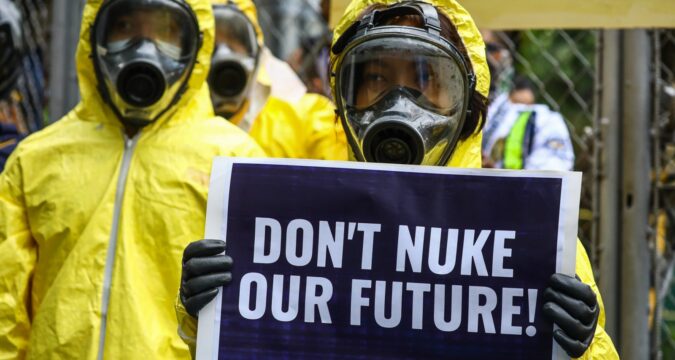
ALAMINOS (LiCAS News): “It is good that we reflect on this and pray over this plan, and I encourage you to join our bishops, especially here in our diocese, our beloved bishop, where the Diocese of Alaminos, the Philippines, does not agree with the construction of a nuclear power plant here in our town of Labrador,” said Father Ed Inacay.
He made the call in a video message as he called on residents to participate in an 8.00am Mass celebrated by Bishop Napoleon Sipalay Jr., at St. Isidore Parish, on January 4.
Father Inacay said that the Mass was linked to the Church’s discernment on the proposed nuclear facility in Labrador town, Pangasinan province, and reflects the diocese’s opposition to the project.
Caritas Philippines expressed support for the Diocese of Alaminos and urged the public to “demand an energy policy that prioritizes human safety, ecological integrity, and the constitutional right to a balanced and healthy environment.”
Caritas Philippines president Bishop Gerardo Alminaza of San Carlos, in a January 2 video message, warned that nuclear energy “remains a perilous energy source that poses long-term risks to our communities and our ‘common home’.”
The bishops said the Philippines’ vulnerability to earthquakes and typhoons, its location along the Pacific ‘Ring of Fire,’ and the lack of a secure, long-term solution for radioactive waste make nuclear facilities an ‘unacceptable risk,’ especially in disaster-prone areas
Bishop Alminaza said, “As you gather for the Holy Mass at 8:00am, let your presence be a powerful testament of your refusal to accept a future defined by hazardous technology.”
The bishops said that the country is already leading the way in renewable energy transition, “with the potential to reach a 64 per cent to 70 per cent share of clean, decentralised, and flexible energy by 2050.”
He added, “This path not only creates nearly a million green jobs but also avoids the inherent dangers of radioactive waste and the catastrophic risks associated with nuclear facilities in a country prone to natural disasters.”
In December 2025, Catholic dioceses across the country expressed collective opposition to the proposed construction of a nuclear power plant in Western Pangasinan, citing moral responsibility, environmental risk, and the protection of life as central concerns.
As we celebrate the 500 years of Christianity in the Philippines. The Chaplaincy to Filipino Migrants organises an on-line talk every Tuesday at 9.00pm. You can join us at:
https://www.Facebook.com/CFM-Gifted-to-give-101039001847033
In a pastoral letter, the bishops, particularly those of the Metropolitan See of Lingayen-Dagupan, said the proposal came as communities were still recovering from Typhoon Fung-wong [Uwan], which left the province under a state of calamity and affected more than 233,000 people.
The bishops said the Philippines’ vulnerability to earthquakes and typhoons, its location along the Pacific “Ring of Fire,” and the lack of a secure, long-term solution for radioactive waste make nuclear facilities an “unacceptable risk,” especially in disaster-prone areas.
They warned that nuclear energy carries “irreversible, long-term risks” that outweigh projected benefits and said radioactive waste, which remains deadly for thousands of years, would impose a burden on future generations.
Drawing from the experiences of bishops in Japan after the Fukushima nuclear disaster, the bishops said nuclear power generation is fundamentally incompatible with a vision of society that respects all life.
Echoing Pope Francis, the bishops stressed prudence, human safety, and environmental protection over immediate economic gains, urging government officials and the public to pursue renewable energy paths that safeguard communities, ecosystems, and the common good.