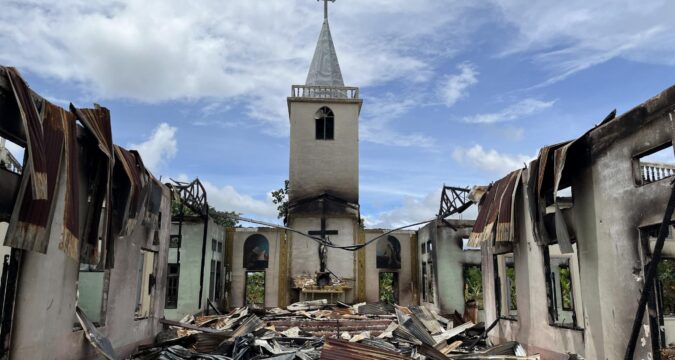
YANGON (LiCAS News): “Hope in Myanmar today is crucified hope, yet it is not dead,” Charles Maung Cardinal Bo of Yangon said, as the country continues to grapple with conflict, poverty, and what many citizens perceive as international neglect.
In a wide-ranging reflection on the national mood, Cardinal Bo described an atmosphere of anxiety and uncertainty, particularly among young people.
He said the prevailing mood among many citizens is “one of stress, concern for safety, and uncertainty about the future due to ongoing political, economic, and security challenges.”
Many young people, the cardinal noted, live with persistent fear linked to violence, displacement, economic instability, and the threat of forced recruitment. Feelings of sadness, anger, and distress have increased in recent years, leading some to consider migration in search of safety and opportunity.
At the same time, Cardinal Bo emphasised that despair has not overtaken the country.
“Yes—it is still possible to maintain hope in Myanmar, even in the midst of conflict, poverty, and the painful sense of international neglect,” he said. “But this hope is not naïve optimism; it is a Christian hope born of the Cross and Resurrection.”
Yes—it is still possible to maintain hope in Myanmar, even in the midst of conflict, poverty, and the painful sense of international neglect. But this hope is not naïve optimism; it is a Christian hope born of the Cross and Resurrection
Cardinal Bo
The cardinal acknowledged that many citizens feel abandoned by the international community.
“Yes—many people in Myanmar do feel forgotten, though this feeling is not uniform and is often expressed quietly rather than loudly,” he said.
For ordinary people, that perception stems from “prolonged suffering with little visible change,” limited international attention, and what many see as cautious or inconsistent action by powerful actors. He explained, “When suffering becomes long and unresolved, people naturally feel abandoned by the world.”
Yet Cardinal Bo grounded hope firmly in faith.
“First, our hope rests in God, not in circumstances,” he said, adding that even in villages displaced by war and in camps for the internally displaced, “God is still walking with His people.”
Noting the resilience of ordinary communities, he said, “Second, the poor themselves have become signs of hope,” observing that families continue to pray together, young people still volunteer and serve, and communities share what little they have.
“Third, the Church’s faithfulness is itself hope,” he said. “When the Church refuses hatred, rejects violence, and continues to speak the language of reconciliation and human dignity, she becomes a sacrament of hope.”
Both Catholic and Protestant Church leaders in Myanmar have continued to promote dialogue, interfaith cooperation, and grassroots reconciliation initiatives.
When the Church refuses hatred, rejects violence, and continues to speak the language of reconciliation and human dignity, she becomes a sacrament of hope
Cardinal Bo
The Church has supported displaced communities, encouraged nonviolent resistance to injustice, and called for reconciliation grounded in justice and truth.
Despite fading headlines abroad, Cardinal Bo insisted that Myanmar is not abandoned in the eyes of faith.
“Myanmar may feel overlooked, but it is not forgotten in God’s plan,” the cardinal stressed.
He also underscored that the Holy See remains attentive to the crisis.
“The Holy Father is deeply concerned about Myanmar,” he said, pointing to repeated appeals for peace, dialogue, protection of civilians, and humanitarian access.
For Cardinal Bo, hope is not optional, stating, “Hope in Myanmar is a moral duty. To lose hope would be to surrender the future to violence and despair.”
He concluded with a message that resonates across a wounded nation.
“Myanmar hopes not because the situation is easy, but because God is faithful,” he said. “And as long as there are people who pray, forgive, serve, and refuse to hate, hope is alive in Myanmar.”