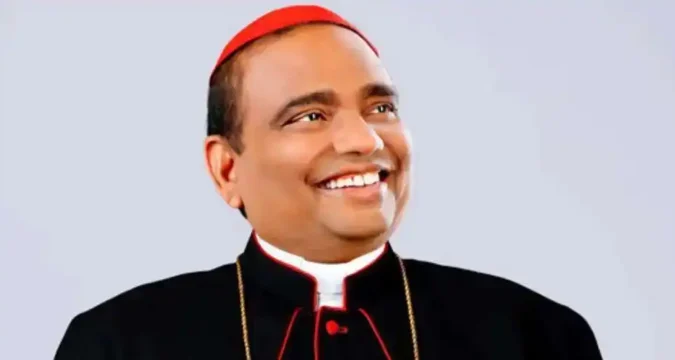
BENGALURU (UCAN): Church leaders in India welcomed the election of Poola Cardinal Anthony, archbishop of Hyderabad and a member of the historically marginalised Dalit [untouchables] community, as the new head of the Catholic Bishops’ Conference of India [CBCI] at its 37th General Body Meeting on February 7 in Bengaluru [formerly Bangalore].
The 64-year-old Cardinal Poola is the first Dalit to lead the bishops’ conference, which comprises India’s three rites—Latin, Syro-Malabar, and Syro-Malankara. He succeeds Archbishop Andrews Thazhath of Trichur, who held the post for the past four years.
Cardinal Poola was born on 15 November 1961, was ordained a priest at the age of 30, and appointed Bishop of the Diocese of Kurnool in 2008. He became archbishop of Hyderabad in 2020, and Pope Francis elevated him to cardinal in 2022.
He studied theology at Loyola University Chicago, USA, and worked at St. Genevieve’s Church in the Archdiocese of Chicago.
Bishop Theodore Mascarenhas of Daltonganj described the election as “a big step forward” in addressing the continuing “discrimination and inequality within the Catholic Church.”
Out of roughly 180 bishops nationwide across all rites, only about 12 are Dalit, a stark 6.7 per cent
John Dayal
He observed that a Dalit leading the bishops’ conference “will send a strong message to Christians of Dalit origin that the Church upholds the dignity of everyone.”
John Dayal, spokesperson for the All India Catholic Union, said Cardinal Poola’s leadership is “an opportunity” for the Church to align its actions with its 2016 Dalit empowerment policy, which recognised caste discrimination as a “grave social sin.”
“Out of roughly 180 bishops nationwide across all rites, only about 12 are Dalit, a stark 6.7 per cent,” Dayal said, noting, however, that Dalit and tribal people constitute more than 60 per cent of Indian Catholics.
The only tribal bishop to have headed the bishops’ conference was the late Telesphore Cardinal Toppo [1939–2023], Archbishop of Ranchi until 2018. He led the CBCI for two consecutive terms from 2004 to 2008.
Dayal added that priests and nuns from Dalit backgrounds also represent only a small fraction of the clergy and religious sisters.
Father Francis Xavier, rector of Loyola Institutions in Chennai, southern India, said, “Catholics of Dalit origin, who converted from Hinduism, hoped for justice and equality. But they continue to endure caste-based discrimination, including social exclusion and segregated places within the Church.”
He noted, “For example, there are separate cemeteries for Dalits, and even the hearses used to transport the dead are different.”
Dalit Catholics are also excluded from decision-making bodies. In this context, Cardinal Poola’s election as CBCI president “affirms that Dalits are equally capable and deserving leaders,” Father Xavier stressed.
Jesuit Father Prakash Louis, former director of the New Delhi-based Indian Social Institute, said the cardinal’s election “is an effort to rectify the historical wrong of caste discrimination.”
Rights activist and Gujarat-based Jesuit Father Cedric Prakash called Cardinal Poola’s election “historic,” adding that he should “reach out to Dalit Christians and other Catholics, who have been at the receiving end both internally within the Church and outside.”