MANILA (UCAN): Catholic groups have opposed a diluted version of a new anti-dynasty bill approved by a 32-member committee of the Philippine House of Representatives, saying it is “designed to leave dynastic power mostly untouched.”
Karlo Abadines, executive director of the Jesuit-run Simbahang Lingkod ng Bayan [Church at the Nation’s Service], said on 3 March that “the concentration of power with a few families” undermines the principle that “the common good is the good of all, not just a few.”
The organisation was joined by the anti-corruption group, Clergy for Good Governance and the Socio-Political Affairs Ministry of the Archdiocese of Manila.
The Catholic groups, along with 10 others, released a statement on March 3 emphasising that the approved version of the anti-dynasty bill is “designed to leave dynastic power mostly untouched.”
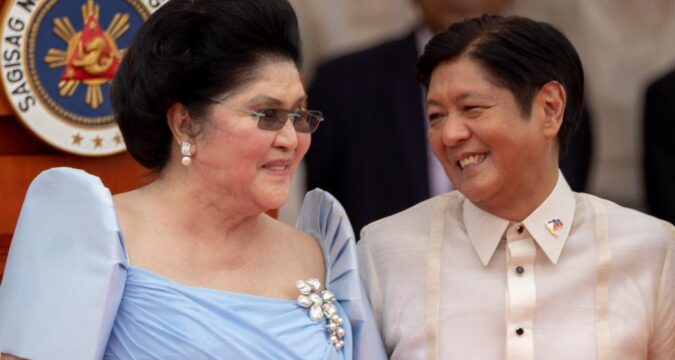
The bill is supported by allies of the president, Ferdinand Marcos Jr., who himself hails from one of the country’s most enduring political families.
Reform advocates have long awaited the anti-dynasty bill, blaming political dynasties for much of the corruption and inequality in one of Asia’s oldest democracies
It will now move to the plenary, where all 318 members of the House—most of whom are members of political dynasties—will scrutinise the bill.
Reform advocates have long awaited the anti-dynasty bill, blaming political dynasties for much of the corruption and inequality in one of Asia’s oldest democracies.
Nearly 80 per cent of members of Congress are part of political dynasties, according to a 2022 study by the Ateneo School of Government.
The new bill has been widely criticised as a watered-down version of earlier proposals—nearly identical to a version promoted by Faustino Dy III, the speaker of the House who also belongs to a political dynasty, and Ferdinand Alexander Marcos, the House majority leader and the president’s son.
As we celebrate the 500 years of Christianity in the Philippines. The Chaplaincy to Filipino Migrants organises an on-line talk every Tuesday at 9.00pm. You can join us at:
https://www.Facebook.com/CFM-Gifted-to-give-101039001847033
The House version prohibits political dynasties only up to the second degree of consanguinity or affinity, while reform advocates want a prohibition up to the fourth degree.
Nearly 80 per cent of members of Congress are part of political dynasties, according to a 2022 study by the Ateneo School of Government
It also allows members of the same family to hold government positions simultaneously, provided they run in different areas or at different levels of government.
In their statement, anti-dynasty advocates said that Congress “is poised to pass an ‘anti-dynasty’ label without an anti-dynasty effect.”
They called on Congress to ensure the prohibition “must cover relatives within the fourth civil degree of consanguinity or affinity,” and also ban them from simultaneously holding public office.
“We call on the public, civil society, faith communities, youth, and all democracy advocates to speak out and demand a real anti-dynasty law,” the advocates said. “The country cannot afford fake reform that legitimises dynasty rule.”
Most recently, Pablo Virgilio Cardinal David criticised political dynasties in a speech on the 40th anniversary of the People Power Revolution
Abadines stressed that the concentration of power in a few families “leads to corruption and loss of accountability, which is, at the end of the day, against the idea of the common good.”
The Catholic Church in the Philippines remains one of the most vocal opponents of political dynasties in the country, although its leaders have also been criticised for accepting donations, sponsorships, and even luxuries from politicians.
Most recently, Pablo Virgilio Cardinal David criticised political dynasties in a speech on the 40th anniversary of the People Power Revolution.
Cardinal David, the bishop of Kalookan, said the country’s democracy is not yet strong, “when politics still revolves around patronage and dole-outs.”