(OSV News): Israeli prime minister, Benjamin Netanyahu, quickly reversed a controversial police action on March 29, Palm Sunday, announcing on X [formerly Twitter], “I have instructed the relevant authorities that Cardinal Pierbattista Pizzaballa, the Latin Patriarch, be granted full and immediate access to the Church of the Holy Sepulchre.”
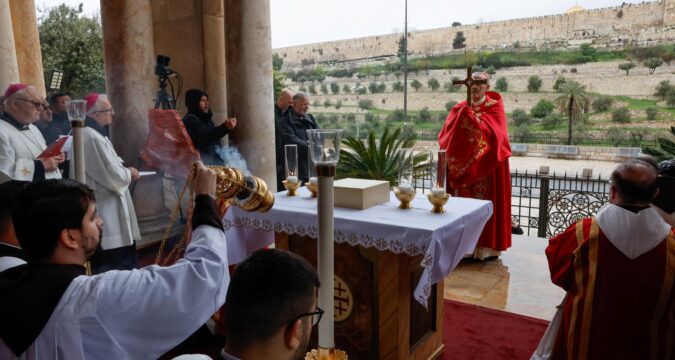
The move came after Israeli police prevented Cardinal Pizzaballa and Franciscan Father Francesco Ielpo, custos of the Holy Land, from entering the church to celebrate Palm Sunday Mass.
The incident, according to the Latin Patriarchate, marked the first time in centuries that the heads of the Church were barred from Palm Sunday services at the historic site. The patriarchate called the event “a grave precedent, disregarding the sensibilities of billions of people who, during this week, look to Jerusalem.”
It denounced the decision as “hasty and fundamentally flawed.”
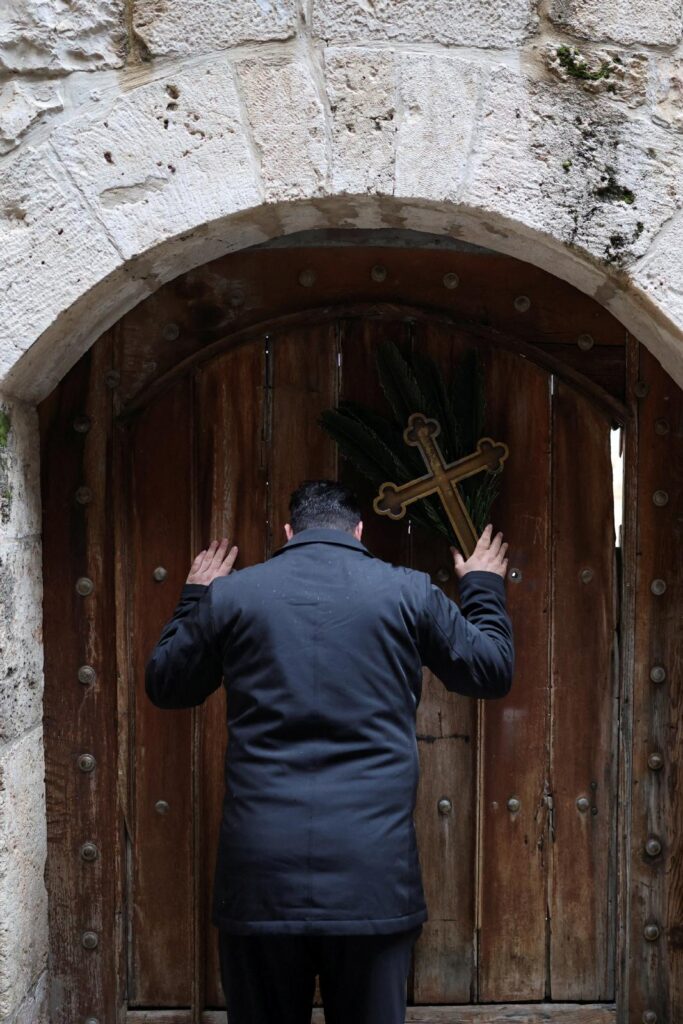
A Palestinian Christian stands at the doors of the Church of the Holy Sepulcher after finding them locked, following the cancellation of the traditional Palm Sunday procession from the Mount of Olives on March 29. Photo: OSV News /Ammar Awad, Reuters
The police action took place amid heightened security in Jerusalem’s Old City. Since February, several holy sites—including the Church of the Holy Sepulchre, the Western Wall, and the Temple Mount—have been closed following a joint Israeli-US attack against Iran.
Israeli president, Isaac Herzog, explained on March 30 that the incident arose from “security concerns over ongoing missile threats from Iran,” citing recent missile strikes in the Old City area.
Despite official explanations, the decision triggered swift international condemnation.
Palestinian authorities called the move “a crime and an illegal military measure” and “a flagrant violation of the basic rights of the Palestinian people, foremost among them freedom of worship.”
Italy’s prime minister, Giorgia Meloni, expressed solidarity with Cardinal Pizzaballa and Father Ielpo, emphasising that the Church of the Holy Sepulchre is “a sacred place of Christianity” that “must be preserved and protected for the celebration of sacred rites,” La Republicca reported.
Meloni added the move “constitutes an offence not only to believers, but to every community that recognises religious freedom.”
US ambassador to Israel, Mike Huckabee, called the action “difficult to understand or justify.”
European Union foreign policy chief, Kaja Kallas, posted on X that barring the clerics was “a violation of religious freedom and long-standing protections governing holy sites,” urging that “freedom of worship in Jerusalem must be fully guaranteed, without exception, for all faiths.”
Polish president, Karol Nawrocki, also writing on X objected, saying, “Palm Sunday marks the beginning of Holy Week, and Christians are preparing for the resurrection of Jesus Christ.” He added, “The actions of the Israeli police, which I condemn, are an expression of disrespect for Christian tradition and culture.”
Pope Leo XIV, before the Angelus in St. Peter’s Square on Palm Sunday, offered prayers for Christians in the Middle East “who are suffering the consequences of a brutal conflict and, in many cases, are unable to observe fully the liturgies of these holy days.”
The pope stressed, “Jesus is the King of Peace, who rejects war, whom no one can use to justify war. He does not listen to the prayers of those who wage war, but rejects them.”
Herzog reaffirmed Israel’s “unwavering commitment to freedom of religion for all faiths and to upholding the status quo at Jerusalem’s holy sites.” The Latin Patriarchate expressed gratitude to Herzog “for his prompt attention and valued intervention.”