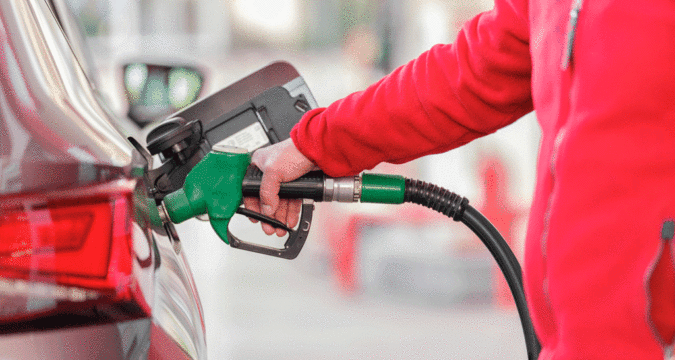
MANILA (LiCAS News): The IBON Foundation policy group observed in late March that a Philippine government-declared energy emergency would do little to curb rising fuel and food prices, as the country grapples with a deep dependence on imported fossil fuels amid global conflict.
On March 24, the president, Ferdinand Marcos Jr., signed Executive Order No. 110, declaring a state of national energy emergency as supply risks linked to the ongoing conflict involving the United States, Israel, and Iran threaten fuel availability and price stability.
The order adopts the Unified Package for Livelihoods, Industry, Food, and Transport [UPLIFT], a coordinated response framework involving key economic and social agencies.
However, Sonny Africa, executive director of IBON, said the order is unlikely to shield consumers from the immediate impact of rising prices.
Africa said that “the declaration won’t do much to rein in rising prices not just of oil products but of basic goods and services,” warning that “inflation will still double or triple in the coming months.”
Soaring domestic oil prices charged by the oil firms are the main channel of shock transmission—but the [executive order] doesn’t say anything about public and transparent determination of these prices,
Sonny Africa
He said the executive order [EO] leaves key mechanisms unclear, noting that while the Price Act “is presumably triggered and will freeze prices,” it was not explicitly cited in the measure, raising questions about whether price ceilings will be implemented.
“Soaring domestic oil prices charged by the oil firms are the main channel of shock transmission—but the EO doesn’t say anything about public and transparent determination of these prices,” Africa said.
He added that the policy effectively “protects the profits of every oil, electricity and other companies with the presumption that their market-determined prices enabling profits as usual are ‘reasonable’.”
At the same time, Africa said the order lacks clear commitments to support vulnerable sectors.
As we celebrate the 500 years of Christianity in the Philippines. The Chaplaincy to Filipino Migrants organises an on-line talk every Tuesday at 9.00pm. You can join us at:
https://www.Facebook.com/CFM-Gifted-to-give-101039001847033
“The EO is unable to be explicit that the livelihoods of transport workers, fisherfolk, farmers, and other small producers will be protected,” he said, adding that it also “avoids saying how many need help, how much help will be given, and for how long.”
He pointed to funding constraints, noting that assistance will rely on existing budgets, as the order states that financing “shall be sourced from existing appropriations.”
…the [executive order] message is clear: the Marcos Jr. administration wants the burden of adjusting to the oil shock to be borne by poor and ordinary Filipinos, while the profits of corporations and the wealth of billionaires are protected
Sonny Africa
Africa said, “In short, there’s an emergency, but not that bad because the budget planned before the crisis is apparently enough,” raising concerns that millions could remain underserved.
He added that “the EO’s message is clear: the Marcos Jr. administration wants the burden of adjusting to the oil shock to be borne by poor and ordinary Filipinos, while the profits of corporations and the wealth of billionaires are protected.”
Structural weaknesses exposed
The Institute for Climate and Sustainable Cities [ICSC] said the crisis reflects deeper structural vulnerabilities rooted in the country’s dependence on imported fossil fuels.
ICSC executive director, Angelo Kairos dela Cruz, said the declaration “just proves how resilience is not a trade-off to development, but in fact, it must be our main anchor towards a better development pathway for the country.”
He warned that “Filipinos will still bear the brunt of the impact: fuel prices will continue to increase, detrimentally affecting the lives and livelihoods of people,” pointing to how global disruptions quickly translate into domestic price shocks.
Filipinos will still bear the brunt of the impact: fuel prices will continue to increase, detrimentally affecting the lives and livelihoods of people
Angelo Kairos dela Cruz
Dela Cruz said this reflects “a deeper structural issue, that an import-dependent energy system leaves countries like ours exposed to volatility, while private gains persist during crises.”
He urged a shift toward domestic and renewable energy, saying “prioritising renewable energy and effectively moving away from our overreliance on fossil fuels will make us independent from international shocks” and help stabilise power costs.
The group also highlighted the role of local governments in building resilience, noting that “we also have to recognise the crucial role of local government units, who have a better understanding of their communities’ actual situation.”
Dela Cruz said existing local initiatives show that “we do not need to start from scratch: practical and efficient solutions already exist.”
All things considered: renewable energy advancement, multimodal public transportation, active transport and energy security must all be part of a combined, resilient system
Angelo Kairos dela Cruz
Push for long-term transition
ICSC said addressing the energy crisis requires a coordinated, long-term approach that integrates energy security, transport reform and climate action.
“All things considered: renewable energy advancement, multimodal public transportation, active transport and energy security must all be part of a combined, resilient system,” dela Cruz said.
He added that “true climate action must be centred on the actual needs of people and local communities,” warning that delays in addressing structural issues will deepen future crises.