
Ambrose Mong
It is of great significance that the first papal trip of Pope Leo XIV was to Turkey and Lebanon, as the people there yearn for peace and prosperity. The primary motivation for this journey, from 27 November to 2 December 2025, was to celebrate the 1,700th anniversary of the First Council of Nicaea [325AD], which gave us the Creed that all mainstream Christians adhere to and recite.
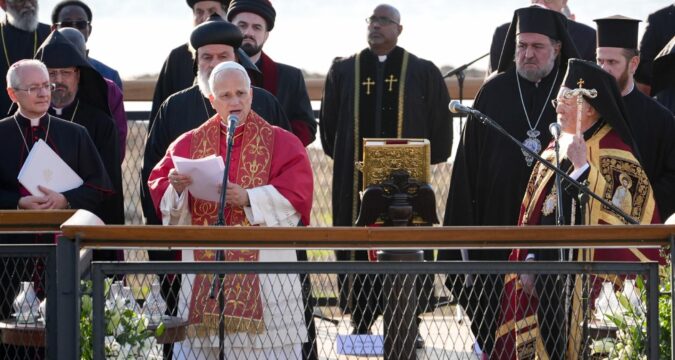
This journey marked a historic event for Christian unity, when Pope Leo and Ecumenical Patriarch Bartholomew I recited the Nicene-Constantinople Creed together, without the Filoque, at the ancient Basilica of St. Neophytos in Nicaea [modern-day Iznik, Turkey].
The controversial Filoque phrase, meaning “and the Son”, was a main cause of dispute between the Eastern and Western Churches. This omission of the Filoque on the part of the pope was a deliberate gesture of respect for the Orthodox tradition and a move towards reconciliation.
With original Nicene Creed from the Council of Constantinople in 381, the standard practice of the Eastern Churches, was without the Filoque – “The Spirit proceeds from the Father.” The Filoque clause was inserted into the Creed in Spain at the Third Council of Toledo around 589 and spread throughout the West. It was officially added to the liturgy in Rome in 1014 and became a major cause of dispute, leading to the Great Schism of 1054 between the Eastern and Western Churches.
The Filoque clause was inserted into the Creed in Spain at the Third Council of Toledo around 589 and spread throughout the West. It was officially added to the liturgy in Rome in 1014 and became a major cause of dispute, leading to the Great Schism of 1054 between the Eastern and Western Churches
The Eastern Orthodox objected fiercely to the Filoque because it was an unauthorised addition to an ecumenical creed. Theologically, it undermined the unique role of the Father as the source within the Trinity. For the Eastern Church, the Spirit proceedes from the Father alone, but is sent through the Son.
The Western Church argued that the Filoque was necessary to safeguard the divinity of Christ and to express the consubstantial unity of the Father and the Son. Itwas inserted into the Nicene Creed to combat Arianism, a heresy that denied the divinity of Christ, which spread in Spain during the 6th century.
Modern papal teaching formally acknowledges the Nicene-Constantinopolitan Creed in its original form without the Latin insertion of Filoque. When the pope and the patriarch of Constantinople recite the Creed together, they use the original Greek form as a sign of respect for the Eastern Orthodox tradition and a gesture towards full communion.
Thus, during the 1995 Eucharistic celebration with Patriarch Bartholomew, Pope St. John Paul II did not in fact “omit” the Filoque because it was recited in Greek without the Filloque clause.
When the pope and the patriarch of Constantinople recite the Creed together, they use the original Greek form as a sign of respect for the Eastern Orthodox tradition and a gesture towards full communion
What is remarkable is that Pope Leo and Patriarch Bartholomew recited the Nicene-Constantinopolitan Creed together in English without the Filoque on 28 November 2025, during an ecumenical prayer service in Iznik.
Avoiding the traditional Latin of the Catholic Church and Greek of the Orthodox Church and using English, a neutral and widely spoken language, is a symbol of Christian unity.
The symbol of faith – The Nicene Creed
I believe in one God, Father Almighty, Creator of Heaven
and Earth, and of all things visible and invisible.
And in one Lord, Jesus Christ, the Only-begotten Son of
God, begotten of the Father before all Ages. Light of Light,
True God of True God, begotten not created, of one
essence with the Father, through Whom all things were made.
Who for us men, and for our salvation, came down from
Heaven, and was incarnate of the Holy Spirit, and the
Virgin Mary, and became Man.
He was crucified for us under Pontius Pilate, and suffered and was buried.
And rose on the third day according to the Scriptures.
He ascended into Heaven, and is seated at the right hand of the Father.
And He will come again with glory to judge the living and dead; His Kingdom shall have no end.
And in the Holy Spirit, the Lord, the Creater of Life, Who
proceeds from the Father, Who together with the Father
and the Son is worshipped and glorified, Who spoke
through the prophets.
In One, Holy, Catholic, and Apostolic Church.
I confess one baptism for the forgiveness of sins.
I look for the resurrection of the dead.
And the life of the Ages to come.
Amen.
The Filoque presents such a significant obstacle to full communion with the Eastern Orthodox Church that the Catholic Church is willing to omit without denying its doctrinal importance. In fact, the Catholic Church views the Filoque as a valid doctrine within its Latin Tradition, but not essential from an ecumenical or liturgical point of view.
From a Chinese philosophical perspective, the Eastern Orthodox formulation resonates more appropriately and profoundly than the Latin Creed.
In fact, the Greek text, without the Filoque resonates with the Confucianist idea of Li [禮] or hierarchy, the proper ordering of relationships, with the Father as the first person of the Trinity. The Son is “begotten” and the Spirit “proceeds,” in their proper order, in relation to the Father, the first principle. Thus filial piety [xiao, 孝]is maintained within the Godhead in the cosmic hierarchy.
The insertion of the Filoque by the Western Church suggests a more collaborative relationship and upsets the cosmic hierarchy. Followers of Confucianism might view this insertion as destabilising the proper order [Li]. If the Son is also the source of the Spirit, the unique role of the Father is compromised.
From a Chinese philosophical perspective, the Eastern Orthodox formulation resonates more appropriately and profoundly than the Latin Creed
The Creed in the Western Church, however, emphasises profound unity and harmony [he, 和] between the Father and the Son, which is also highly valued by Confucianism.
Daoism offers a more profound perspective, with the Dao [道], as the ineffable and ultimate source of all things. The eternal Dao is unknown, analogous to the apophatic [negative] Orthodox theology. The classic Daoist cosmogony is “The Dao produced One; One produced Two; Two produced Three; and Three produced all things” [道德經].
This formula finds parallels in the Eastern Church’s understanding of the Trinity: The Father generates the Son, and from the Father, through the Son, proceeds the Spirit. From the Daoist perspective, the Filoque seems to confuse the distinctive modes of emanation from the Father, the ultimate source.
In sum, the Eastern Church formulation regarding the Trinity aligns better with Confucian respect for a singular, hierarchical order and the Daoist understanding of procession from a single, ineffable origin.
Thus, it is more readily comprehensible within Chinese cultural framework, with its emphasis of patriarchal structure to understand God the Father as the first principle.
The Filoque debate reflects a deeper theological understanding: is reality best understood as a hierarchical chain emanating from a single source or as a dynamic mutual relationship? Both the Eastern and Western Churches formulations can be viewed positively and negatively through a Confucianist or Daoist lens.