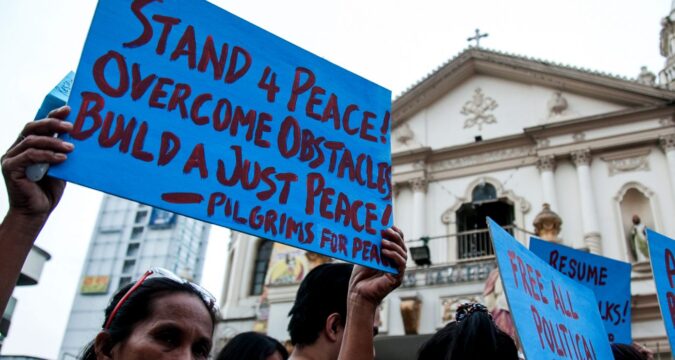
(LiCAS News): Catholic peace movements across the Asia-Pacific region are invoking Pope Leo XIV’s World Day of Peace message to challenge militarisation, security policies driven by fear, and enduring injustices stemming from the region’s history of conflict.
This call emerged at an international online forum in January, which brought together Catholic peace advocates, theologians, scholars, and youth leaders to reflect on the pope’s message and its implications for societies experiencing escalating conflict and social fragmentation.
The webinar was organised by Pax Christi Asia Pacific, the International Movement of Catholic Students Pax Romana, the International Catholic Movement of Intellectual and Cultural Affairs Pax Romana, and the International Youth Training Centre.
Speakers said Pope Leo XIV’s appeal for a “disarmed and disarming peace” [Sunday Examiner, 28 December 2025] directly challenges dominant global narratives that equate security with military power and deterrence.
“The realisation that true and lasting peace cannot be built on an equal supply of armaments is especially significant today,” said Bishop José Colin Bagaforo of the Philippines, newly elected co-president of Pax Christi International.
Human rights defender, Ruki Fernando of Sri Lanka, highlighted the persistence of militarisation even after armed conflict has formally ended, demonstrating that peace is not simply the absence of war but requires ongoing accountability and reform
He noted that the message urges the Church to resist fear-based politics and to ground peace efforts in justice, dialogue, and human dignity.
Human rights defender, Ruki Fernando of Sri Lanka, highlighted the persistence of militarisation even after armed conflict has formally ended, demonstrating that peace is not simply the absence of war but requires ongoing accountability and reform.
“Although Sri Lanka’s war ended in 2009, the country remains heavily militarised,” Fernando said, citing the military’s ongoing involvement in civilian life and the absence of accountability for serious human rights violations.
He warned that, without confronting these realities, Pope Leo’s call for unarmed peace would remain “a distant aspiration.”
Fernando also cautioned against relying solely on dialogue in deeply unequal contexts.
“Dialogue alone is not always sufficient when there are vast inequalities in political, military, and economic power,” he said, noting that non-violent direct action has often been necessary to restore dignity and justice where dialogue has failed.
Several speakers stressed that, as articulated in the pope’s message, peace cannot be separated from justice, restorative processes, and the healing of historical wounds.
Dialogue alone is not always sufficient when there are vast inequalities in political, military, and economic power
Ruki Fernando
In the Philippines, panellists reflected on how armed conflict, political dynasties, and corruption continue to undermine democratic institutions and social trust.
One speaker said an “unarmed and disarming peace” requires addressing state-sponsored violence and supporting transitional justice, including accountability for past abuses and solidarity with victims of the war on drugs.
Regional solidarity also featured prominently.
Speakers urged Catholic peace movements to remain vigilant amid growing militarisation and to continue advocating for human rights, reparations, and meaningful peace processes across borders.
On the Korean Peninsula, Joseph Shin from Jeju described how global power rivalries have turned the island into a strategic military site.
He linked Pope Leo’s warning against fear-driven security narratives to Jeju’s experience, marked by the expansion of naval bases and widespread public anxiety about the island becoming a frontline in future conflicts.
When peace is framed through realism devoid of hope, people are left with fear and powerlessness
Joseph Shin
“When peace is framed through realism devoid of hope, people are left with fear and powerlessness,” Shin said, recalling Jeju’s history, including the April 3 massacre and its designation as an “Island of Peace.”
He said the pope’s message challenges societies to reject security discourses that normalise violence, and instead to invest in trust, historical truth, and restorative justice.
Jesuit Father Jun Nakai from Japan underscored the importance of international solidarity in reconciliation.
He highlighted regular exchange programmes between Japanese and Korean bishops as a concrete response to rising xenophobia and racism in Japan, and introduced a new Pax Christi Hiroshima peace initiative focused on reconciliation grounded in historical memory and justice.
From Aotearoa New Zealand, Sacred Heart of Mary Bridget Crisp of Pax Christi Aotearoa challenged perceptions of the country as removed from violence.
“If you scratch the surface, New Zealand is not as removed from violence as it is often perceived,” she said, citing racism, inequality, and the unresolved impacts of colonisation.
Pope Leo XIV’s message gives young people not only hope, but also a mandate to act creatively and non-violently
Bianca Reyes, Pax Christi Pilipinas
Drawing on the pope’s call to “open ourselves to peace,” she said peace must be practised daily through listening, relationship-building, and dignified responses to conflict.
Youth participants framed the pope’s message as a call to intergenerational responsibility and action.
“Pope Leo XIV’s message gives young people not only hope, but also a mandate to act creatively and non-violently,” said Bianca Reyes of Pax Christi Pilipinas, who called for greater inclusion of young people in peacebuilding, advocacy, and Church-led initiatives.
Organisers said the World Day of Peace should serve as a starting point for sustained action rather than a symbolic observance.
“At a time when violence is increasingly normalised and militarisation is portrayed as inevitable, Pope Leo XIV dares to propose another path,” said Anselmo Lee, co-convener of the Catholic Peace Forum and co-president of Pax Christi Korea.
“The task before us is to make that path both visible and viable through ongoing education, advocacy, and solidarity across regions and generations,” Lee added.
They said follow-up dialogues and coordinated peace initiatives will continue throughout 2026, culminating in activities linked to the Seoul World Youth Day in 2027, with the aim of keeping the message of the World Day of Peace alive across Asia-Pacific communities and beyond.