At the peak of her career in 2016, Hong Kong artist Lucia Cheung Nga-yin stood inside the global headquarters of Sotheby’s in New York. It was Asia Week, and the atmosphere was electric. Even before her paintings had been fully hung on the gallery walls, international art specialists were already competing to acquire them. Nearby, museum curators carried limited-edition tote bags featuring her vibrant artwork.
To any artist, this was the pinnacle of professional success. Yet, as Cheung stood in the middle of the crowd, she felt unexpectedly detached.
In a world that often places artists on a pedestal, Cheung realised how easily one can be swept up in personal glory. “An artist’s position has too many illusions and halos around it,” she reflected. “It is very dangerous because our talent is given to us by God, and we actually have nothing of our own.”
Only months earlier, her beloved mother had passed away. Standing at the summit of the international art world, the glamour of worldly success suddenly paled beside the fragility of human life. The endless cycle of networking, public relations, and commercial pressures that defined the professional art scene began to feel less like a vocation and more like a burden.
“I suddenly thought to myself: Was it really worth devoting the rest of my life to this?” Cheung recalled.
It marked the beginning of a huge change. Gradually, she stepped away from the commercial art market and embarked on a quieter journey towards spiritual fulfilment.
…she sees each chapter as part of God’s patient formation, stripping away her ego and shaping her heart for selfless service
The classroom of grief
Cheung’s capacity for surrender was related to intense personal trials. Decades earlier, she endured every parent’s worst nightmare. Her young son, born with severe physical disabilities, required round-the-clock care. For ten and a half years she lovingly cared for him through immense physical and emotional hardship until his death in 1988.
Rather than hardening her heart, this deep sorrow opened it to a greater compassion for others. Shortly after her son’s death, an essay she wrote caught the attention of editors at Ming Pao Daily.
Despite having no journalism experience, she was invited to become editor of a children’s weekly.
Cheung threw herself into the role, seeing it as God’s providential answer during a time of grief. Driven by a desire to bring beauty to underprivileged children, she brought together a volunteer team of more than 20 academics, musicians and writers to produce a high-quality cultural magazine distributed free of charge.
Looking back on her winding path—which later included producing television documentaries about families facing hardship—Cheung no longer sees random career changes. Instead, she sees each chapter as part of God’s patient formation, stripping away her ego and shaping her heart for selfless service.
I suddenly thought to myself: Was it really worth devoting the rest of my life to this?
Lucia Cheung
A ministry bringing hope
By 2018, Cheung had completely withdrawn from commercial exhibitions. She stepped away from public attention to study sacred art and culture, eventually joining the Word on Fire Institute founded by Bishop Robert Barron, an international Catholic community dedicated to evangelisation through beauty, culture and the arts.
Recognising that her artistic talent was a gift entrusted to her by God, Cheung decided to devote it entirely to his service.
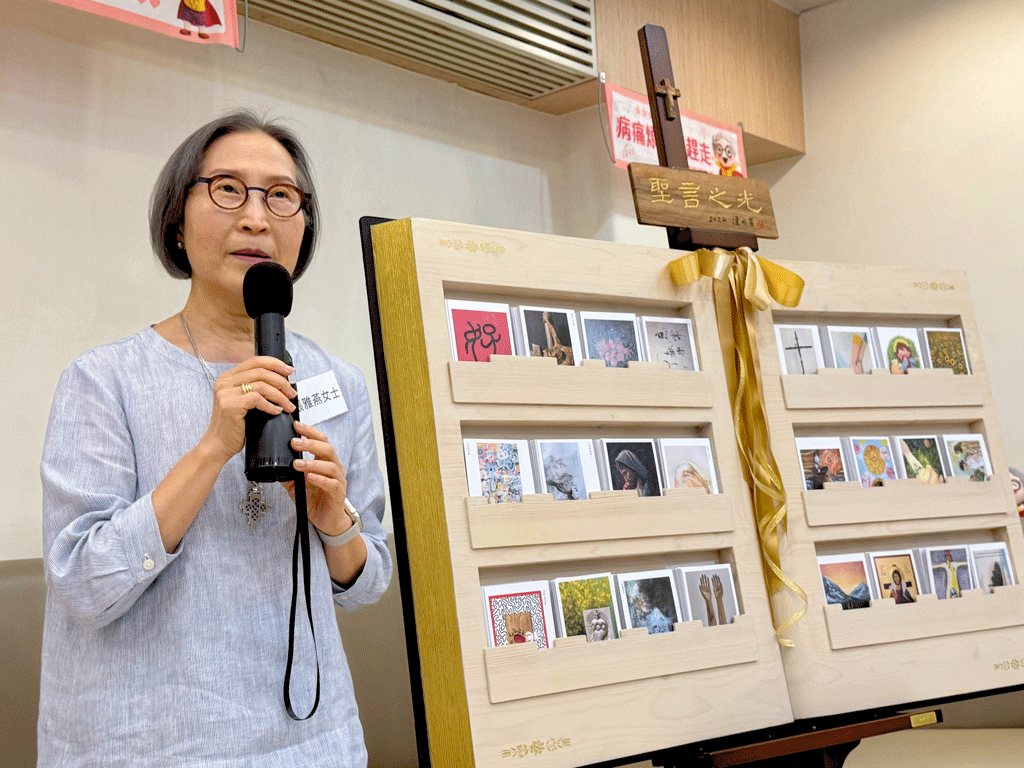
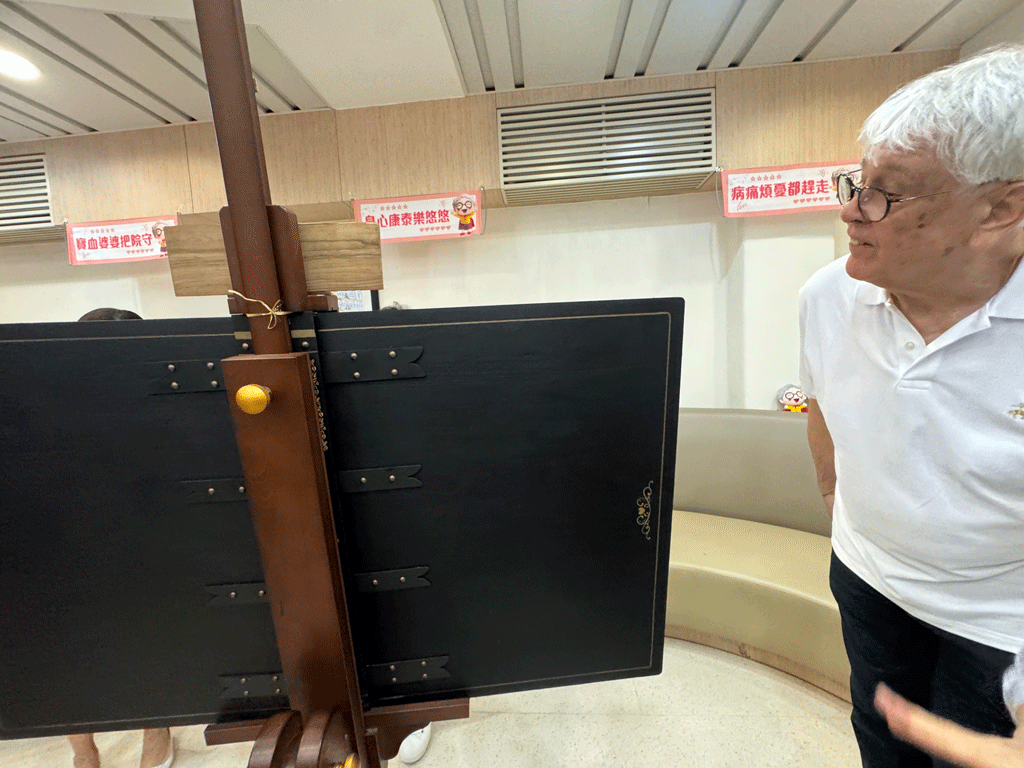
In 2023, she was invited to join the Ecumenical Art Committee to design a major art installation. Rather than creating a decorative display, she envisioned a monumental one-metre-long, hand-carved wooden Bible serving as a shelf to hold greeting cards created by Christian artists.
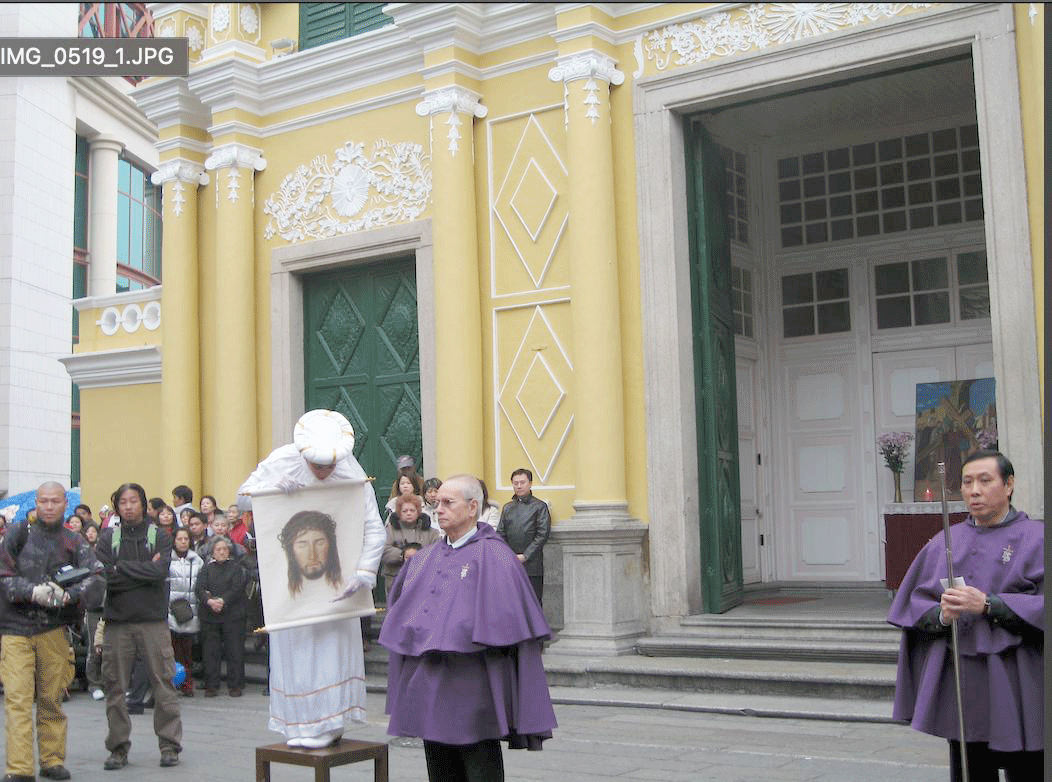
The annual procession of the Passion of Our Lord in Macau features Cheung’s painting of Jesus’ face held by a participant depicting St. Veronica. Photo: supplied
She had never before undertaken a project involving such a large wooden Bible. Yet she entrusted the entire process to God. In what she describes as a series of quiet miracles, supporters—including calligraphers and master woodcarvers—came forward, offering their skills with remarkable generosity and joy to bring the vision to life. She is also deeply grateful for the unwavering support of her Italian husband and sculptor, Arnaldo Acconci.
For Cheung, the installation is far more than an artwork. It is a vessel of healing that reveals beauty, goodness and truth. Patients and their families passing through the hospital would be able to take scriptural messages of hope from the Bible-shaped installation, finding comfort and strength during some of the darkest moments of their lives.
I enjoy doing a small piece for the Church just as much. In fact, I might even prefer this because it is so pure
Lucia Cheung
The richness of the small
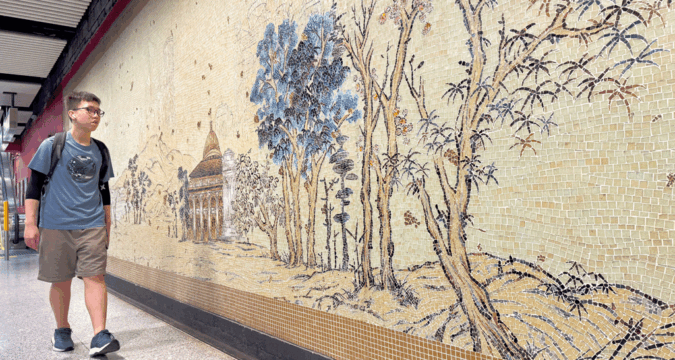
Today, many commuters encounter Cheung’s more than 17-metre-long glass mosaic mural, Home With A View, at the MTR station in Central. Completed in 2003, the work symbolises Hong Kong’s unity through stones of many different colours while offering a moment of peace to busy travellers.
Yet she finds equal joy in far humbler acts of service. She is just as happy arranging the Nativity scene in her parish, painting the face of Jesus for a procession in Macau, or spending hours handcrafting an intricate thank you card for a departing priest in the Italian-speaking Catholic community that she and her husband have served faithfully for decades.
“I enjoy doing a small piece for the Church just as much,” she says with a serene smile. “In fact, I might even prefer this because it is so pure.”
By letting go of worldly fame, Cheung did not abandon her art. Rather, she transformed her life itself into her greatest masterpiece—one painted not with the fleeting colours of celebrity, but with the enduring brushstrokes of faith, hope, love and peace.