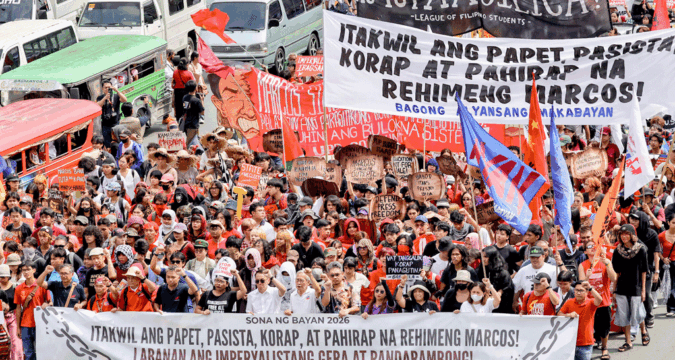
MANILA (Agencies): The fifth SONA [state of the nation address] by Philippine president, Ferdinand Marcos Jr., delivered on July 27, received mixed reactions, according to media reports.
Father Raymond Ambray, director of the Indigenous Peoples’ Apostolate in the Diocese of Tandag, Cagayan de Oro, criticised what he described as Marcos’ glaring omission of environmental issues, UCAN reported.
“The regime’s aggressive expansion of agri-industries has dispossessed the Lumads [indigenous people] of their ancestral lands,” Father Ambray said on July 27. He also condemned the government’s push for extractive industries—specifically citing Pax Silica, Tampakan Mining, the Angat Dam, and Isla Verde liquefied gas.
Carlos Isagani Zarate, a lawyer and former representative for Bayan Muna, branded the speech an outright failure, describing the SONA as filled with populist rhetoric but lacking concrete solutions. He also noted the absence of initiatives to address the worsening economic burden on the Filipino people.
The regime’s aggressive expansion of agri-industries has dispossessed the Lumads [indigenous people] of their ancestral lands
Father Raymond Ambray, director of the Indigenous Peoples’ Apostolate in the Diocese of Tandag, Cagayan de Oro
Charlito Manlupig, chairperson of the lobby group Kusog Mindanaw, observed, “It lacked a clear 10-year roadmap for the administration’s ‘Bagong Pilipinas’ [New Philippines] agenda,” and pointed out that nearly half the speech focused on accomplishments and ongoing initiatives, while promising economic relief through expanded income tax exemptions and social safety nets for workers.
Regarding the Bangsamoro Autonomous Region in Muslim Mindanao, Manlupig noted that Marcos focused solely on energy security, notably omitting mention of the region’s fragile peace process.
He added that the president also sidestepped the issue of rescheduling the first Bangsamoro Parliament election, expected to take place on September 14, despite prior pleas from peace coalitions.
Meanwhile, LiCAS News reported that the president’s proposal to remove system loss charges from electricity bills, through an amendment to the Electric Power Industry Reform Act by congress, while welcome, would not substantially reduce power costs without broader reforms to the country’s energy policies.
System loss refers to electricity lost because of technical factors, such as heat in wires and transformers, and nontechnical causes, including pilferage.
As we celebrate the 500 years of Christianity in the Philippines. The Chaplaincy to Filipino Migrants organises an on-line talk every Tuesday at 9.00pm. You can join us at:
https://www.Facebook.com/CFM-Gifted-to-give-101039001847033
It lacked a clear 10-year roadmap for the administration’s ‘Bagong Pilipinas’ [New Philippines] agenda
Charlito Manlupig
The Power for People Coalition [P4P] welcomed Marcos’ call for the amendment, but said the government must also address high generation charges and the country’s dependence on imported coal and gas.
“The elimination of system loss charges is a good step, but it’s absurd to present it as novel in his fifth SONA,” P4P convenor Gerry Arances said in a statement on July 27.
Arances noted that consumers had been calling for the removal of unfair charges from electricity bills for decades.
“The administration cannot expect a pat on the back for too little too late–especially when it keeps ignoring the biggest extra charge in our power bills: high fuel costs,” he said.
During his address, Marcos said, “It is time to remove the system loss charges passed on to consumers.” He said, “Consumers are not responsible for system loss, so it is not right to make them pay for it.”
P4P said the amendment proposal, as it stood, would leave the larger problems in the power sector unaddressed, pointing to high generation rates, the country’s dependence on imported fossil fuels, and policies that allow power companies to pass fuel cost increases on to consumers.
It called for an overhaul of the wider policy and regulatory framework governing the electricity industry, not only the provisions covering system loss.
The coalition welcomed Marcos’ recognition of renewable energy as a response to the energy crisis and his call for Congress to pass the proposed “Sariling Kuryente” Act. which seeks to make household solar panels and battery storage systems easier and more affordable to install.
However, it opposed the administration’s plans to pursue nuclear energy and expand gas development.
Marcos also announced that hydrogen power projects were in the pre-development stage in Marinduque, Masbate, Zamboanga Sibugay, Basilan, and other areas.
P4P described nuclear power and expanded gas development as “dangerous and costly distractions.”
Arances said, “If the government can allocate time and resources to be aiming to launch rockets into space, we can most definitely build a 100 per cent renewable energy-based power sector.”