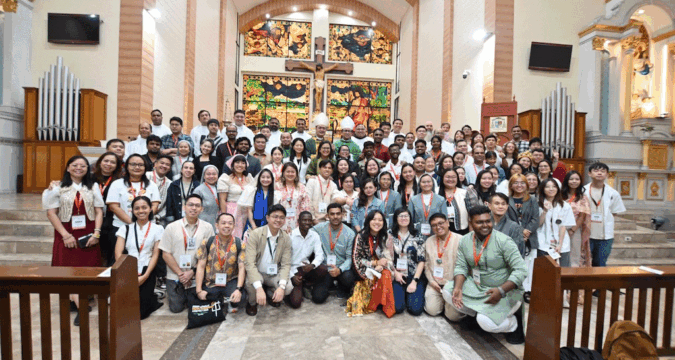
MANILA (SE): More than 100 Catholic digital communicators from across Asia were commissioned to make the digital world a place of listening, encounter, reconciliation and communion during a Mass on September 13, which concluded the first Asian Catholic Digital Missionary Assembly at the Good Shepherd Cathedral of the Diocese of Novaliches in Quezon City, Metro Manila, the Philippines.
Organised by the Federation of Asian Bishops’ Conferences Office of Social Communication [FABC-OSC], in collaboration with Radio Veritas Asia [RVA], the September 10-13 assembly sought to reflect on the Church’s digital presence and mission. It aimed to strengthen missionary formation, foster collaboration among Asian Churches, and encourage spreading the gospel in digital spaces.
Pablo Virgilio Cardinal David of Kalookan, vice president of the Federation of Asian Bishops’ Conferences, presided over the Mass. He was joined by Bishop Marcelino Antonio Maralit Jr., chairperson of the FABC Office of Social Communication; Divine Word Father Felmar Fiel, general manager of RVA; Father John Mi Shen, programme director of RVA; Father Albert Delvo, rector of Good Shepherd Cathedral; and other clergy.
In his homily, Cardinal David described the digital world as a new culture where people meet, search, suffer, and sometimes seek God. “Go there as missionaries,” he said, urging communicators to listen before reacting and to pay attention to voices often ignored—including the poor, wounded, lonely, angry, young, and those distanced from the Church.
Cardinal David described the digital world as a new culture where people meet, search, suffer, and sometimes seek God. ‘Go there as missionaries’
He emphasised that digital mission should move beyond mere connection towards genuine human and spiritual communion by building relationships, creating spaces for encounter, and helping people journey together.
Concerning those with whom they disagreed, he said, “The person on the other side is not an enemy to defeat.” He urged digital missionaries to respond to anger with courage, contempt with dignity, and to build bridges through forgiveness.
At the end of the Mass, the participants made a solemn pledge, led by Father Mi Shen, to serve as digital missionaries and to be “an authentic witness of faith in Asia.” They committed to “walking the synodal way, listening deeply, collaborating across borders,” and transforming digital presence “into a living encounter with Christ.” They also pledged to share “the diverse stories, joys, and challenges of the Asian Church,” bringing the light of the Gospel to “every screen and digital periphery.”
In an earlier interview, Dr Natasha Govekar, director of the Theological-Pastoral Department within the Vatican Dicastery for Communication, stressed that evangelisation cannot be reduced to producing content or increasing online engagement, but must help build communion and relationships.
Govekar said the Church’s presence in the digital world must lead people towards genuine human encounters and community, even as social media platforms can foster isolation, addiction, and polarisation. She noted rising concerns about social media algorithms driving addictive scrolling and polarisation.
Every headline, photograph, video, post, and story makes a choice
Archbishop Garcera
“The Church is not outside of this danger,” she said, noting that polarisation fuelled by digital platforms can also affect Christian communities. She said the challenge lay in developing a “different style” of presence that promotes genuine encounters, fostering community and facilitating communion.
Speaking of the Faith Communication in the Digital World programme, she stressed the need for discipleship and accompaniment as people grow in their mission. “It is not just about delivering content or reproducing a programme,” she said. “It is about entering very profoundly an experience” that becomes easier when accompanied by someone who has already made a similar journey.
At the opening Mass on September 11 at the Pope John Paul II Auditorium on the campus of Radio Veritas Asia, Archbishop Gilbert Garcera, president of the Catholic Bishops’ Conference of the Philippines, said, “We bring Jesus, not by shouting over Asia, but by drawing close to Asia, listening to its people, walking with our people, serving them, and gently making the love of Jesus heard and experienced.”
Archbishop Garcera reminded participants they were more than content creators—they were witnesses with a moral responsibility. “Every headline, photograph, video, post, and story makes a choice,” he said, urging communicators to consider whose voices are amplified or excluded. He warned against prioritising online popularity over truth, urging, “verify before you publish, listen before you judge, understand before you interpret, and give context before you condemn.”
On the previous day, September 10, during the orientation, Luis Antonio Cardinal Tagle addressed the digital missionaries via video message. He noted that every influencer is influenced by someone, and urged them to “allow Jesus, in the power of his Word and Spirit, to be a big influence in your life, in your outlook.”
Cardinal Tagle remarked, “We influence others by what has influenced us,” and encouraged the delegates to deepen their relationship with Jesus.