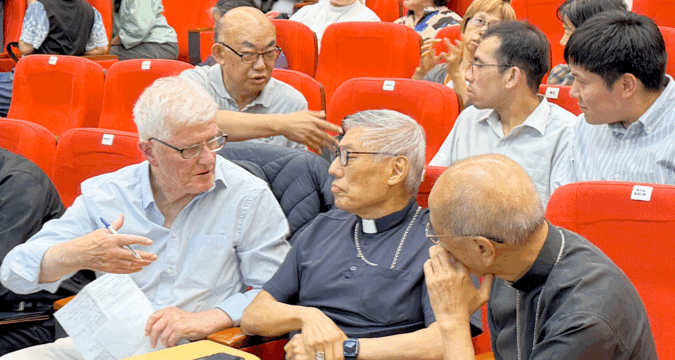
HONG KONG (SE): The Diocese of Hong Kong held a two-day symposium at Saint Francis University from September 11 to 12 to mark its 80th anniversary, bringing together clergy, scholars, and the faithful to reflect on the Church’s history and discern what it means to be a “messenger of hope” in Hong Kong today.
Cardinal Stephen Chow, S.J., opened the symposium with a welcoming address and prayers, stressing the importance of hope in times of social disillusionment and conflict. Recalling his early formation in Belfast, Northern Ireland, where he encountered hostility, the cardinal spoke of the power of cross-denominational reconciliation and praised keynote speaker Jesuit Father Gerry O’Hanlon, who had lived at the Presbyterian Chaplaincy of Queen’s University during the sectarian conflict of the late 1970s and early 1980s.
Cardinal Stephen urged the faithful to engage in deep listening, prayer, and synodal discernment suited to Hong Kong’s particular social and political context.
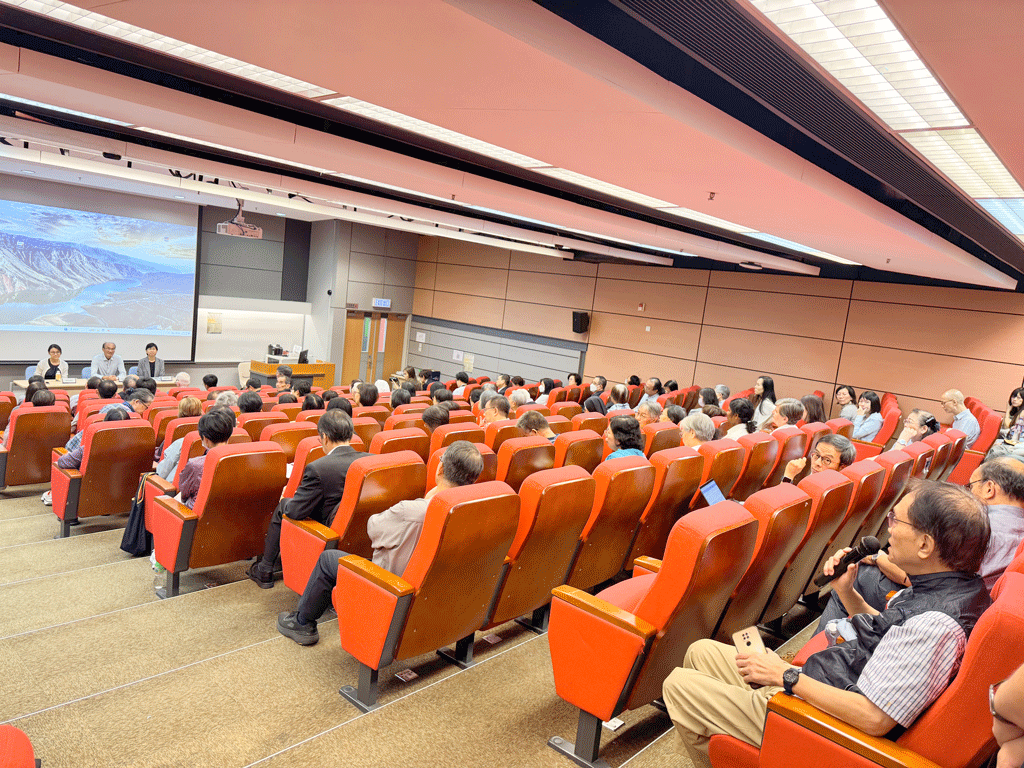
Auxiliary Bishop Joseph Ha Chi-shing, chairperson of the preparatory committee, described the symposium as an occasion to honour past leaders, noting that history is a living record of God walking with his people — one that inspires the courage and imagination needed to face the future.
Over the two days, participants examined five thematic areas of contemporary concern: labour, family and caregiving, life and death, social reconciliation, and care for the environment.
Ministry for labour
Professor Mary Yuen Mee-yin of the Holy Spirit Seminary College of Theology and Philosophy said Catholic outreach unites spiritual mission with social justice, grounded in human dignity and Catholic social teaching. She traced the Church’s historical support for industrial workers through bodies such as the Young Christian Workers and the Catholic Commission for Labour Affairs, noting that today the Church combines direct pastoral care with advocacy for policy reform to address precarious employment, the platform economy, and vulnerable workers including cleaners, security guards, and migrant domestic workers.
Professor Au Yeung Tat-chor of Lingnan University described a shift towards “liquefied labour”, in which digital platforms break down traditional employment structures into fragmented tasks. This instability, along with shrinking benefit coverage, he said, has now reached middle-class professions as well. Turning to foreign domestic workers, he criticised Hong Kong’s reliance on cheap migrant labour as a systemic failure in public care, calling for wage improvements and expanded public care services.
Over the two days, participants examined five thematic areas of contemporary concern: labour, family and caregiving, life and death, social reconciliation, and care for the environment
Both speakers agreed that, since most congregation members are ordinary workers, the Church must stay close to the community, listen to workers’ lived experiences, and press for stronger systemic protections.
Family and carers
Professor Wong Yu-cheung of Saint Francis University noted that Hong Kong’s elderly population is projected to reach 2.5 million by 2047, with as many as 500,000 people requiring long-term care. As traditional family support networks weaken, he said, seniors caring for other seniors now make up nearly 30 per cent of informal carers.
Sally Lo Ka-wing of Hong Kong Shue Yan University called for a broader understanding of who counts as a carer, extending beyond middle-aged women to anyone supporting a dependent. She said carers, though bound by strong emotional ties, often face burnout and need community support to take essential breaks.
Catholic initiatives already active in this field include Caritas-Hong Kong and the Diocesan Marriage and Family Commission. Participants proposed parish-based weekend mutual-aid networks and Sunday consultations with social workers to connect carers with professional resources.
…the Church must stay close to the community, listen to workers’ lived experiences, and press for stronger systemic protections…
Life and death
Father Dominic Lui Chi-man of the Holy Spirit Seminary College of Theology and Philosophy Bioethics Resource Centre called for building a “culture of life” in place of a “culture of death”. Criticising Hong Kong’s fast-paced society for prizing economic efficiency over human dignity, he urged a shift towards holistic care addressing body, mind, social, and spiritual needs.
Tracing the Catholic Church’s pro-life work in Hong Kong—from early medical care by the Sisters of St. Paul and the Canossian Sisters to today’s pastoral services—Father Lui pointed to initiatives such as the Angel Garden for the dignified burial of miscarried foetuses, the St. Goretti’s Centre for protecting minors and other vulnerable groups, and the Church’s 2001 letter to the Hospital Authority affirming medical staff’s right to conscientious objection.
Doctor Derrick Au Kit-sing of the Centre for Bioethics at the Chinese University of Hong Kong called on Hong Kong to safeguard humanity in healthcare in the years ahead. He argued for genuine dignity in end-of-life care beyond purely technical decisions, raised concerns over youth mental health in the age of social media, and criticised assembly-line medical practices that erode patient dignity and drive healthcare worker burnout.
Social reconciliation
Professor Anselm Lam Wing-kwan of the Fu Jen Faculty of Theology of St. Bellarmine said biblical peace is not merely the absence of conflict but a dynamic, holistic transformation grounded in truth and justice. He outlined the pressures weighing on young people today—housing costs, limited social mobility, identity struggles, shrinking civic space, and anxieties over artificial intelligence—alongside declining youth trust in traditional authorities.
…Criticising Hong Kong’s fast-paced society for prizing economic efficiency over human dignity, he urged a shift towards holistic care addressing body, mind, social, and spiritual needs…
Father Lui
Professor Andrew Kwok Wai-luen of Hong Kong Baptist University said true peace demands truth, justice, mercy, and mutual connection. Rather than focusing only on conflicts themselves, he urged examination of the deeper social tensions behind them, advocating “multiple empowerment”—an approach in which marginalised individuals become active participants in transforming their communities rather than passive recipients of charity.
Caring for our common home
Professor Amos Tai Pui-kuen of the Chinese University of Hong Kong, a climate scientist, said that while science can define environmental problems, it is spiritual values and compassion that truly drive behavioural change. He challenged the misreading of biblical “dominion” as licence for exploitation, calling instead for “stewardship” in the image of God, and stressed that climate change is, at its core, a matter of justice.
Marky Ma Nok-yin of the Chinese University of Hong Kong outlined the Hong Kong Catholic Church’s environmental mission, citing pioneers such as Father Anthony Chang, who founded the “Green Messengers” in 1989. With only six parishes currently running active environmental groups, Ma said, ecological care remains an essential—if still underdeveloped—dimension of faith, rooted in papal teaching such as Laudato Si’.
Alongside the formal presentations, parallel workshops under the theme “Word Made Flesh” showcased practical expressions of faith and charity, highlighting frontline initiatives such as MercyHK, the Angel Garden, the Light Up Fund, and parish-based environmental projects. The symposium closed with an open forum chaired by Professor Lam.
At Mass on the first evening, Bishop Ha reminded the faithful that all baptised Catholics are called to “become all things to all people” [1 Corinthians 9:22] through listening, prayer, and discernment of local needs.
Cardinal Stephen celebrated the closing Mass the following day, reflecting with gratitude on two days of rich dialogue. He noted that contributions from Protestant speakers had enriched the gathering, illustrating how the Church should welcome diversity in Christ, and reminded the assembly that it must not fear differing perspectives.
He sadi that creative tension is not inherently negative—the Church must learn the art of “holding the tension”, resisting the urge to resolve differences too quickly and instead allowing time and patience to build deeper mutual understanding.
Comparing discernment to observing the fruit of a tree, Cardinal Stephen described it as an evolving, self-correcting process of learning from outcomes rather than a rigid pursuit of consequentialism.
He closed by cautioning against a “messianic mentality”, urging the Church to engage in social care not with a saviour complex, but by walking alongside others, collaborating, and learning together in genuine humility.