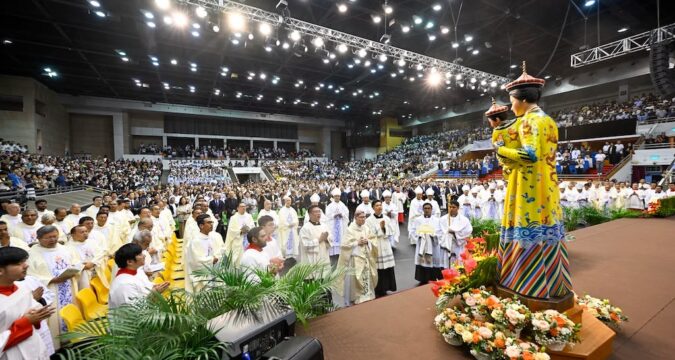
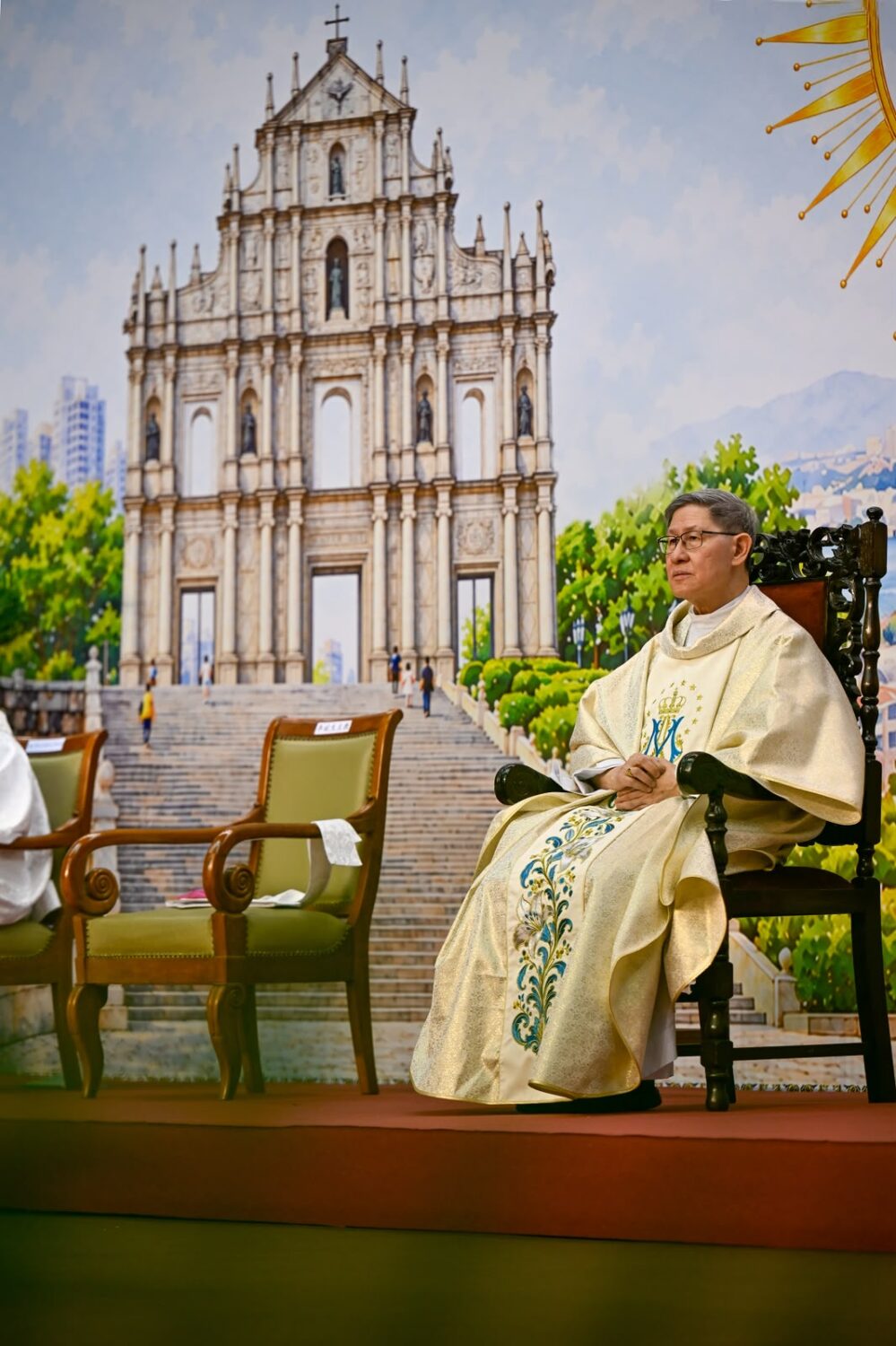
MACAU (SE/RVA): The Diocese of Macau must celebrate its 450th anniversary not simply by honouring its past, but by renewing its missionary calling and walking alongside the poor and vulnerable, Luis Antonio Cardinal Tagle told thousands of Catholics gathered at Forum de Macau on October 31.
Presiding at the solemn anniversary Mass on the vigil of All Saints, the cardinal urged the local Church to rediscover its identity as a community gathered around the Gospel and the Eucharist, whose blessings find their deepest expression in faithfulness to God and service to others.
“Diocese of Macau, you are blessed,” he said, inviting the faithful to find their happiness in God and become a blessing to others.
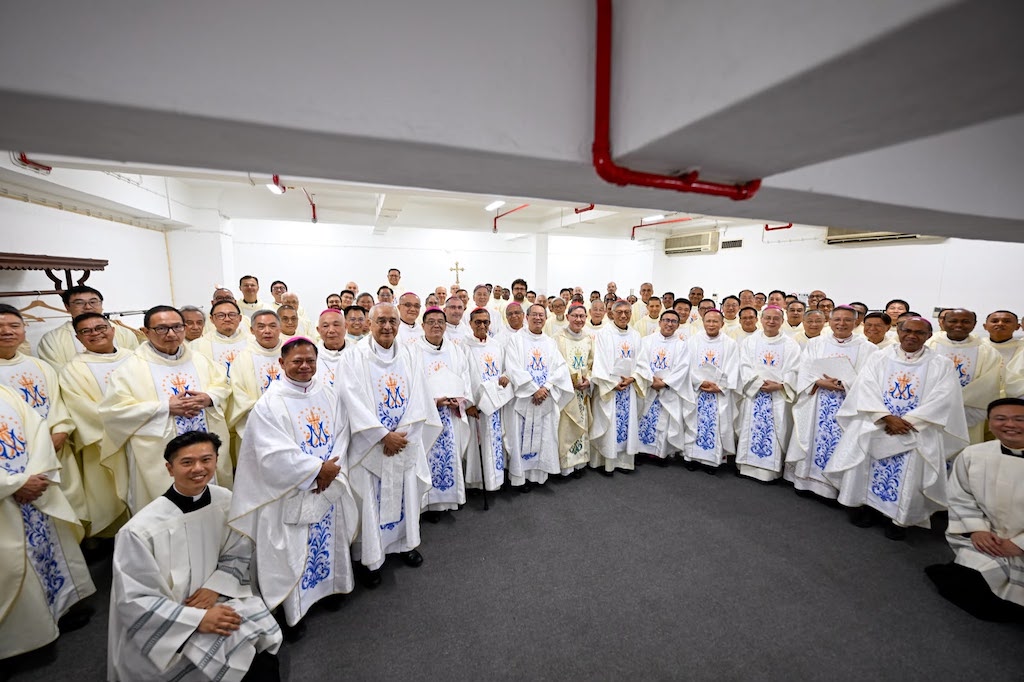
More than 15 bishops from across Asia, and over 100 priests concelebrated the Eucharist, attended by approximately 5,000 people. Among the concelebrants were Bishop Stephen Lee Bun-sang of Macau, Cardinal Stephen Chow S.J. of Hong Kong and Sebastian Cardinal Francis of Penang.
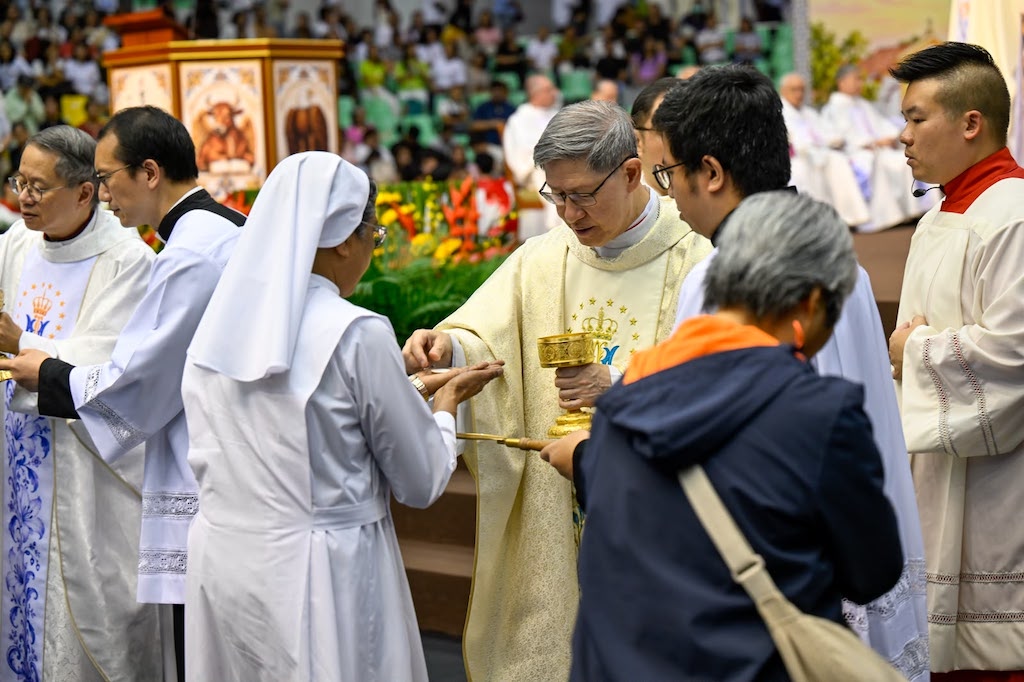
Cardinal Tagle conveyed greetings from Pope Leo XIV, who had sent an anniversary message to the diocese. He also communicated the pope’s gratitude to the faithful who had been praying for him.
“We praise and thank our benevolent and gracious God, who has gathered as a community, as a family of faith, as we join the Diocese of Macau in celebrating the 450th anniversary of her establishment,” the cardinal said.
Established on 23 January 1576, by Pope Gregory XIII through the papal bull Super Specula Militantis Ecclesiae, Macau is the oldest modern Catholic diocese in the Far East.
An inheritance that calls for action
Cardinal Tagle reminded the congregation that the Gospel had reached the region before the diocese’s formal establishment. Missionaries arriving from different parts of the world had shared their faith, nurturing the community from which the diocese emerged.
That history, he explained, was not merely an inheritance to preserve. It carried a responsibility to continue the work of evangelisation with imagination and courage.
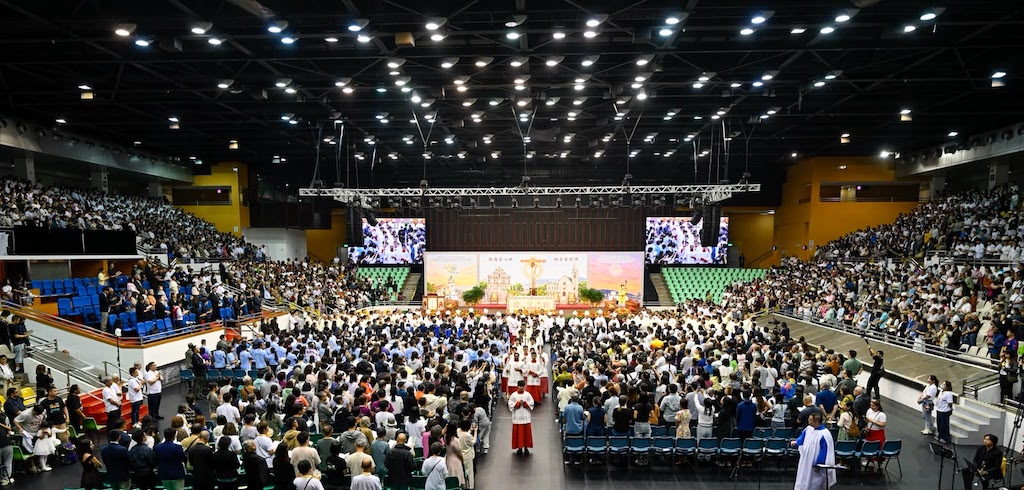
“Being a fruit of evangelieation, the Diocese of Macau can be fruitful only by being active, creative, and courageous evangelizers herself,” he said. The missionary task encompasses both those living in Macau and people arriving from elsewhere. Looking at the diversity of the congregation, the cardinal pointed to the opportunities for encounter already present within the territory. “If you cannot go to the world, the world will come here,” he said.
The anniversary therefore offered an opportunity to consider how the faith received through earlier generations might now be shared with others.
More than offices and organisation
“What is a diocese?” Cardinal Tagle asked, encouraging the faithful to look beyond familiar structures and rediscover the meaning of belonging to a local Church.
Religious celebrations, he observed, can lose their deeper significance when attention settles on their outward arrangements. Baptism can become associated chiefly with a meal, while preparations for marriage can revolve around clothes and expenses. An anniversary likewise requires more than festivities.
Drawing on Christus Dominus, the Second Vatican Council’s decree on the pastoral office of bishops, he explained that a diocese is a portion of the people of God entrusted to a bishop, who shepherds it with the cooperation of priests.
“A diocese is not just an organisation. It is not just a structure. It is not just offices, but it is a living community,” he said. Gathered through the Gospel and the Eucharist in the Holy Spirit, that community makes present the one, holy, catholic and apostolic Church. Its unity must therefore spring from Christ, rather than personal ambition, economic interests or worldly attachments.
The cardinal encouraged Catholics, especially young people, to make room for Scripture and opportunities to deepen their faith. With humour, he contrasted reluctance to attend Bible study with the enthusiasm often shown when celebrities, singers or actors appear. His challenge was to give the Word of God a central place in community life.
A local Church with worldwide communion
Macau’s identity, Cardinal Tagle continued, cannot be separated from its communion with the universal Church. He conveyed expressions of solidarity from other dioceses and reminded the congregation that Catholics across widely differing countries share the same Gospel, Eucharist and apostolic faith.
Whether in Macau, Hong Kong, Djibouti, Papua New Guinea or India, these communities belong to one another. Their joys and difficulties are not distant concerns, but part of a shared life of faith.
“They are our brothers and sisters,” he said.
Happiness rooted in God
Turning to All Saints, Cardinal Tagle questioned assumptions about what it means to be blessed.
Material success or good fortune may invite that description in everyday conversation. The Beatitudes, however, reveal a different understanding. Jesus calls blessed the poor in spirit, those who mourn, the meek, those who hunger and thirst for righteousness, the merciful, the clean of heart and peacemakers. He also calls blessed those persecuted for righteousness.
Their circumstances may seem far removed from conventional ideas of success. Yet their hope rests in God’s promises rather than favourable conditions. “It is happiness in God,” the cardinal said.
Reflecting on the readings, he recalled the multitude before the Lamb in Revelation who had passed through great tribulation, and the assurance in the First Letter of Saint John that believers are God’s children.
Holiness begins with God’s gift, he explained, inviting the faithful to consider whether their deepest confidence lay in power, money and profit, or in God’s presence. “Do we find happiness in God?” he asked. “Whatever the condition of our lives may be, do we find happiness in God?”
For Macau, the answer must take shape in solidarity with people who mourn, experience vulnerability or suffer persecution. The diocese’s next chapter, he urged, should unite courageous evangelisation with compassion, following the saints whose quiet fidelity often remained unknown.
“Please take the path of the Beatitudes,” he said.
“Diocese of Macau, you are blessed. And may many more people be blessed by your happiness in God.”