MANILA (UCAN): Four people working for the poor in Asia and the environment have been selected for this year’s Ramon Magsaysay Award, dubbed the “Asian Nobel Prize.” Announcing the awardees on August 31, the Ramon Magsaysay Foundation said in a statement that they “have shown moral courage and impassioned insistence on making the societies that they serve better, kinder and more equitable for everyone, especially for the marginalised.”
“Indeed, they offer us inspiring examples of vision, leadership, empathy, persistence, and Greatness of Spirit,” the statement said.
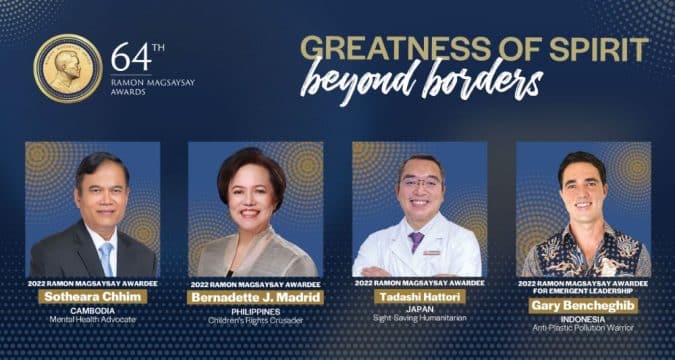
The winners are 54-year-old Cambodian psychiatrist, Sotheara Chim; 58-year-old Japanese ophthalmologist, Tadashi Hattori; 64-year-old Filipino child rights activist, Bernadette J. Madrid; and 27-year-old Gary Bencheghib, an Indonesia-based French filmmaker and environmentalist.
Chim, a mental health advocate was selected for the award for being “a leading voice” in Cambodian trauma syndrome, particularly for the victims of the genocidal Khmer Rouge regime.
Chim was only seven when the Khmer Rouge took over Cambodia in 1975 and forced people in Phnom Penh and other cities to rural camps for slave labour and re-education. Like other children, he was separated from his parents to work in a camp. More than three years later he was reunited with his family when Phnom Penh was liberated in 1979.
While announcing the 2022 awards, Aurelio R. Montinola III, chairperson of the Ramon Magsaysay Award Foundation, said: ‘This year’s roster of Magsaysay Awardees have all challenged the invisible societal lines that cause separation and have drawn innovative and inspiring ones that build connections
He studied medicine and graduated from Phnom Penh’s University of Health Sciences. In 2002, he assumed a leading role in mental health as executive director of Cambodia’s Transcultural Psychosocial Organisation. It is now the largest non-government organisation in the field of mental health care and psychosocial support in Cambodia.
Chim was recognised for “his calm courage in surmounting deep trauma to become his people’s healer; his transformative work amidst great need and seemingly insurmountable difficulties, and for showing that daily devotion to the best of one’s profession can itself be a form of greatness,” the foundation said.
Hattori worked in hospitals in Japan after graduating from Kyoto Prefectural University of Medicine in 1993. In 2002, he visited Hanoi, Vietnam, for the first time and found cataract blindness was prevalent in the country amid a dire lack of eye specialists and up-to-date treatment facilities.
The experience moved him and on his return to Japan, he used his savings to buy medical equipment to donate and started visiting Hanoi almost every month.
As we celebrate the 500 years of Christianity in the Philippines. The Chaplaincy to Filipino Migrants organises an on-line talk every Tuesday at 9.00pm. You can join us at:
https://www.Facebook.com/CFM-Gifted-to-give-101039001847033
Hattori provided free eye treatments, trained Vietnamese doctors, and donated equipment and supplies to hospitals.
The foundation recognised him for “his simple humanity and extraordinary generosity as a person and a professional; his skill and compassion in restoring the gift of sight to tens of thousands of people not his own; and the inspiration he has given, by his shining example, that one person can make a difference in helping kindness flourish in the world.”
Madrid is a doctor and the executive director of the Child Protection Network Foundation, which supports the training of child protection professionals and the development of women and child protection units in the Philippines.
The foundation says it recognised Madrid’s “transformative work” in integrating child protection into the health infrastructure in the Philippines and noted that she has been at the forefront in providing medical, legal, and psychosocial care to children and women who are victims of abuse.
The Ramon Magsaysay Award was established in 1958 in memory of the third president of the Philippines. Each year it honours individuals and organisations in Asia who transform lives and societies by manifesting ‘selfless service’
She is being honoured for “her unassuming and steadfast commitment to a noble and demanding advocacy; her leadership in running a multi-sectoral, multidisciplinary effort in child protection that is admired in Asia; and her competence and compassion in devoting herself to seeing that every abused child lives in a healing, safe, and nurturing society.”
Bencheghib was selected for his efforts in saving the Citarum River, one of the most polluted rivers in the world. He and his brother Sam made kayaks made of plastic bottles and bamboo to collect trash from the river. Their efforts gained the attention of Indonesian president, Joko Widodo.
The foundation said it recognises Bencheghib’s Emergent Leadership for “his inspiring fight against marine plastic pollution, an issue at once intensely local as well as global; his youthful energies in combining nature, adventure, video, and technology as weapons for social advocacy; and his creative, risk-taking passion that is truly a shining example for the youth and the world.”
While announcing the 2022 awards, Aurelio R. Montinola III, chairperson of the Ramon Magsaysay Award Foundation, said: “This year’s roster of Magsaysay Awardees have all challenged the invisible societal lines that cause separation and have drawn innovative and inspiring ones that build connections.”
Susan B. Afan, president of the Ramon Magsaysay Award Foundation, said, “The extraordinary work of the 2022 Ramon Magsaysay Awardees is a testament to the borderless and limitless possibilities of Greatness of Spirit.”
The Ramon Magsaysay Award was established in 1958 in memory of the third president of the Philippines. Each year it honours individuals and organisations in Asia who transform lives and societies by manifesting “selfless service.”
The winners will formally receive their awards during a ceremony in Manila on November 30.