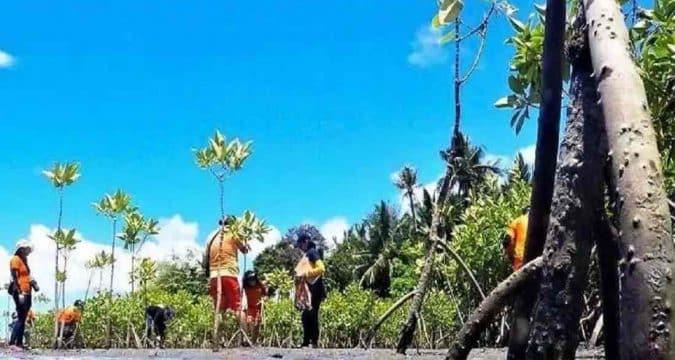
MANILA (UCAN): The Philippine Biodiversity and Conservation Group, together with the Catholic Bishops’ Conference of the Philippines, began a mangrove reforestation programme along the coastlines of Cebu, Bohol, Leyte and Samar provinces in the Visayas region on November 2, to prevent erosion caused by tropical storms.
The Green Earth Foundation planted along the beaches of Sorsogon, Albay, Camarines Sur, and Camarines Norte provinces in the Bicol region, southern Luzon.
More than 800 volunteers participated in the mangrove planting project that aims to cover more than 100 hectares in the archipelago.
“We started the project right after Typhoon Paeng [Nalgae] while the experience of being swept away by flash floods is still fresh. Taking care of the environment is urgent. It will save thousands of lives,” Biodiversity and Conservation group president, Lorenzo Tumasin, said.
Private and Church groups pooled funds to purchase Rhizophora Apiculata, the most abundant mangrove species in the Philippines, from local producers.
“There are companies that are engaged in breeding mangroves. They sell them to the government or to environmental groups because they know many are needed to restore coastlines,” Tumasin added.
We started the project right after Typhoon Paeng [Nalgae] while the experience of being swept away by flash floods is still fresh. Taking care of the environment is urgent. It will save thousands of lives,” Biodiversity and Conservation group president
Lorenzo Tumasin
So far, more than 5,000 saplings have been planted, covering 36 hectares across the Visayas and Luzon regions.
The Philippines has 39 mangrove species growing along rivers and the coast, according to the Department of the Environment and Natural Resources.
Mangroves are known to grow above ground roots that slow down water flow and encourage sediment deposits that reduce soil erosion, according to environmentalist Arnold Pua.
As we celebrate the 500 years of Christianity in the Philippines. The Chaplaincy to Filipino Migrants organises an on-line talk every Tuesday at 9.00pm. You can join us at:
https://www.Facebook.com/CFM-Gifted-to-give-101039001847033
Pua, who also heads the Green Peace Foundation, said mangrove roots helped stabilise erosion caused by water surges and strong waves that hit the coast.
“They absorb water during heavy rains and storm surges, reducing the chances of coastal flooding. Their roots provide nursery habitat for many commercial fish and shellfish, and thus contribute to a local abundance of seafood,” he added.
Aside from protecting humans, the Bureau of Fishery and Aquatic Resources [BFAR] confirmed that mangrove plantations protect the country’s lucrative seafood industry.
They absorb water during heavy rains and storm surges, reducing the chances of coastal flooding. Their roots provide nursery habitat for many commercial fish and shellfish, and thus contribute to a local abundance of seafood
Arnold Pua
“In 2022, our revenue from the fresh seafood segment amounted to US$1.65 billion [12.9 billion]. We are still expecting the market to grow by 7.3 per cent from this year to 2027. But without mangroves, our seafood catch will surely decline,” BFAR spokesperson, Natalie Cadral, explained.
Militant fisher folk group, Pambansang Lakas ng Kilusang Mamamalakaya ng Pilipinas [Pamalakaya] [National Federation of Small Fisherfolk Organisation of the Philippines], urged the president, Ferdinand Marcos Jr., to pursue reforestation of mangroves as a measure to prevent intense flooding caused by the rise in sea levels, devastating storm surges and other climate change threats.
“The destruction of mangrove forests exposes fishing families to damaging floods and storm surges. Mangroves are vital to the marine ecosystem and biodiversity as they serve as fish sanctuaries, pollution filters and defense for coastal communities,” Pamalakaya national spokesperson, Ronnel Arambulo, told the press on November 2.
Meanwhile, the Catholic Bishops’ Conference of the Philippines mobilised social action centres in dioceses where mangrove reforestation is taking place by sending volunteers to aid the project.
“More than 50 per cent of the volunteers in the project are Church volunteers,” Caritas Philippines’ executive secretary, Father Antonio Labiao Jr, said. Those who participated in the project were mostly victims of previous tropical storms.
“We are here because we have experienced how difficult and dangerous it is to live along coastal areas. When typhoons hit, you can only pray for your safety,” Sorsogon parishioner, Dennis Domingo, said.