ANKARA (CNS): Pope Leo XIV began his first papal trip on November 27 with a nearly three-hour flight to Ankara, where he was met by Turkish president, Recep Tayyip Erdogan, and Safi Arpagus, head of the national religious affairs office [Diyanet)].
“Today, more than ever, we need people who will promote dialogue and practice it with firm will and patient resolve,” Pope Leo said, addressing Erdogan, other government officials, members of the diplomatic corps and civic leaders.
The pope recalled that after World War II, the world came together and formed the United Nations and other international and regional organisations committed to dialogue, cooperation and conflict resolution.
He opened his visit with an urgent call for global dialogue amid rising conflict, warning that economic and military power struggles are driving us toward “a third world war fought piecemeal,” as Pope Francis once cautioned.
He urged leaders to turn away from destructive dynamics, insisting the future depends on channelling resources into peace, poverty alleviation, health, education, and environmental protection.
Today, more than ever, we need people who will promote dialogue and practice it with firm will and patient resolve
Pope Leo XIV
In Muslim-majority but constitutionally secular Türkiye, Pope Leo praised the country’s tolerance and encouragement of religious diversity.
“In a society like the one here in Türkiye, where religion plays a visible role, it is essential to honour the dignity and freedom of all God’s children, both men and women, fellow nationals and foreigners, poor and rich,” the pope said.
“We are all children of God, and this has personal, social and political implications,” he said, urging a commitment to the common good and universal respect.
Recalling Pope Francis’s 2014 visit, Pope Leo highlighted the need for believers to “feel the pain of others and listen to the cry of the poor and of the earth,” advocating compassion rooted in both Muslim and Christian traditions.
The pope called for defending social bonds, starting with the family.
In a society like the one here in Türkiye, where religion plays a visible role, it is essential to honour the dignity and freedom of all God’s children, both men and women, fellow nationals and foreigners, poor and rich
Pope Leo
“People do not obtain greater opportunities or happiness from an individualistic culture, nor by showing contempt for marriage or shunning openness to life,” he said.
“Those who scorn fundamental human ties and fail to learn how to bear even their limitations and fragility,” the pope said, “more easily become intolerant and incapable of interacting with our complex world.”
He urged Türkiye to embrace its cultural and religious diversity and assured the nation that its small Catholic community—about 35,000 people—wants to contribute positively.
“Uniformity would be an impoverishment,” the pope said. “Indeed, a society is alive if it has a plurality, for what makes it a civil society are the bridges that link its people together.”
Unfortunately, today “communities are increasingly polarised and torn apart by extreme positions that fragment them,” he warned.
He recalled Pope Saint John XXIII’s call to reject isolation and embrace a “culture of encounter”—a message still urgent today.
Indeed, a society is alive if it has a plurality, for what makes it a civil society are the bridges that link its people together
Pope Leo
The emblem for Pope Leo’s visit—a bridge over the Dardanelles—symbolises Türkiye as a bridge between Asia and Europe, east and west, tradition and modernity, diversity and unity.
He expressed hope that the country would remain “a source of stability and rapprochement between peoples.”
“Let us walk together,” he concluded, “in truth and friendship, humbly trusting in the help of God.”
Meeting with Catholic leaders and visiting the Little Sisters of the Poor on November 28, Pope Leo stressed that clear witness matters far more than numbers.
According to Vatican statistics distributed for the pope’s trip, Catholics comprise less than one per cent of Türkiye’s population. They belong to the Latin, Chaldean, Armenian and Syriac Catholic Churches.
Let us walk together in truth and friendship, humbly trusting in the help of God
Pope Leo
At his meeting in the cathedral, the pope noted the central place of Türkiye in the early Christian community, hosting the apostles St. John, St. Philip and St. Paul and a thriving Christian community, as well as being the site of the first eight Church councils.
“The history that precedes you is not something merely to be remembered and then venerated as a glorious past while we look with resignation at how small the Catholic Church has become numerically,” the pope said.
Instead, Catholics must see through God’s eyes, discovering that “he has chosen the way of littleness, descending into our midst.”
As Advent approaches, he noted, the prophets announce God’s promise by speaking of “a small shoot that will spring forth.”
The pope said, “Jesus praises the little ones who trust in him. He teaches that God’s kingdom does not impose itself with displays of power but grows like the smallest of all the seeds planted in the earth.”
Local priests report growing interest in Christianity among young Turks, a vibrant community of foreign Catholic students and workers, especially from Africa and the Philippines, and outreach to migrants and refugees
Pope Leo stressed, “This logic of littleness is the Church’s true strength. It does not lie in her resources or structures, nor do the fruits of her mission depend on numbers, economic power or social influence.”
The pope said that, though small, the Church in Turkey is “fruitful like a seed and leaven of the kingdom.”
Local priests report growing interest in Christianity among young Turks, a vibrant community of foreign Catholic students and workers, especially from Africa and the Philippines, and outreach to migrants and refugees.
Pope Leo outlined four priorities for Catholic communities: “ecumenical and interreligious dialogue, transmitting the faith to the local population and pastoral service to refugees and migrants.”
He urged them “to cultivate a spiritual attitude of confident hope, rooted in faith and in union with God.” He also reminded them to proclaim faith in Jesus Christ as both truly human and truly divine.
…cultivate a spiritual attitude of confident hope, rooted in faith and in union with God
Pope Leo
On his final morning in Türkiye, Pope Leo again reaffirmed the Catholic Church’s dedication to Christian unity.
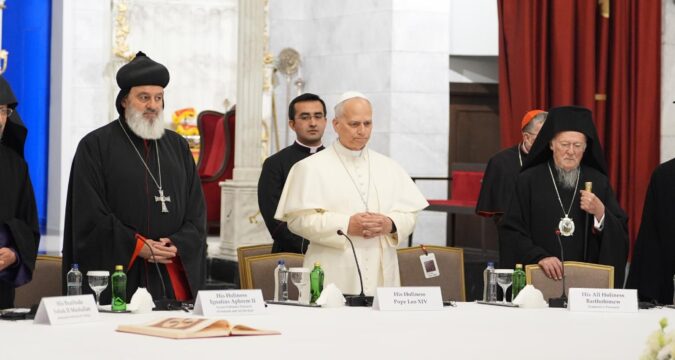
A key symbol was the pope’s attendance at the Divine Liturgy led by Orthodox Ecumenical Patriarch Bartholomew of Constantinople on November 30, St. Andrew’s feast day.
For decades, popes and patriarchs have exchanged delegations for each other’s patronal feasts—Ss. Peter and Paul on June 29 at the Vatican, and St. Andrew on November 30 at the patriarchate.
After the liturgy, the pope and patriarch jointly blessed the crowd from a balcony.
Patriarch Bartholomew attended most of Pope Leo’s events, including the November 27 meeting in Ankara with the country’s president, Erdogan, the November 28 commemoration of the 1,700th anniversary of the Council of Nicaea, and Pope Leo’s November 29 Mass for Turkish Catholics.
We cannot be complicit in the bloodshed in Ukraine and elsewhere, nor remain silent as Christians leave their homeland in the Holy Land.
Orthodox Ecumenical Patriarch Bartholomew of Constantinople
At the November 30 liturgy in St. George’s Cathedral, Pope Leo noted that for 60 years Catholics and Orthodox have followed “a path of reconciliation, peace and growing communion.”
These cordial relations, he said, have been “fostered through frequent contact, fraternal meetings and promising theological dialogue.” He added, “today we are called even more to commit ourselves to the restoration of full communion.”
The pope highlighted the significant work of the Joint International Commission for Theological Dialogue, but noted that tensions among Orthodox Churches have caused some to suspend participation.
The commission last met in Egypt in 2023, notably without the Russian Orthodox Church, which severed ties with the Ecumenical Patriarchate in 2018 after it recognised the autonomy of the Ukrainian Orthodox Church’s.
Pope Leo affirmed that pursuing full Christian communion “is one of the priorities of the Catholic Church” and his ministry as Bishop of Rome, serving to build and safeguard unity.
In his homily, Patriarch Bartholomew reiterated Orthodoxy’s commitment to unity and urged joint Christian action to protect the environment and end wars.
The patriarch said, “We cannot be complicit in the bloodshed in Ukraine and elsewhere, nor remain silent as Christians leave their homeland in the Holy Land.”
Pope Leo began the day visiting Archbishop Sahak II Mashalian, Armenian Apostolic patriarch of Constantinople, at his Istanbul cathedral.
He said the 1,700th anniversary of the Council of Nicaea and its creed affirms the need to “draw from this shared apostolic faith” to recover early unity between Rome and the ancient Oriental Churches.
He stressed restoring full communion, not by “absorption or domination,” but by exchanging gifts received from the Holy Spirit.
Pope Leo honoured “the courageous Christian witness of the Armenian people,” but avoided directly addressing the “Armenian genocide” of 1915-18, when 1.5 million Armenians were killed by Ottoman Turks.