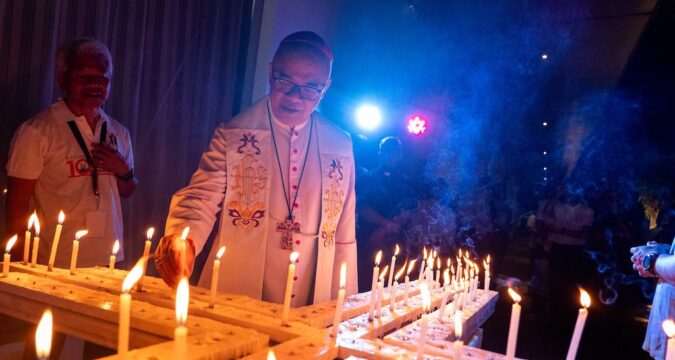
MANILA (LiCAS News): Bishop Gerardo Alminaza of San Carlos, the Philippines, called on the faithful to stand in solidarity with communities bearing the brunt of climate change and environmental destruction, framing the birth of Christ as a story rooted in displacement, vulnerability, and life on the margins.
Bishop Alminaza, who heads Caritas Philippines, made the appeal in a pastoral reflection delivered on December 19 at the Green Convergence–Kamayan para sa Kalikasan Forum.
The bishop linked the Christmas narrative to the lived realities of Filipinos facing climate disasters, land conflicts, and ecological degradation.
“Christ is born into a world marked by uncertainty and danger,” Alminaza said, adding, “His parents are displaced, forced to travel under imperial decree. There is no room for them in places of comfort or safety. He is born on the margins, in conditions shaped by power beyond their control.”
The bishop said these circumstances mirror those of many Filipino families today, particularly those affected by extreme weather events and environmental threats.
The manger is not a romantic image. It is a feeding trough for animals. It tells us that Christ enters the world not in cleanliness and order, but in vulnerability, exposure, and dependence on the natural world
Bishop Alminaza
“Across the Philippines, children are born in evacuation centres after typhoons, in coastal communities threatened by rising seas, in upland villages where land is contested by mining and energy projects,” he said. “Families welcome new life amid uncertainty about food, shelter, and security.”
Bishop Alminaza urged a deeper reading of the manger scene, saying it reflects fragility rather than sentimentality.
“The manger is not a romantic image. It is a feeding trough for animals,” he said. “It tells us that Christ enters the world not in cleanliness and order, but in vulnerability, exposure, and dependence on the natural world.”
He said environmental damage has made life increasingly precarious for farmers, fisherfolk, and indigenous communities whose survival depends on land and sea.
As we celebrate the 500 years of Christianity in the Philippines. The Chaplaincy to Filipino Migrants organises an on-line talk every Tuesday at 9.00pm. You can join us at:
https://www.Facebook.com/CFM-Gifted-to-give-101039001847033
“When these environments are damaged, life itself becomes precarious,” Bishop Alminaza said.
Across the Philippines, children are born in evacuation centres after typhoons, in coastal communities threatened by rising seas, in upland villages where land is contested by mining and energy projects
Bishop Alminaza
The bishop also placed Christ’s birth within a political context, drawing parallels between imperial rule in biblical times and present-day decisions that affect communities without their consent.
“Christ’s birth takes place under empire. Decisions made far away shape the lives of ordinary people,” he said. “Joseph and Mary have no say in the census that uproots them. They must comply or face consequences.”
He said similar patterns persist in the Philippines, where development projects often proceed despite local opposition.
“These are not merely technical issues,” Bishop Alminaza said. “They are questions of power, voice, and responsibility.”
The bishop stressed that faith cannot remain neutral when ecological destruction and social injustice threaten human dignity.
He also questioned development models that prioritise economic gain over environmental and social well being
“A Luntiang Pasko [Green Christmas] recognises that faith cannot be neutral in situations where decisions about land, water, and resources determine who lives with dignity and who does not,” he said.
Citing stronger typhoons, floods, droughts, and extreme heat, the bishop said the poorest communities continue to suffer the most from climate impacts.
“A Luntiang Pasko calls us to listen to these cries, not as background noise, but as moral appeals,” he said. “It asks us to acknowledge that suffering is not inevitable. It is shaped by choices that can be challenged and changed.”
He also questioned development models that prioritise economic gain over environmental and social well being.
“A pastoral reflection does not deny the need for development,” Bishop Alminaza said. “But it insists on asking a deeper question: development for whom, and at what cost?”
Pointing to disaster-affected and environmentally threatened communities, the bishop said Christ continues to be encountered among those defending land, water, and livelihoods.
“These encounters challenge us to move beyond charity toward solidarity,” he said. “They invite us to accompany communities, to listen to their stories, and to stand with them as they seek justice.”
The bishop said that responding to ecological and social crises requires both personal responsibility and collective action.
“Pastoral care, in this sense, is not withdrawal from public life,” he said. “It is accompaniment, walking with communities as they work for healing and justice,” he said.
The bishop called for sustained commitment beyond the Christmas season, calling Luntiang Pasko a way of life that demands continued work for healing, justice, and accompaniment long after the holidays end.