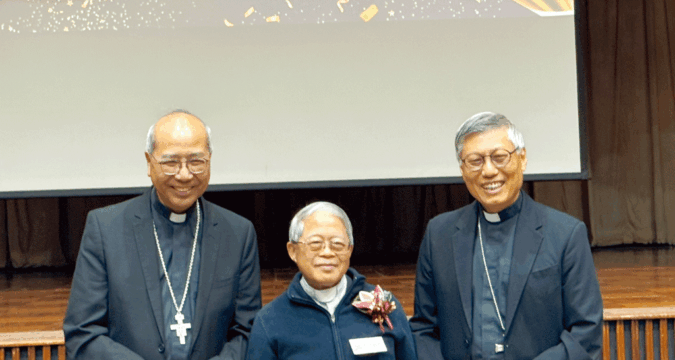
HONG KONG (SE): Father Lawrence Lee Len, chancellor of the Diocese of Hong Kong, celebrated his golden jubilee this year, marking 50 years of dedicated priesthood characterised by unwavering commitment and extensive service to the Church. With over 40 years of experience in the diocesan chancery, Father Lee continues to be a guiding presence for both clergy and lay faithful on their spiritual journeys.
Baptised at the age of 16 in 1964, he initially led a relatively passive faith life. His involvement with a youth association at St. Jude’s Church, North Point, around 1967 ignited a deeper engagement in Church activities. This experience strengthened his conviction and ultimately led him to answer the call to priesthood.
At just 20-years-old, Father Lee entered the seminary in 1968, undertaking seven years of formation despite initial resistance from his family. Life in the seminary brought various challenges, including Latin, then the primary medium of instruction.
Following his ordination, he was appointed assistant parish priest of St. Margaret’s Parish in Happy Valley from 1976 to 1978. This role provided invaluable pastoral experience and exposed him to the practical implementation of Vatican II reforms in parish life.
Having served as chancellor for more than four decades, Father Lee attributes his longevity not to personal merit but to the realities of Church governance
In 1979, the late John Baptist Cardinal Wu Cheng-chung sent him to the Pontifical Urbaniana University in Rome to pursue studies in Canon Law. This decision was crucial in preparing him for future service in the chancery and aligned with the diocese’s vision of localising Church leadership in the post-Vatican II era.
Upon his return from Rome, Father Lee became vice diocesan chancellor in 1984. A year later, in 1985, he succeeded Father Osvaldo Pisani of the Pontifical Institute for Foreign Missions as chancellor. Father Lee recalls Father Pisani as sharp and diligent—serious in his work yet flexible and practical. It was he who instilled in Father Lee the importance of careful and precise documentation. He is also grateful for the guidance of Jesuit Father John Russell, then judge of the Diocesan Tribunal.
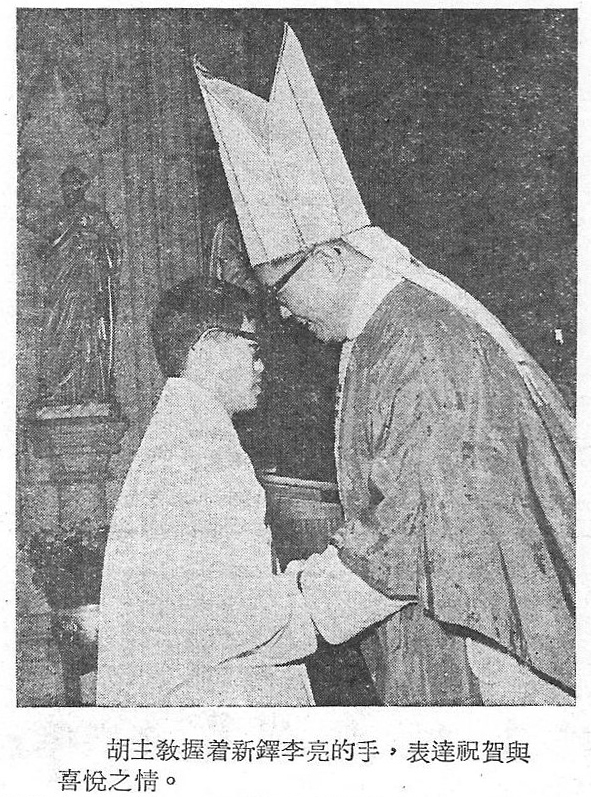
A photo from the front page of the Chinese language diocesan weekly taken during the ordination of Father Lee at the Cathedral of the Immaculate Conception on 28 November 1975. Father Lee was the first local diocesan priest ordained by John Baptist Cardinal Wu. File Photo: Kung Kao Po
Having served as chancellor for more than four decades, Father Lee attributes his longevity not to personal merit but to the realities of Church governance—namely, that a chancellor typically remains in office when a new bishop is appointed, coupled with the persistent shortage of priests capable of undertaking Canon Law studies. He noted that the diocese is now preparing to send a young priest to Rome to support future chancery work.
His responsibilities span administrative management, legal compliance, and oversight of formal documentation. These duties demand meticulous attention to detail and clear communication with the Vatican, parishes, media, and other stakeholders, often under tight deadlines.
At just 20-years-old, Father Lee entered the seminary in 1968, undertaking seven years of formation despite initial resistance from his family.
Beyond administrative work, Father Lee remains committed to addressing pastoral concerns such as marriage, education, hospital visits, home blessings, and spiritual counselling. He also collaborates with legal professionals and government authorities to ensure the Church’s operations remain fully compliant with regulatory requirements. “From these issues, I have gained valuable experience, which I often share with others,” he said.
Crisis management has posed significant challenges, particularly during high-profile cases that attract intense media attention, such as the sexual abuse cases in 2002. These incidents placed enormous pressure not only on him but also on others required to testify. He observed with sadness how these burdens affected the health of the late Cardinal Wu, just as he had begun to recover.
He also spoke about the health concerns that led to spinal surgery in 2022, a stark reminder of the need to safeguard his well-being, especially during periods of heavy pressure at work.
Apart from his additional appointments to several diocesan offices, Father Lee has engaged in the formation and apostolates of the lay people. He had served for some years as spiritual director of the Legion of Mary during the 1970s and 1980s. For over two decades he has been actively associated with the prison apostolate, the Catholic Charismatic Renewal, the Hong Kong Catholic Nurses’ Guild and some other Catholic groups, as adviser or spiritual director.
Apart from his additional appointments to several diocesan offices, Father Lee has engaged in the formation and apostolates of the lay people
Reflecting on the past five decades, he notes a shift in how bishops are perceived—from figures of authority to more pastoral shepherds. He also observes the diocese’s expansion of pastoral and charitable services to meet the needs of increasingly diverse communities, including migrants, ethnic minorities, seafarers, workers, and the socially marginalised. The diocese has also developed greater awareness of pressing social issues, environmental protection, and safeguarding minors from abuse.
He highlights the growing competence and involvement of laypeople in liturgy, sacred music, catechetical instruction, Biblical and theological studies, Church finance, Church construction and renovation, pre-marriage programmes and family life, social communications, IT technology, hospital pastoral care and prison apostolate.
Considering the current state of faith among believers, he expressed concern about the decline in traditional devotional practices, such as devotion to the Sacred Heart, which he believes helps strengthen the spiritual life.
Since 1988, Father Lee has taught Canon Law at Holy Spirit Seminary College. Over the decades, he has consistently reminded his students of a central principle: the salvation of souls is the supreme Church law. “The law should not restrict individuals but assist them on their spiritual journey towards sanctification. Its essence is to support and guide rather than to hinder,” he emphasised.