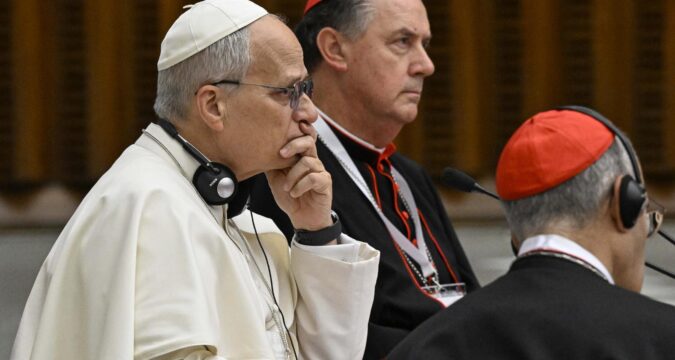
VATICAN (OSV News): After an intense day of roundtable discussions, the “low-batteried” but “very pleased” cardinals wrapped the first historic extraordinary consistory convened by Pope Leo XIV in a spirit of fraternity, with a sense of knowing each other better and saying they “discovered” the pope, while he did “more listening than talking.” They left the consistory with a clear vision of the new pontiff for “a Church that cares.”
Pope Leo intends to hold consistory discussions annually. The next is scheduled for June 27-28, with a four-day consistory planned for 2027.
According to Matteo Bruni, director of the Holy See Press Office, Pope Leo told the cardinals on January 8 that the consistory is designed as a “continuity with what was requested during the cardinals’ meetings before the conclave and also after the conclave,” and that the synodal methodology used “was chosen to help them meet and get to know each other better.”
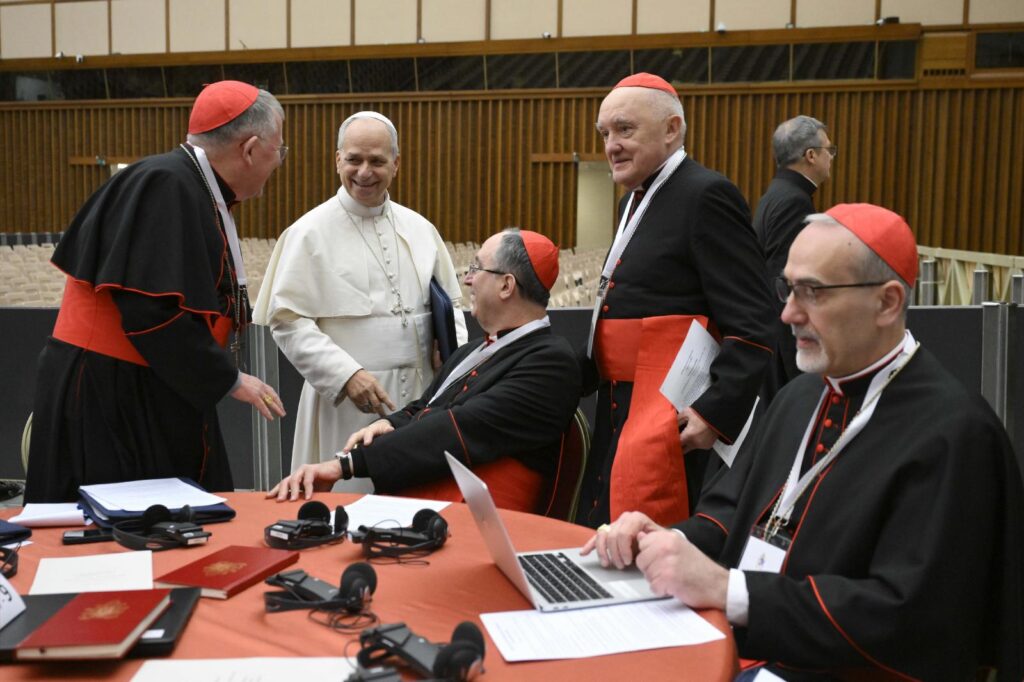
Cristóbal Cardinal López Romero of Rabat, Morocco, told journalists in front of the Paul VI Audience Hall that, with the level of fraternity reached during merely 15 hours of the consistory discussions, “the College of Cardinals has been strengthened.”
Cardinal López Romero said he is “very pleased,” as the meeting “has allowed us to get to know each other a little better, to share, and because it will also continue.”
The cardinal said, “I believe it has been a way of reaffirming that there is continuity—not so much with Pope Francis, but with the gospel, with the Second Vatican Council, and with all the magisterium that has emerged as a consequence of this Second Vatican Council. So in that sense, I am very pleased with the results.”
Cardinal Brislin stressed that the meeting “has been an assistance” to Pope Leo “as successor of St. Peter” and that it proved that synodality is “a way of being Church”—and a “disposition” of the Church.
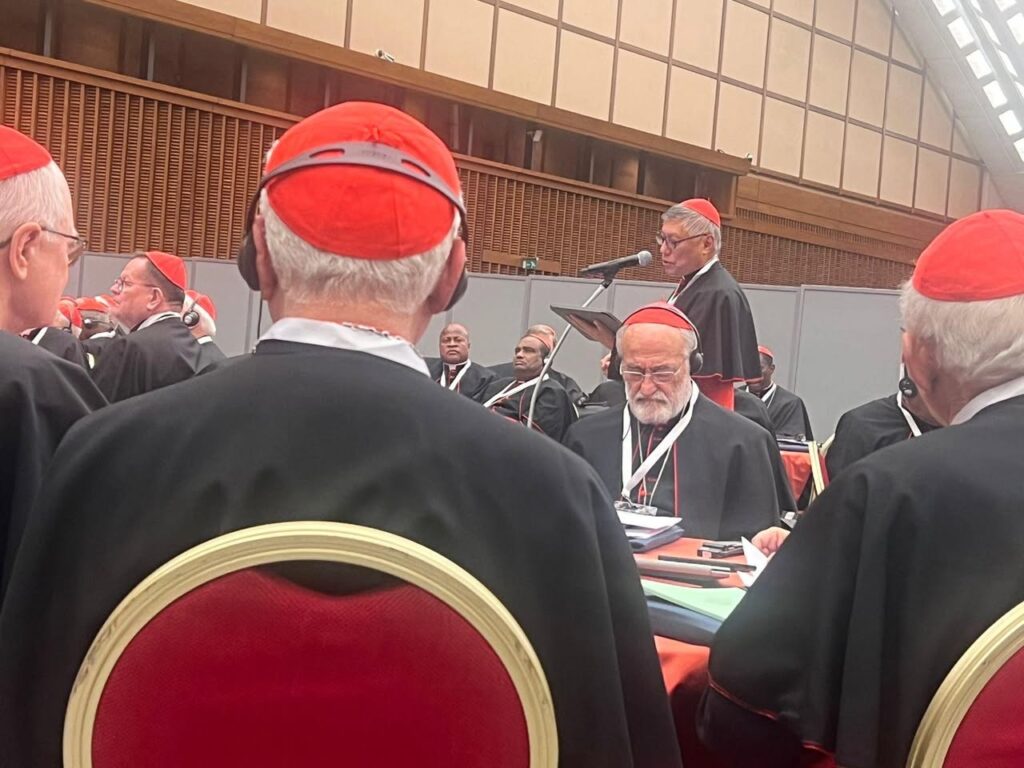
The second day of the consistory reminded the cardinals of the Synod on Synodality, with three-minute interventions from participants in group discussions, sharing meals and thoughts—from “the treasure that the gospel is for mission,” through necessity to approach people’s “broken lives with humility,” and to synodality as “a tool for growing relationships,” Bruni said.
Cardinal Stephen Chow, S.J., the bishop of Hong Kong, was chosen as secretary of his working group, and was responsible for presenting the group’s reflections and recommendations arising from the discussions
Stephen Cardinal Brislin of Johannesburg, South Africa told journalists, “The importance of this consistory was not solely in the discussion that took place,” but in the possibility “to listen to each other and to get to know each other” as the cardinals “haven’t known each other very well.”
Because of the time constraints, Vatican News reported that a “clear majority” of the cardinals voted for “Synod and synodality” and “Evangelisation and mission in the Church in the light of Evangelii Gaudium” as the themes on which to reflect during the two days.
The cardinals worked in 21 small groups, with particular attention given to contributions from the nine groups representing local Churches. These groups were tasked with sharing pastoral insights rooted in concrete ecclesial experience.
Cardinal Stephen Chow, S.J., the bishop of Hong Kong, was chosen as secretary of his working group, and was responsible for presenting the group’s reflections and recommendations arising from the discussions.
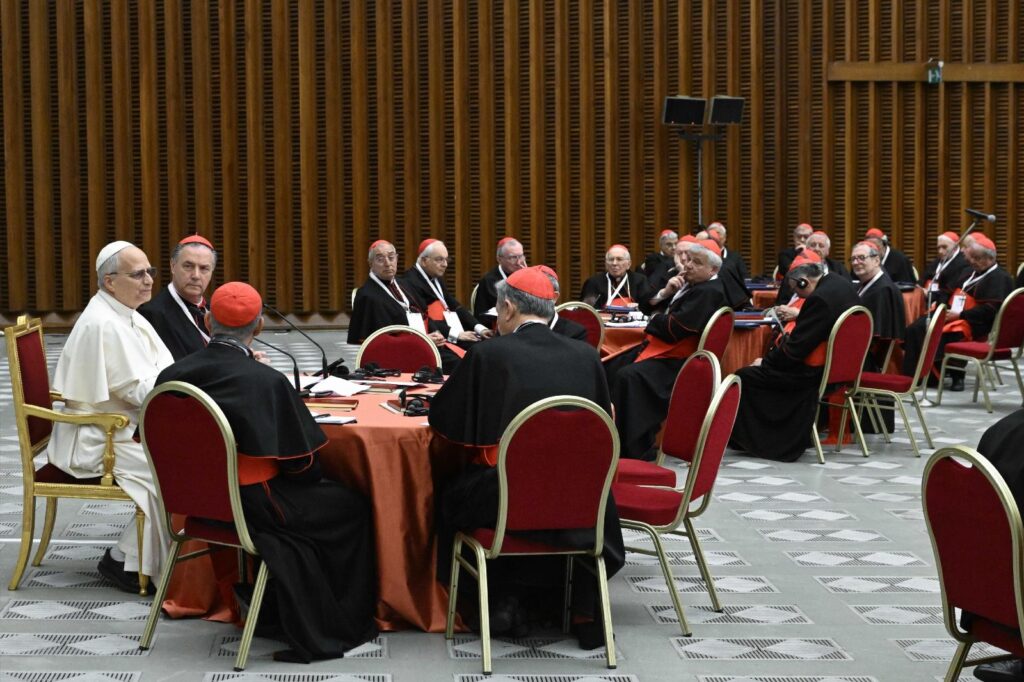
Asked whether there were any tensions—especially upon setting aside liturgy and Church governance from the list of issues to discuss—Cardinal Brislin said it was a “pleasant experience, friendly experience,” and that “the pope wants to be collegial” and learn from “the richness that comes from the experiences of people” coming from different parts of the world.
Luis José Cardinal Rueda Aparicio of Bogotá, Colombia, added that “sometimes there is criticism or different positions—but we try to reach harmony, which does not mean uniformity, but going back to the roots,” which he referred to as the Second Vatican Council.
The themes of the June consistory are yet to be named, and were not specified.
Cardinals walking out of the Paul VI Hall confirmed however, that during the January 7-8 consistory there had been no time to discuss liturgy.
The list of cardinals that participated in the extraordinary consistory has not been released, only the number—170. But the Vatican said Pope Leo met 93-year-old Joseph Cardinal Zen Ze-kuin, retired bishop of Hong Kong, on January 7, and on January 8 he specifically thanked the senior cardinals for making the effort to come.
It was really refreshing to see the Holy Father was more listening than talking
Cardinal David
Cardinal Zen, had to get permission from the judicial authorities in Hong Kong to attend the consistory.
Passing the pope’s words to journalists, Bruni said the pope emphasised: “’Your witness is truly precious,’ reaffirming his closeness to the cardinals around the world who were unable to come.”
Repeating the pope’s words, he said, “We are with you and we feel close to you,” as some cardinals, like Baltazar Cardinal Porras of Venezuela, whose diplomatic passport was confiscated by the regime, were unable to come.
Pablo Cardinal David of Kalookan, the Philippines, said, “It was really refreshing to see the Holy Father was more listening than talking” during the consistory and added that while no concrete decisions have been made, “he was taking notes very, very seriously, so he must be up to something.”
Jean-Paul Cardinal Vesco of Algiers, Algeria, speaking outside the Paul VI Hall, said that the consistory was “a wonderful time,” emphasising that it was not only a time for the cardinals to get to know each other, but for them to discover the personality of Pope Leo.
[The pope] wanted to show he is starting his pontificate as a good leader, and a good leader is making the cardinals know each other
“This pope is … a pope you want to love. He’s … deeply kind. He loves. He was there, present, simply. It was beautiful,” Cardinal Vesco, who may see the pope coming to his country in the footsteps of St. Augustine, told journalists.
The cardinal described the pontiff as “consistent” and “straightforward” in his “simplicity.”
He said he leaves the consistory with a notion that the cardinals “feel loved” by their boss and “want to love him” with a certain level of fraternity being a clear fruit of the gathering.
“He completely succeeded in that from the very first time,” Cardinal Vesco said.
Emphasising the need for teamwork in the Church, the pope told the cardinals in his off-the-cuff remarks on January 7: “I experience the need to be able to count on you: you are the ones who called this servant to this mission!” adding in his introductory speech that the consistory will “point the way for our path ahead.”
Cardinal Vesco said that even with such a short gathering, it is clear that Pope Leo “wants a Church … that is both a missionary Church that proclaims the Gospel, but also a Church that cares,” and “that is precisely in this form of communion and fraternity.”
He stressed, “Before anything else, rather than just talking about things, he does them. And to me, that seems very solid, we can clearly feel that this reservoir of trust” the pope puts in the College of Cardinals “is a value, a value that will stand the test of time.”
Father Jordi Pujol, associate professor of the Pontifical University of the Holy Cross in Rome, explained, “The emphasis is more on the relationship part than content,” even if a day and a half is too short of a timeframe to deeply discuss any issue, let alone the four projected at the beginning of the meeting.
Father Pujol stressed that the pope “wanted to show he is starting his pontificate as a good leader, and a good leader is making the cardinals know each other.”
A good leader, he added, is one that says “don’t expect all coming from me—it’s the team that is going to move things forward. It shows that he is not personalistic, and it sets up his style” of listening first, the professor of media ethics and media law at the School of Church Communications said.
Claudio Cardinal Gugerotti, prefect of the Dicastery for the Eastern Churches, echoed this sentiment in his brief comments, saying that the pope “was also very eager to exchange a few words, to connect with others in a very simple, informal way, and that was very pleasant.”
Joking about the Italian nature of the Vatican consistory, he added, “The lunch was excellent. Unfortunately, we missed the nap.”