Father Shay Cullen, Preda.org
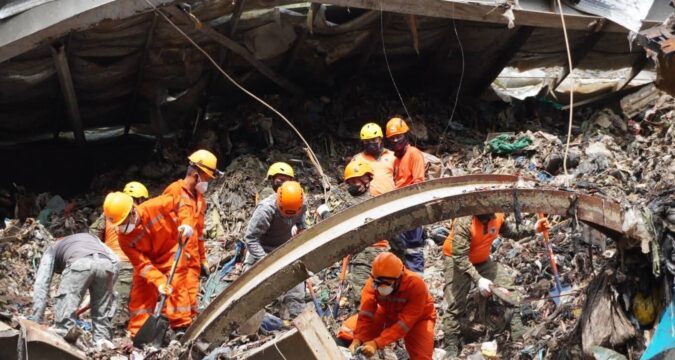
The massive landslide at a landfill facility in Binaliw village, Cebu City, the Philippines, on January 8, left at least 22 people dead and 18 others injured as of January 15 [Sunday Examiner, January 18]. More are still missing. It could have been prevented if there was greater respect for human life, the environment, and the implementation of the rule of law in the Philippines.
There are excellent laws in place to protect nature and preserve forests and seas. However, our once-beautiful environment is being destroyed by corruption, irresponsibility, and neglect, which allow these laws to be flouted and ignored.
One example is the enormous level of corruption and maleficence uncovered during the investigation into fraudulent flood control projects. The accumulation of rubbish and human waste, dumped in both legal and illegal sites, is polluting—and even destroying—the environment and our communities. Republic Act 9003, or the Ecological Solid Waste Management Act of 2000, is seldom implemented or obeyed. People suffer and die as a consequence.
A workers’ rights group said the death of so many workers in the Binaliw landfill was a crime against them. Bishop Gerardo Alminaza of San Carlos, chairperson of Church People-Workers Solidarity [CWS], said the landslide was not an accident, but was, “in truth, a crime born of greed, neglect, and the systematic violation of workers’ rights.”
The mountain of rubbish, said to be about 35 metres—or 20 storeys—high, collapsed on the 50 or so people working there, burying them. Some were pulled out alive; others died horribly beneath the debris.
Many were working inside adjacent buildings when the tragedy struck.
The landslide demolished the buildings and trapped the workers inside.
The waste management company operating the landfill is Prime Integrated Waste Solutions Inc. (PWS). According to its website, the site receives about 1,000 tonnes of solid waste daily from Cebu City and surrounding areas.
As we celebrate the 500 years of Christianity in the Philippines. The Chaplaincy to Filipino Migrants organises an on-line talk every Tuesday at 9.00pm. You can join us at:
https://www.Facebook.com/CFM-Gifted-to-give-101039001847033
As [a] Church, we affirm that work is sacred because the worker is sacred,” the CWS said. The statement added that when greed and profit cause safety to be ignored, then “human dignity is gravely violated and work is reduced to exploitation
Bishop Alminaza
The Cebu City Council declared January 16 a day of mourning for the victims. Following the incident, a cease-and-desist order was issued against the landfill operator, and a state of calamity was declared in Cebu City to manage the waste crisis.
The CWS has called for justice for the affected workers, saying they were “compelled to work under dangerous and inhumane conditions—conditions that should never have been allowed and that ultimately cost them their lives.”
Bishop Alminaza stood with the CWS, demanding accountability from both the company and government that failed to monitor the site and assess the dangerous condition after heavy rains and an earthquake in September made the garbage dump dangerous and unstable.
“As [a] Church, we affirm that work is sacred because the worker is sacred,” the CWS said. The statement added that when greed and profit cause safety to be ignored, then “human dignity is gravely violated and work is reduced to exploitation.”
The bishop and the group’s leaders demanded that there be an “immediate, thorough, and transparent investigation.”
The late Pope Francis frequently denounced the modern ‘throwaway culture’ that treats both objects and people as disposable
The late Pope Francis frequently denounced the modern “throwaway culture” that treats both objects and people as disposable. He had warned that the earth was beginning to look like “an immense pile of filth” due to the vast amounts of waste generated annually.
He also criticised the wasting of food and water, saying that throwing out food is akin to stealing from the poor.
The late pope advocated for a circular production model that prioritises reusing and recycling to conserve resources for future generations.
Cebu City councillor, Joel Garganera, told the media that “a landfill or a mountain that is made of rubbish… is like a sponge: it really absorbs water. It doesn’t [take] a rocket scientist to say that, eventually, [such an] incident will happen.”
The Philippines is facing serious challenges in waste management that the government must address urgently. Otherwise, more tragic events will occur at the many dumpsites across the country, endangering thousands of people.
As of 2025, illegal dumpsites around the country increased by 84 per cent year on year. Meanwhile, legal landfill sites grew by 14.7 per cent, bringing the total to 343
Many of these sites are, in fact, illegal and are growing faster than those approved by local government units (LGUs).
As of 2025, illegal dumpsites around the country increased by 84 per cent year on year. Meanwhile, legal landfill sites grew by 14.7 per cent, bringing the total to 343.
LGUs cannot cope with the growing volume of rubbish being generated, some of which is hazardous.
The region with the most serious concentration of hazardous industrial waste as of 2024 is Region 4A, or Calabarzon [Cavite, Laguna, Batangas, Rizal and Quezon]. It accounted for about 43 per cent of the country’s total.
Some of the illegal dumpsites on private property are located in Arenda, on the north shore of Laguna de Bay, as well as in Nosara Spring.
In Manila Bay, Baseco Beach is constantly polluted with plastic despite the ongoing heroic efforts of the “Baseco Beach Warriors,” who hold regular clean-up operations and pick up hundreds of bags of rubbish every week.
This situation will only get worse everywhere unless there is strict enforcement of the rule of law and a complete change in the minds and hearts of the people—to love their environment and to clean, recycle, and segregate rubbish for organised municipal collection
This situation will only get worse everywhere unless there is strict enforcement of the rule of law and a complete change in the minds and hearts of the people—to love their environment and to clean, recycle, and segregate rubbish for organised municipal collection.
A World Bank study predicted that by 2025, the nation’s waste generation would be 77,776 tonnes a day, or close to 28.39 million tonnes a year, considering the country’s population growth—particularly in urban areas.
The most recent National Waste Analysis and Characterisation Study found that 56.7 per cent of municipal solid waste was generated from residential sources. A further 27.1 per cent came from commercial establishments. The industrial and manufacturing sectors contribute the remaining 12.1 per cent and 4.1 per cent, respectively.
Pope Francis linked environmental abuse to social injustice, urging humanity to hear “both the cry of the earth and the cry of the poor.” He described the pollution of oceans, particularly from plastic waste, as “criminal.”
The late pope argued that wealthier nations have an “ecological debt” to poorer ones due to their disproportionate use of resources and export of toxic waste. He also attributed the “great majority” of global warming to human activity driven by a “predatory attitude” and the pursuit of short-term gain.