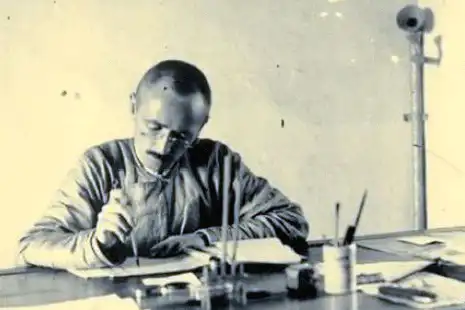

Father Vincent Lebbe [1877–1940], known in Chinese as Lei Mingyuan [雷鳴遠]—literally, “thunder that makes his voice heard afar”—was a Belgian priest of the Congregation of the Mission [the Lazarists]. He arrived in China in 1901 and was ordained as a priest in Beijing that same year. For the first 13 years, he served in rural parishes near Beijing and the Tianjin district. In 1916, following the expansion of the French concessional territory in Tianjin, he began an ‘exile’ that took him from Tianjin to Shaoxing in Zhejiang Province, and ultimately to Europe; he would not return until 1927.
Father Lebbe’s heart for Chinese Christians was unwavering. During this period, he reconsidered his original plan to introduce Benedictine monasticism to China—a plan he had discussed at the start of his mission with his brother, Béde, a Benedictine monk at Maredsous. Instead, he resolved to indigenise Christian monastic life within Chinese society.
Accordingly, he founded an indigenised congregation in China, for Chinese Christians, called “The Little Brothers of the Congregation of St John the Baptist”—[耀漢] Yaohan Xiao Xiongdi Hu. ‘Yaohan’ literally means “to glorify Han”—a transliteration of John the Baptist—while also expressing the mission of the congregation: to promote and honour Han people, that is, Chinese Christians, within the Church. The congregation was founded on 16 December 1928, which he described as “an historic date, the date when Chinese monasticism was born—yes, Chinese totally.”
Father Lebbe understood early 20th‑century Chinese society chiefly through its peasants. Most of them still considered Christianity a conflict between the East and the West
This narrative involves three main elements: the historical context of China in his time, his view of monasticism, and the concept of indigenisation.
Father Lebbe understood early 20th‑century Chinese society chiefly through its peasants. Most of them still considered Christianity a conflict between the East and the West.
Non-believers perceived that the luxurious and grand churches had been built with the support of foreigners who had imposed economic burdens on China through the forced signing of treaties. The lives of foreign priests and monks stood in sharp contrast to the destitute lives of the rural people. Some even called Christians 吃教者 “chijiao zhe”, meaning people who believed for food.
The rural peasants were the flock Father Lebbe cared for first. Therefore, he shaped the monastic life of the Little Brothers to give a new impression to the non-believers: simple and sustained not by material comfort, but by faith.
The core of monastic life for the Little Brothers rested on two pillars: the ascetic and the apostolic. Father Lebbe expressed these pillars through three essential attitudes: total sacrifice [全犧牲, quan xisheng], true charity [真愛人, zhen airen], and constant joy [常喜樂, chang xile]. These attitudes are inseparable and mutually sustaining.
The lives of foreign priests and monks stood in sharp contrast to the destitute lives of the rural people. Some even called Christians 吃教者 “chijiao zhe”, meaning people who believed for food
“Total sacrifice” is a refined formulation of an earlier, more colloquial phrase used when Father Lebbe explained to his brothers: beat me, beat me down, beat me to death [打擊我, daji wo, 打倒我, dadao wo, 打死我, dasi wo]. The analogy of beating the self demonstrates the inner purification that takes place through ascetical renunciation. Ascetic practices are not merely exertions; they are responses to God’s love and expressions of one’s relationship with Him. Such a relationship is a true communio personarum, an interpersonal union in which one gives oneself completely to the Other, as Pope St John Paul II described.
In this same spirit, St. John of Cross, the Carmelite saint, spoke the process of the self-renunciation for the love of God as the Dark Night [active] of sense and spirit, in which, he wrote, “love produces such likeness in this transformation of lovers that one can say each is the other and both are one.” [Spiritual Canticles, Stanza 12]
Father Lebbe emphasised total sacrifice because it shows the essence of true charity that is fully revealed in Jesus Christ. His spirituality is nothing but Christological. Every form of “hard work” in the spiritual life is ordered toward following Christ, conforming oneself to his self-emptying love. In Christ’s kenosis, that is, his self-emptying, we discover both the true image of divine love and humanity.
He frequently referred to St. Paul’s teaching on union with Christ, especially the death of the “old self” [Colossians 3:3]. In this light, his striking and analogical expression —beat me to death [dasi wo]—points to the spiritual dying that makes room for a new life in Christ.
Total sacrifice became the condition for authentic apostolic work, for being a Christian monk was not merely a matter of following religious ideology or cultivating an individualistic spiritual life in isolation
Father Lebbe chose John the Baptist as one of the two patron saints of the congregation because John had prepared himself for the work of his whole life—that is, to proclaim the coming of the Messiah—by a long-consecrated life in the desert. So, the brothers also prepared themselves for apostolic work. He called it, “Carthusians at home, apostles outside.”
Total sacrifice became the condition for authentic apostolic work, for being a Christian monk was not merely a matter of following religious ideology or cultivating an individualistic spiritual life in isolation. Ascetic practice was precisely the place where a mature relationship with God was revealed and strengthened. And to live out the image of God in which we are created is, ultimately, to live in constant joy [chang xile].
Father Ts’ao Li Shan [曹立珊], a close disciple of Father Lebbe, in his book on Lebbe’s spirituality, noted that he used the image of a roly-poly doll to illustrate the meaning of constant joy. This toy never fully topples because its centre of mass is low, its body is mostly hollow, and its weight is concentrated at the base.
In the same way, the source of a Christian’s joy cannot rest in emotional, physical, or intellectual pleasures, all of which inevitably fade with time. Only when our joy is anchored in Heaven can we remain steadfast—able to rise again with constant joy even amid the sufferings of earthly life.
Total sacrifice became the condition for authentic apostolic work, for being a Christian monk was not merely a matter of following religious ideology or cultivating an individualistic spiritual life in isolation
Though the Divine Office was translated into Chinese and the liturgy chanted in Chinese following the Benedictine tradition—Benedict being the other patron saint of the congregation—the true indigenisation of Chinese monasticism, or indigenisation in general for Lebbe, was not about language. Rather, he expressed the primitive spirit of monasticism—hard work and prayer—and Christian values in a way that aligned with the Chinese thinking pattern: pictorial, analogical, and helical, whereas the Western approach tends to be abstract and linear.
An expression being abstract and linear does not mean it is unreal, but it does not fit with the nature of the Chinese language or the way the Chinese prefer to think.
In his letters and the reflections by his brothers, Father Lebbe largely used analogies [e.g., beating me to death and the roly-poly doll] along with references to demonstrate a deep idea of and his own innermost experience with God. His three attitudes [全真常 quan zhen chang] even echo the concise style of mantras found in the Buddhist tradition.
In his legacy, we can see that the heart of Christianity is not found primarily in Greek philosophical terms or Latin formulations, but in a sincere heart open to encountering Christ and loving others. In an age when modern technology can bridge many of our linguistic and cultural barriers, one might wonder: does this mean that missionary work is no longer necessary?
In his legacy, we can see that the heart of Christianity is not found primarily in Greek philosophical terms or Latin formulations, but in a sincere heart open to encountering Christ and loving others
He never imposed a “privileged” way from the West on the rural peasants. Instead, he ‘incarnated’ Christianity and monasticism in the soil of the East. His indigenisation is not merely IN China but FOR the Chinese, as Jesus Christ’s Incarnation is not merely a historical event IN the world but FOR everyone in the world.
Father Vincent Lebbe’s dream was simple: that the gospel could take root in China in a truly Chinese way. By founding the Little Brothers of St John the Baptist, he showed that a life of prayer, hard work, and humble service could speak powerfully to the hearts of ordinary people. His life reminds us that the Church grows most fruitfully when it enters deeply into the life of the people it serves. His legacy invites us to live our own faith with the same sincerity, simplicity, and love for our culture and our neighbour.
Joshua Yuan, Ph.D.
Research Associate in Computing & Information Sciences, Saint Francis University