MANILA (LiCAS News): The National Council of Churches in the Philippines [NCCP] called on the government to abolish oil taxes and regulate fuel prices, warning that conflict-driven price hikes are worsening the burden on poor and vulnerable communities.
On March 26 the Protestant group called for “genuine and sincere measures to control prices and minimise the effect” of the ongoing conflict involving the United States, Israel, and Iran on the Philippine economy.
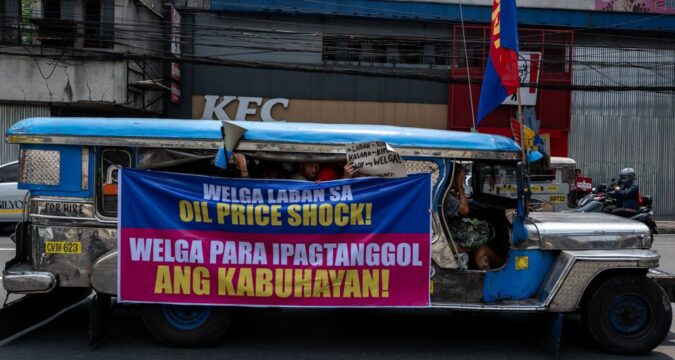
This appeal coincided with a nationwide transport strike from March 26 to 27, which drew widespread support from civil society groups.
The NCCP highlighted that “instantaneous oil price hikes as a consequence of the US-Israel instigated war” have “hit the people hard,” pushing many Filipinos into daily hardship amid a deepening economic crisis.
The council noted that Filipinos were already grappling with rising costs and unemployment, citing “massive price increases of basic commodities” even before the recent escalation of tensions in West Asia.
…every litre of fuel consumed is a meal snatched from their families
Council for People’s Development and Governance
Church leaders described the government response as inadequate, saying current measures “are merely palliative, if not performative”, with subsidies that “are insufficient and may not even last a few days”.
The group urged authorities to remove excise tax and value-added tax on oil products and repeal the Oil Deregulation Law, arguing that “high, excessive, and overlapping taxes imposed on the majority of poor Filipinos do not serve the common good.”
They added that it is “deeply appalling” for oil taxes to remain “high, excessive, and redundant” amid corruption scandals and worsening economic conditions.
The NCCP called on Churches to show “compassion and solidarity” with those most affected—including jeepney drivers, workers, and producers—and to pursue “acts of justice”.
As we celebrate the 500 years of Christianity in the Philippines. The Chaplaincy to Filipino Migrants organises an on-line talk every Tuesday at 9.00pm. You can join us at:
https://www.Facebook.com/CFM-Gifted-to-give-101039001847033
The Council for People’s Development and Governance warned that the projected rise in diesel prices to 120 pesos per litre amounts to “economic violence,” driven by policies that “disproportionately take wealth from the poor”.
…high, excessive, and overlapping taxes imposed on the majority of poor Filipinos do not serve the common good.
National Council of Churches in the Philippines
For many drivers, “every litre of fuel consumed is a meal snatched from their families,” underscoring how rising costs are eroding already fragile livelihoods.
The Centre for Women’s Resources [CWR] reported that women and low-income households are bearing the brunt of the crisis, with inflation forcing families into painful trade-offs.
Cham Perez, executive director of CWR, said the situation as “the daily reality of women absorbing the impact of inflation”, noting that “each price hike multiplies the burden on women managing households on near-zero budgets.”
For families reliant on transport income, the effects are immediate. Marissa Figueroa of PISTON Women shared that before the price hikes, her husband earned 700–800 pesos daily as a jeepney driver. With fuel prices soaring, his income has dropped to 200–300 pesos, sometimes leaving the family with nothing but rice and bagoong [shrimp paste] or forced to sleep hungry.
Environmental advocates also called for deeper reforms, insisting the government’s energy emergency declaration must go beyond short-term relief.
…the current tax system puts the burden on ordinary Filipinos who are already shouldering rising costs
Jefferson Chua
Greenpeace criticised the government response as “lackadaisical”, citing “constant denials that we are in a crisis” and the absence of long-term direction as climate impacts worsen.
Climate campaigner, Jefferson Chua, argued that Executive Order 110 must provide immediate support but also “pave the way for structural reforms” to address systemic problems that “put the burden of economic shocks on ordinary Filipinos”.
He recommended suspending value-added tax, regulating prices, and shifting away from fossil fuels, warning that “the current tax system puts the burden on ordinary Filipinos who are already shouldering rising costs.”
Chua added that the crisis should be a catalyst to move beyond “business as usual” and “build a fair, resilient future for all Filipinos.”
Groups from various sectors warned that without decisive action, the cost of global conflict will continue to fall on those least able to bear it.
The country’s president, Ferdinand Marcos Jr., declared a state of national energy emergency on March 24 through Executive Order No. 110, as global supply disruptions linked to the Middle East conflict threaten fuel stability.
The Department of Budget and Management has allocated 20 billion pesos for the Department of Energy’s Emergency Energy Security Programme, which includes procuring up to two million barrels of fuel to boost local supply.
Funds will be channelled to the Philippine National Oil Company and its exploration arm to purchase refined petroleum products, augment LPG supply, and build reserves.
The Department of Energy said this move “demonstrates the administration’s resolve to protect the Filipino people from external supply shocks” and will help “preserve market stability” and support critical sectors.
Energy secretary, Sharon Garin, described the allocation as “a strong intervention… to strengthen the country’s fuel security amid global oil market disruptions”, adding that the government is taking “concrete and proactive steps to secure fuel supply” and protect consumers.