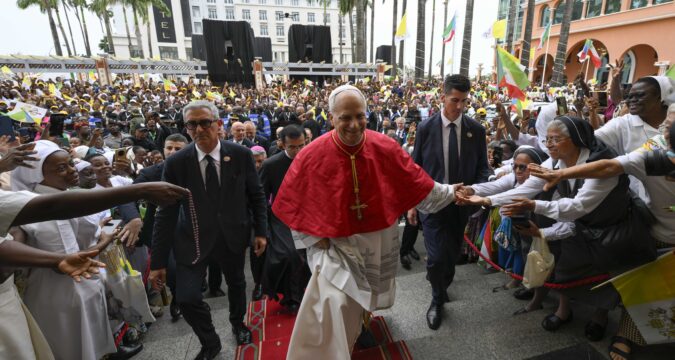
(OSV News): On the papal flight from Luanda, Angola, to Malabo, the capital of Equatorial Guinea, Pope Leo XIV paused to honour his predecessor, Pope Francis, on the first anniversary of his death, remembering his witness to mercy and closeness to the poor.
“I would like to remember, on this first anniversary of his death, Pope Francis, who gave so much to the Church with his life, his testimony, his words, and his gestures,” Pope Leo told reporters travelling with him, reflecting on the legacy of Pope Francis, who died on 21 April 2025.
He recalled how the late pope truly lived with “closeness to the poorest, the little ones, the sick, the children, the elderly.”
Pope Leo said, “We can also remember his message of mercy,” remembering in particular how his predecessor invited the entire Church to join in the “beautiful celebration of an extraordinary Jubilee of Mercy.”
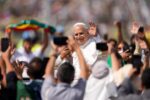
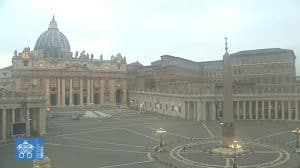
Pope Francis’ final public appearance was on Easter Sunday, 20 April 2025, when he unexpectedly came out onto the central loggia of St. Peter’s Basilica, to greet thousands of faithful gathered in the square below before boarding his popemobile for a final pass through the square to greet the faithful.
I would like to remember, on this first anniversary of his death, Pope Francis, who gave so much to the Church with his life, his testimony, his words, and his gestures,
Pope Leo XIV
“We pray that he is already enjoying the mercy of the Lord and we thank the Lord for the great gift of Francis’ life to the whole Church and to the whole world,” Pope Leo said on the flight.
In Rome, the anniversary of Pope Francis’ death was marked with a Mass held in the Basilica of St. Mary Major, the final resting place of the late pope.
After his tribute, the pope responded to three questions from Angolan journalists about his experience in their country.
Pope Leo said that it was “a joy to see the places in the world where the Church is growing,” noting that is not the case in other parts of the world, underlining that this is “a call to evangelisation, to continue to announce the gospel and to try to invite others, not with proselytism as Pope Francis said so many times, but with the beauty, the attraction of faith.”
He added, “The joy of believers is one of the best announcements of faith, of the gospel.”
Asked about the possibility of new appointments of African cardinals, Pope Leo said that “this is a question that many want to ask,” noting that it’s “still not decided yet when new cardinals will be created.”
In a world wounded by arrogance, people hunger and thirst for justice
Pope Leo
He said, “We must look at the question at the global level. We hope that for Africa, and also for Angola, in the future—I’m not saying the next one, a bit further on—but we can consider the creation of new cardinals also for Angola.”
Pope Leo’s April 21–23 visit to Equatorial Guinea—his final stop on this papal visit—will be only the second papal visit to the country; the first was by St. John Paul II in 1982.
Upon arrival, the pope was met by its president, Teodoro Obiang Nguema Mbasogo, who has ruled the oil-rich Central African nation since seizing power in a 1979 coup.
Speaking at the presidential palace, he delivered a pointed appeal for justice and ethical governance.
“In a world wounded by arrogance, people hunger and thirst for justice,” the pope said, telling the authorities that the Church can help to form “free and responsible consciences.”
Pope Leo warned against economic systems that exclude the poor, echoing his predecessor, Pope Francis, and his criticism that ‘such an economy kills’
Pope Leo recalled words spoken by Pope St. John Paul II during his 1982 visit to the country, emphasising the enduring need for “authentic liberty, justice, respect and promotion of the rights of every person.”
“These are words that remain timely and that challenge anyone entrusted with public responsibility,” Pope Leo added.
Turning to St. Augustine, the pope reflected on the contrast between two “cities” described in St. Augustine’s classic work “The City of God”: one built on love of God and neighbour, the other on self-interest and the pursuit of power.
The “city of God” is characterised by love, especially for the poor, Pope Leo said. “The earthly city … is centred upon the proud love of self, on the lust for power and worldly glory that leads to destruction.”
He urged leaders and citizens alike to discern “which city they wish to serve.”
In his speech, Pope Leo warned against economic systems that exclude the poor, echoing his predecessor, Pope Francis, and his criticism that “such an economy kills.” He added that global conflicts are increasingly driven by the exploitation of natural resources “with no regard for international law or the self-determination of peoples.”
Pope Leo said, “The destiny of humanity risks being tragically compromised without a change of direction. God does not want this.”