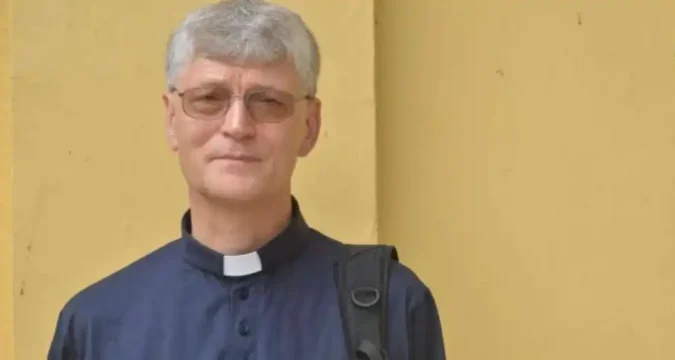
MACAU (UCAN): Divine Word Father Andrzej Miotk observed that Macau has played an instrumental role for centuries in spreading the Christian faith across East Asia, serving as a hub for missionary training and cultural exchange, according to the Polish priest who has studied the history of Asian missions.
For almost four centuries, Macau has been a strategic platform, a training centre, and a base for spreading the Christian faith across China, Japan, Korea, and Southeast Asia, according to an interview in Jornal O Clarim.
The interview, which discussed several aspects of Asian missions, was conducted after Father Miotk taught an intensive course on the history of Asian missions in the Diocese of Macau. This year marks the 450th anniversary of its establishment as a diocese by Pope Gregory XIII.
“Macau’s role and its relationship with other Asian missions are unique and extraordinary,” said Father Miotk, who holds a doctorate in Missiology from St. Augustine University in Bonn, Germany.
“In Asian evangelisation, Macau made all the difference,” Father Miotk said, pointing out that Macau was a gateway to China—where all missionaries, including Jesuits, wanted to go—and then to Japan, as Macau had strong relations with both.
Macau also had a strong connection with Japan, as some Japanese Catholics who fled persecution took refuge there, he added.
“Macau was always a base, a structure that favoured the expansion of Catholic missions. At the time, it was the largest centre for the education, preparation, and training of missionaries,” he said.
“It was truly the best place a missionary could be,” Father Miotk said, adding that “without Macau, the developments that later materialised would not have occurred.”
Over the centuries, around 700 missionaries—mostly Jesuits—have been trained in Macau, including 400 non-Portuguese from 16 different nations.
“It was not just a place for training but also a place for exchange,” he said.
The missionaries who converged in Macau “created a dynamic of exchange that led the Jesuits to make Macau the place where the method of inculturation was perfected, and where missions destined for Japan and China were planned.”
The presence of seminarians and students from different countries also helped them study languages and become familiar with diverse cultures, Father Miotk said, noting that these are key necessities for mission work.
Related posts:
Developing a long-term relationship with the poor
Pope is still energetic, nephew says
Vesak message: Catholics and Buddhists must work for peace