By Faith, Hope and Agape,
A member of the World Community for Christian Meditation, Hong Kong
One autumn a few years ago, after returning from a long trip abroad, I walked into a prayer meeting that I had not attended for months. My heart was weary and dry, worn thin by miles and motion. At the time, I had long believed that the more I travelled, the more I saw, the richer my soul would become.
I pushed open the door. An elderly gentleman with a head of white hair sat quietly before me. A table nearby was laid out simply with quiet reverence: a cross, a Bible and a few icons, and six prayer sheets neatly set out, as if waiting for people who might or might not appear. At five past eight, the clear chime of a singing bowl sounded, and the room slowly settled into a deep silence.
That evening, an indescribable peace fell over me. It seeped into my parched heart like morning dew softens the dry soil. When the meeting ended, and I helped put away the prayer sheets, I could no longer hold back my question: “I almost didn’t come tonight. If I hadn’t shown up, you would have been here all alone. Why did you lay out six places?”
The elderly man looked up, without stopping what he was doing. He spoke in a tone as ordinary as stating the simplest thing in the world: “For the past five years, I have come each week. I prepare what needs to be prepared.” He paused for a moment, offering me a quiet smile. Then his eyes moved past me and rested on the cross at the center of the table. “I come for the Lord,” he said softly, “to spend time alone with him.”
At that moment, a quiet tremor moved within me. I saw clearly the pattern buried deep within me: I was always concerned with the number of people who showed up, the visible results, and how others responded. But this old man paid no heed to the empty chairs. From beginning to end, he had kept his focus on God alone.
In that moment, I finally understood: his perseverance was not born of extraordinary willpower.
It flowed from a heart that never looked away
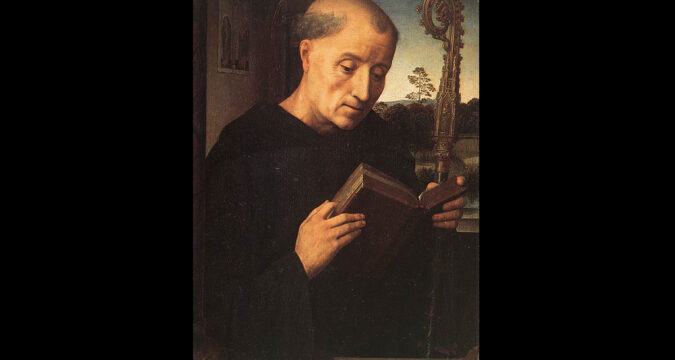
from the One. “Fixing one’s eyes on the Lord”—this, I realised, was the deepest root. It brought to mind St Benedict’s teaching. The saint discouraged monks from wandering from place to place; instead, he called them to stabilitas—stability: the discipline of taking deep root in one place, one community, one calling. Do not give up lightly on your community. Do not give up lightly on your brothers and sisters. Do not give up lightly on yourself.
In today’s world, such fidelity sounds almost unimaginable. We have grown so accustomed to changing our surroundings, our relationships, even our identity the moment difficulties arise. When a prayer practice grows mundane, we go looking for new spiritual techniques. When we become disillusioned with one group, we look elsewhere. When a marriage becomes too difficult to navigate, we begin to harbour thoughts of separation.
Yet the wisdom of St. Benedict reminds us: true depth is never found in constantly changing external forms. It is found in remaining faithful to the present moment, embracing whatever stands before us—even boredom, loneliness, imperfection.
Stability is spiritual courage. It invites us to choose one place and dig deep, until we strike the hidden spring of living water. For that elderly man, steadfastness came not from a sense of duty, but from love. What he kept alive was not a meeting, but a living connection with the Lord.
If at this moment, you feel weary or dry on your spiritual journey—convinced that the next method, the next book, the next gathering will finally satisfy you—perhaps it is time to pause. Return to the place where you first met the Lord. Return to the simplest, most unadorned prayer. Even if you come alone. Even if no one sees you. Come simply to him.
The spring of living water is not far off. It is in the very soil beneath your feet, the ground you have chosen to faithfully tend.
Related posts:

Holy Saturday, Vigil Mass 2024, Cathedral of the Immaculate Conception, 6pm HK time

Lenten reflections from our bishop: Resolve

Reflections from the cardinal: Sakura and Ching Ming Festival