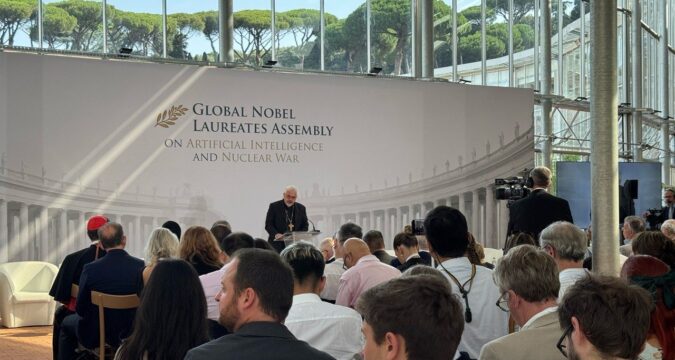
VATicAN (SE): Over 200 Nobel Prize winners, former heads of state, university representatives and experts gathered on Tuesday, July 14, for the three-day Global Nobel Laureates Assembly on Artificial Intelligence and Nuclear War at the Borgo Laudato Si’ in Castel Gandolfo, Vatican News reported.
Inspired by Pope Leo XIV’s encyclical, Magnifica Humanitas, on safeguarding the human person in the time of artificial intelligence, the assembly is set to culminate in the signing of the Rome Declaration on an Unarmed and Disarming Peace in the age of artificial intelligence, nuclear and autonomous weapons, new digital protocols, and emerging models of digital development.
Aiming to present guiding principles for the governance of AI focused on cooperation, human dignity, integral development, and peace, the event featured discussion sessions on topics such as “The fragility of the human family in the nuclear age”, “Technology in the service of humanity”, and “The moral challenges of AI and War”.
“We gather at a moment in history marked by increasingly profound geopolitical tensions, the fragmentation of the international order, and intensifying technological competition,” said Fabio Cardinal Baggio, pro-prefect of the Dicastery for Promoting Integral Human Development and General Director of the Centre for Higher Education at the Borgo Laudato Si’.
At a time when the pace of innovation often exceeds that of reflection, the world stands in need of shared principles capable of guiding progress toward authentically human ends
Fabio Cardinal Baggio
“At a time when the pace of innovation often exceeds that of reflection, the world stands in need of shared principles capable of guiding progress toward authentically human ends,” he said.
In his introductory remarks, he highlighted how these issues are being accompanied by the rapid development of AI and autonomous technologies, according to Vatican News.
“This assembly is not gathered simply to analyse risks,” said Silvano Maria Cardinal Tomasi, president of Domus Communis Foundation, in his address.
“It is gathered to renew hope, to demonstrate that dialogue remains possible, that wisdom can still accompany knowledge, that humanity has not lost the capacity to govern its own future.”
He said, “May future generations be able to say that, at a moment when humanity possessed unprecedented power over its own destiny, women and men of conscience chose cooperation over confrontation, dialogue over fear, and hope over resignation.”