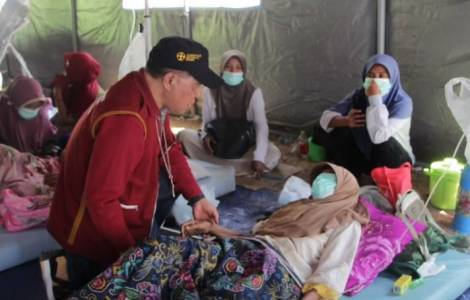
RUTENG (Fides): “An earthquake can bring so many things to collapse in a matter of seconds. Homes, places of worship, schools—even our sense of security can suddenly become fragile,” said Bishop Siprianus Hormat of Ruteng, Flores Island, Indonesia, following the earthquake that struck the area on August 15.
“I witnessed the emergence of a remarkable spirit of solidarity: people began helping one another with generosity and without holding back,” Bishop Hormat observed. “Many started sending food, distributing medicines, and offering their time as volunteers. Government agencies, healthcare workers, humanitarian organisations, and local Catholic communities mobilised through their respective networks.
He noted, “Amid the damaged physical infrastructure, another kind of infrastructure was already at work: a network of kindness.”
The Diocese of Ruteng was among the hardest hit by the earthquake and has suffered extensive damage. Caritas operational centres are active throughout the island, coordinating humanitarian assistance across Flores’ four dioceses: the Archdiocese of Ende and the Dioceses of Maumere, Ruteng, and Labuan Bajo.
The official death toll across Flores, as of August 25, reached 100. More than 1,600 people were injured, many suffering serious trauma caused by collapsing structures. The number of displaced people has exceeded 180,000. The tremors damaged approximately 74,000 homes, 23,000 of which have either completely collapsed or been rendered uninhabitable. Infrastructure has also been severely affected: more than 319 schools and 124 health centres are currently out of service.
“After the emergency, the recovery period will last far longer than the time during which a disaster remains at the centre of media attention. Homes must be rebuilt, trauma must be addressed and healed, and livelihoods restored,” Bishop Hormat said.
“This is where social capital faces its next test: the network of solidarity cannot rely solely on spontaneity; it must be supported by good governance. Flores needs stronger homes, safer schools, and better disaster management. And it needs people who cannot bear to see others suffer alone,” he said.