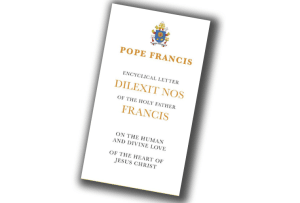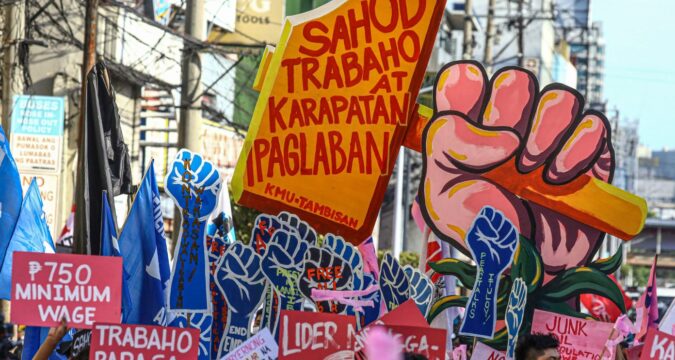
MANILA (LiCAS News): The Ecumenical Institute for Labour Education and Research [EILER], a Philippine labour advocacy group, has welcomed Pope Leo XIV’s encyclical, Magnifica Humanitas, saying it supports calls for stronger worker protections as concerns grow over the impact of artificial intelligence [AI] and automation on jobs and livelihoods.
Released on May 25 [Sunday Examiner, May 31], Pope Leo first encyclical reinforces long-standing demands that technological development serve workers and communities rather than profit alone.
“The encyclical is an important contribution to the labour movement. The pope reiterates the need for solidarity of the workers in the midst of the rapid development of Artificial Intelligence or AI industry,” said Rochelle Porras, executive director of EILER.
The group’s assessment was echoed by the Student Christian Movement of the Philippines, which described the encyclical as a renewed commitment to social justice and human dignity.
The group said Pope Leo’s reflections on artificial intelligence place greater emphasis on the social consequences of technology, particularly for workers and marginalised communities.
The encyclical is an important contribution to the labour movement. The pope reiterates the need for solidarity of the workers in the midst of the rapid development of Artificial Intelligence or AI industry
Rochelle Porras
In its reflection on the encyclical, the Student Christian Movement said Pope Leo views technology not simply as a technical matter but as one shaped by social and economic forces. The group said the document reaffirms the dignity of work and the principle of making labour “primary over profit.”
EILER cited estimates from the International Monetary Fund indicating that around 40 per cent of jobs worldwide could be affected by the expansion of artificial intelligence.
The group also referenced a Goldman Sachs projection that as many as 300 million full-time jobs could face disruption due to automation.
The labour organisation said the issue carries particular urgency in the Philippines, where International Labour Organisation data show that more than 12.7 million jobs, or about one-quarter of total employment, are exposed to AI-related disruption—the highest occupational exposure rate in Southeast Asia.
As we celebrate the 500 years of Christianity in the Philippines. The Chaplaincy to Filipino Migrants organises an on-line talk every Tuesday at 9.00pm. You can join us at:
https://www.Facebook.com/CFM-Gifted-to-give-101039001847033
EILER identified the business process outsourcing industry, which contributes about seven per cent of the country’s gross domestic product, as among the sectors most vulnerable to automation.
Pope Leo’s message reflects the urgency for collective action among the working people. The dignity of the work cannot be compromised in the name of efficiency and progress that deepens exploitation and drives the race to the bottom
Rochelle Porras
“The pope’s reminder that profiteering at the expense of employment protection is unjustified and that technology must not remain at the hands of the few, echoes the long-standing demands of workers for decent jobs, social protection, and social justice,” Porras said.
The Student Christian Movement also pointed to the encyclical’s concern for “hidden, often exploited workers” whose labour supports AI systems while remaining largely invisible to the public.
The group said the document challenges economic systems that reduce people to measures of productivity and efficiency.
“Even neoliberal institutions now recognise the growing precarity that workers experience under profit-driven development. This reaffirms what labour groups have been demanding: without genuine labour protections and a national industry, the democratic control of technology remains elusive and AI will be used mainly for capital accumulation, at the cost of job insecurity, poverty wages, and mass layoffs,” Porras said.
EILER also welcomed Pope Leo’s support for labour unions and collective action, saying workers need stronger protections as emerging technologies continue to reshape workplaces.
“Pope Leo’s message reflects the urgency for collective action among the working people. The dignity of the work cannot be compromised in the name of efficiency and progress that deepens exploitation and drives the race to the bottom,” Porras said.
The statements come as labour advocates and other sectors continue to assess the implications of artificial intelligence for employment and working conditions in the Philippines.
EILER and the Student Christian Movement both cited Magnifica Humanitas in discussing concerns about labour protections, inequality, and the social impact of emerging technologies.