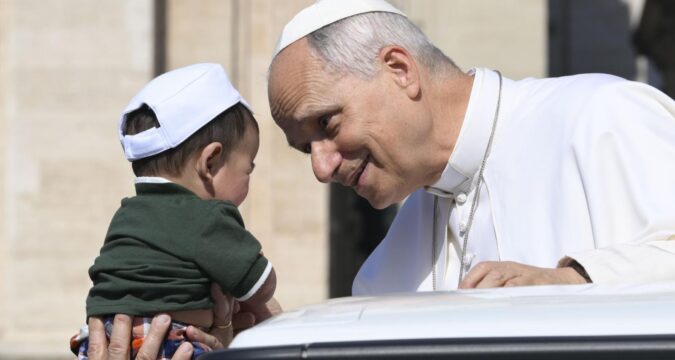
VATICAN (SE): In an editorial published on 13 July, Andrea Tornielli, the editorial director of Vatican News, reflected on the role of the pope and the Magisterium, noting that even when the pope addresses matters of “war and peace, migration or how to remain human in the age of artificial intelligence”, he is always a spiritual leader.
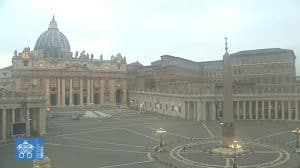
“The fact that the Bishop of Rome, by virtue of the Lateran Pacts of 1929 that resolved the ‘Roman Question,’ is also the sovereign of the world’s smallest state—less than half a square kilometre in the heart of the Italian capital—does not mean that he acts or speaks as a politician when addressing issues concerning the affairs of humanity,” Tornielli pointed out.
He pointed out that Pope St. Paul VI explained this in his 4 October 1965 address to the United Nations General Assembly when he said: “This gathering, as you are all well aware, has a twofold nature: it is marked at one and the same time by simplicity and by greatness. By simplicity because the one who is speaking to you is a man like yourselves. He is your brother, and even one of the least among you who represent sovereign states, since he possesses—if you choose to consider us from this point of view—only a tiny and practically symbolic temporal sovereignty: the minimum needed in order to be free to exercise his spiritual mission and to assure those who deal with him that he is independent of any sovereignty of this world.”
The pope added, “He has no temporal power, no ambition to enter into competition with you. As a matter of fact, we have nothing to ask, no question to raise; at most a desire to formulate, a permission to seek: that of being allowed to serve you in the area of our competence, with disinterestedness, humility and love.”
Tornielli wrote that, to guarantee the absolute freedom of the Vicar of Christ, it was established nearly a century ago that there would be a tiny patch of land where the Bishop of Rome and Shepherd of the Universal Church would also be sovereign—and thus head of state.
He went on to stress that this is “an arrangement designed to recognise precisely this need for independence from any other state, and not an affirmation of a dual mission. Any glorification or exaggeration of the pope’s role as head of state, any emphasis on the importance of this role, is therefore misleading because it comes at the expense of his one true mission as universal Shepherd. A Shepherd who speaks to Catholics, Christians, believers, and all people of good will with the sole intent of proclaiming the gospel—his message of love, brotherhood, and ‘unarmed and disarming’ peace.”
Tornielli highlights how this perspective was illustrated by then-Giovanni Battista Cardinal Montini, the archbishop of Milan [later Pope Paul VI], in his address at the Campidoglio on 10 October 1962, on the eve of the Second Vatican Council. He spoke about the end of the Church’s temporal power with the fall of the Papal States in 1870, stating: “It was then that the papacy resumed with unusual vigour its functions as teacher of life and witness to the Gospel, thus rising to such heights in the spiritual governance of the Church and in its moral influence on the world as never before.”
Tornielli argues that whenever the pope calls for the protection of human life at every stage, advocates for peace for all peoples, or urges an end to the arms race—even challenging the concept of a “just war”—he is not acting as a statesman.
When the pope invokes the Magisterium of Social Doctrine in support of dialogue and negotiation, calls for migrants to be welcomed with dignity, upholds the rights of the poor, insists on religious freedom, or emphasises the stewardship of Creation for future generations, he does so not as a head of state, but as a spiritual leader.
Tornielli concludes that in all these instances, the Successor of Peter is merely fulfilling his mission to proclaim the gospel.