BARCELONA (OSV News): On June 9—the fourth day of his apostolic journey to Spain, Pope Leo XIV arrived from Madrid and began his visit to Barcelona with a midday prayer at the Cathedral of the Holy Cross and Saint Eulalia, greeted by crowds along the streets. “We are strong because we are united, and we are united because we are animated by the same Spirit,” he said.
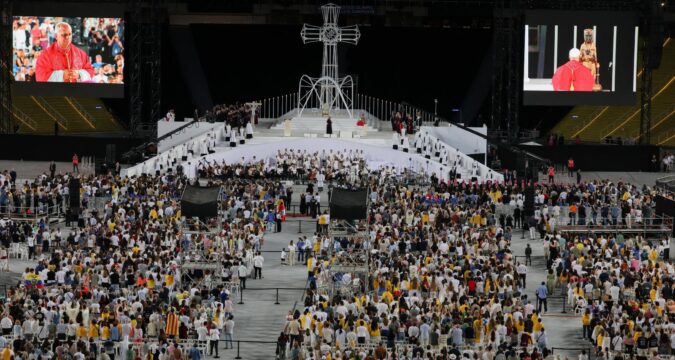
That evening, at Lluís Companys Olympic Stadium, the pope was greeted with cheers as he arrived for a prayer vigil which opened with a performance of the castell—Catalonia’s tradition of building human towers—by a group from Vilafranca del Penedès.
Juan José Cardinal Omella Omella, archbishop of Barcelona, introduced the castell as a symbol of what people can accomplish “when we work together toward a common goal.” He noted the towers may have inspired Antoni Gaudí’s famous spires at the Sagrada Família.
Later, Pope Leo addressed tens of thousands, assuring them that God does not abandon those who suffer, even when his presence feels most distant, as he took questions from young people whose stories reflected the most difficult dimensions of human experience.
In a poignant moment, a young woman named Carmina described her years-long struggle with depression and a suicide attempt, asking the pope where God could be found “when the darkness is absolute and we cannot take it anymore.”
Pope Leo gave her a hug and called her presence “a remarkable miracle.”
Through contact with Jesus, even those who feel lost regain confidence in life; healed of their illness, they can rise to live again
Pope Leo XIV
He said, “I am moved that you are here among us and that you have found the strength to embrace this second chance that the Lord has given you. Through contact with Jesus, even those who feel lost regain confidence in life; healed of their illness, they can rise to live again.”
The pope drew on gospel accounts of Gethsemane and the Crucifixion to show how Christ entered into the deepest human suffering.
“In those dark hours, as he was dying on the cross, Jesus shared our pain and revealed to us the face of a compassionate God who bears our sorrows, who suffers with us, weeps our tears, and remains at our side with his presence full of love and mercy,” he said.
However, he cautioned against the spiritualisation of pain, saying, “God does not want suffering. He carries it with us and invites us to trust in him with perseverance.”
He urged those suffering not to face pain alone: “In times of pain, at least as much as possible, we must open ourselves to someone who can help us utter a simple prayer, who can accompany us with discretion without rushing to explain that pain, who can take us by the hand and lead us out of that cry.”
The pope made a direct appeal for expanded mental health care, calling the rise in psychological illness “a sign that there is something deeply wrong with a certain notion of progress that subjects people to pressures, expectations and tensions that compromise healthy balances.” He added, “We need a health care system that prioritises this invisible and widespread malaise, which also affects young people.”
God does not want suffering. He carries it with us and invites us to trust in him with perseverance
Pope Leo
A 20-year-old woman shared how her childhood was marked by domestic violence from her father, her mother’s subsequent drug use, and her own placement in a juvenile detention centre at the age of 10. She said her father tried to kill her mother, and she still struggles to forgive him, asking how genuine reconciliation is possible.
Pope Leo described forgiveness as a lifelong process: “We must continually ask the Lord—perhaps for our entire lives—to expand the space of love within us, precisely where we have been wounded.”
“We must learn to view forgiveness—that powerful remedy for evil that heals our inner wounds—as part of a process and a journey,” he added.
He added that forgiveness does not require restored closeness, especially in cases of violence: “We can maintain a good disposition of heart toward the person, reject all forms of hatred or revenge, strive to repair the relationship as much as possible, and perhaps pray for him or her.”
The pope condemned domestic violence and femicide as a “toxic climate in family relationships” that demands a societal response.
A recently baptised young man shared his story. The pope commented, “Many young people and adults are rediscovering the Christian faith, sometimes after having drifted away from God over a period of time.”
Pope Leo said, “We are made for the infinite, and that is why every finite horizon, every step, every achievement—while satisfying us—also propels us forward and invites us to keep searching. Above all, to search by ‘going inward,’ that is, by delving deeper.”
He advised the new convert: “Try to walk this inner path together with others, allowing yourselves to be accompanied on the journey and engaging with priests, religious and people who, like us, have set out on this path.”
In closing, the pope reflected, “we are called to engage with the shadows of our own human condition: We lack the full truth; we do not fully fathom the mystery of ourselves or the true identity of others; we do not always succeed in understanding the hidden truth of the reality that surrounds us and the events unfolding before our eyes. We seek a light to illuminate the path.”
He added, “Even in the heart of night, we must not give up searching, questioning and dialoguing with God and with each other.”