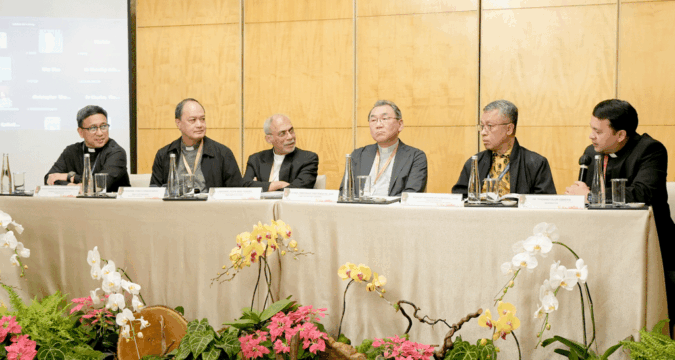
JAKARTA (SE): “It is a significant moment for the Church in Asia to pray together, listen to one another, discern the signs of the times, and seek new ways of proclaiming the gospel in one of the world’s most dynamic and diverse regions,” said Bishop Marcelino Antonio Maralit Jr., at the opening press conference of the Federation of Asian Bishops’ Conferences [FABC]’s 12th Plenary Assembly in Jakarta, Indonesia, on July 20.
“Thus, we hope that this gathering will strengthen the Church’s witness to communion, participation, and mission, while inspiring Catholics across Asia to become bridges and bridge builders within their families, communities, nations, and among people of different cultures and religions,” the bishop said.
He added that a key outcome will be the preparation of two major documents—a Final Document, envisioned as a practical vademecum [reference] on synodality in Asia to guide local churches in implementing the synodal process, and a Message to the Church in Asia encouraging Catholics across the region to continue their journey of synodal renewal.
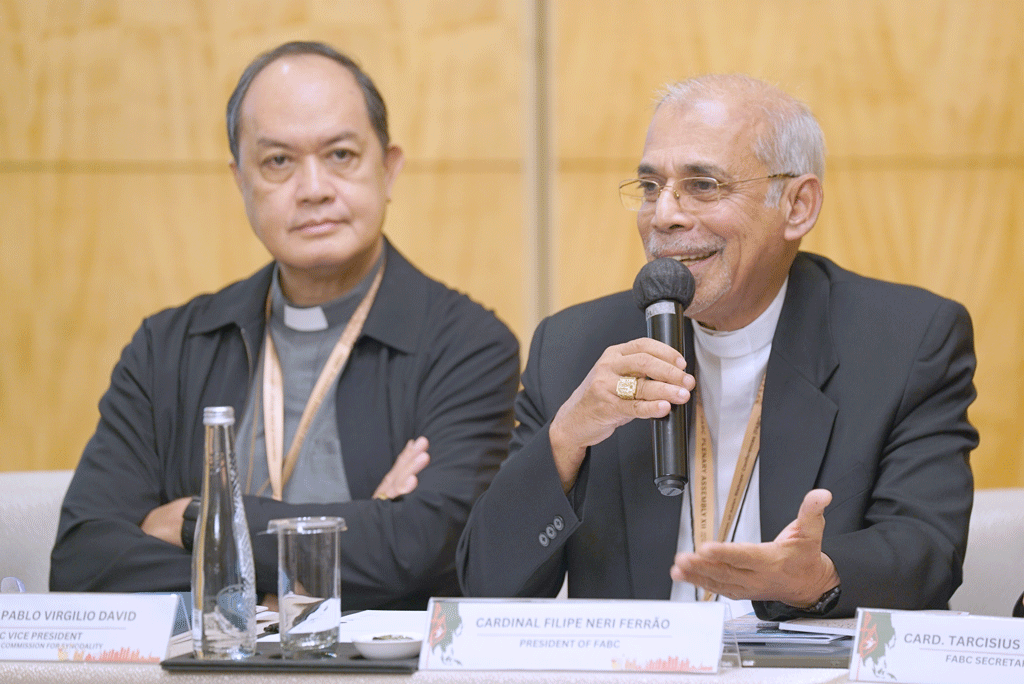
The plenary assembly is slated to run through July 26 and brings together more than 120 cardinals and bishops representing 22 episcopal conferences and ecclesiastical jurisdictions across Asia.
The press conference panel comprised Bishop Maralit, chairperson of the Office of Social Communication; Pablo Virgilio Cardinal David, vice president and chairperson of the Commission of the Synod; Felipe Neri Cardinal Ferrao, president; Isao Cardinal Kikuchi, secretary general; Bishop Adrianus Sunarko, general secretary of the Bishops Conference of Indonesia. The panel was moderated by Father Thomas Ulun Ismoyo.
Addressing journalists’ questions, Cardinal Ferrao acknowledged the challenges faced by Christians in parts of Asia, but insisted, “The Church in Asia believes in dialogue, collaboration, establishing relations of harmony, of peace, cutting across religions, cultures, peoples of Asia.” He added that the Church’s role is to be “not only bridge builder but bridge herself and promote peace, harmony, dialogue.”
On the subject of women’s leadership, Cardinal David described it as a foremost concern for the Synod on Synodality, noting the formation of a special study group to explore the issue and praising the “very dynamic” participation of women in local leadership. He observed that in many parts of the world there is a tendency to pursue “a very androcentric and patriarchal direction… [which] is not in keeping with the spirit of a missionary synodal Church.”
Cardinal David also highlighted the assembly’s inspiration from the Gospel of John, chapter 1, verses 35 to 51, “and in particular that line in John 1, verse 50, where Jesus said to Nathanael, ‘You will see greater things.’”
The cardinal said, “We dream of seeing greater things through synodal conversion—the call to be bridges and bridge builders.” He described the assembly’s fourfold dialogue: with religions, with cultures, with the poor, and with creation, stressing the need for the Church to be an instrument of hope, service, and communion.
We observe is that there is a tendency on the part of our people to compartmentalise… There is a huge gap between the practice of the faith and our action in society
Cardinal David
On social justice and climate change, Cardinal David declared, “We can no longer close our eyes to the climate crisis,” while Cardinal Neri called it “not only an ecological crisis, but a moral crisis, [an] ethical crisis.”
The bishops described concrete initiatives for climate justice and urged the Church to address not only charity, but also the root causes of poverty and inequality, pointing to the “huge gap between the practice of the faith and our action in society.”
Questions about clericalism and corruption prompted frank admissions. “First we have to recognise it as a problem, Cardinal David remarked adding, “Co-responsibility will demand that we now learn to work together. It’s not one sector lording it over another. We’re not higher Christians just because we are ordained,” recalling that Catholics have an equality and dignity rooted in baptism.
He also acknowledged that in some Catholic-majority areas, “corruption is high. Likewise, the poverty level is also high. That remains as a big challenge to all of us.”
The cardinal added, “We observe is that there is a tendency on the part of our people to compartmentalise… There is a huge gap between the practice of the faith and our action in society.”
In closing, Cardinal Neri thanked journalists for their role as digital missionaries and collaborators in spreading the gospel, emphasising, “Interreligious dialogue and harmony is not an option in Asia, it’s an imperative.”
The Church leaders promised to listen, discern, and seek new ways to embody the gospel in Asia’s complex and diverse societies.