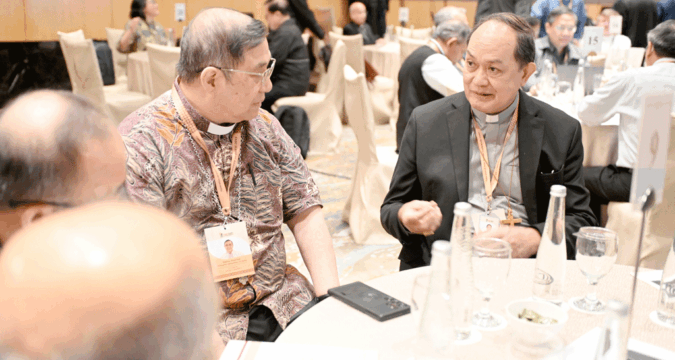
JAKARTA (SE): The theme of the Federation of Asian Bishops’ Conferences (FABC) 12th Plenary Assembly, held from July 20–26, “You will see greater things”, was described by Pablo Virgilio Cardinal David of the Philippines as “a big source of inspiration for all the bishops” during the assembly’s final press conference on July 26.
“We tried to articulate for ourselves what ‘greater things’ the Lord is making us dream for the local Churches in Asia,” said the vice president of the FABC and head of the commission for Synodality, following an interfaith visit through the Tunnel of Friendship between the Assumption Cathedral and the Istiqlal Mosque in Jakarta [see page 12].
Cardinal David was joined on the press panel by Father Clarence Devadass, associate secretary of the FABC and executive secretary of the Office of Synodality; Bishop Anthony Subianto Bunjamin of Bandung, head of the Indonesian Bishops’ Conference; and Father Thomas Ulun Ismoyo, who served as moderator.
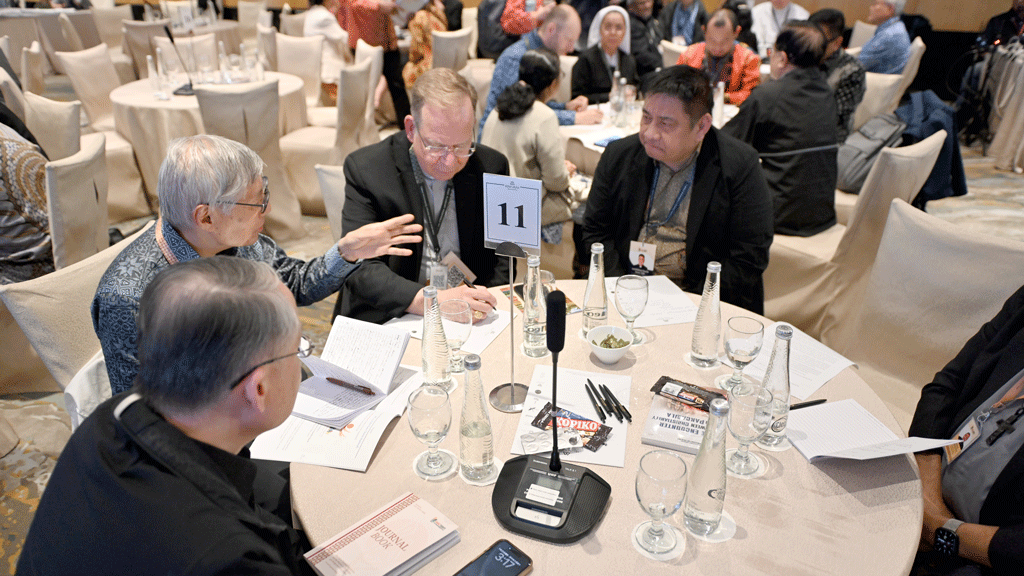
The cardinal noted that in the call to synodal conversion, “synodality isn’t just about a method, it’s about a spirituality, it’s about a lifestyle, it’s a way of being Church”, stressing that it is essential to discipleship. He explained that it is “also conversion of processes, of relationships, and of structures within the Church. But all of this has to lead to mission. That’s why the call to conversion is a call to the mission of being bridges and bridge builders”, as symbolised by the Tunnel of Friendship between the Assumption Cathedral and the Istiqlal Mosque.
“I was so inspired by that encounter with the Grand Imam of Jakarta, of the Istiqlal Mosque, and I will—we will—take that home with us, Cardinal David said. “Yes, we are brothers and sisters. We share a common humanity. So the mission isn’t just about promoting a religion; the mission is promoting a common humanity, common dignity, that we promote a civilisation of love.”
Bishop Bunjamin added, “We just heard from the Grand Imam today in the hall that for him, we do not talk anymore about tolerance. We change into unity. It is synodal conversion we are talking about.”
Father Devadass remarked, “We leave this assembly with renewed hope and confidence … to see greater things by walking together as one Church in Asia.” He added, “This assembly has been a success … measured not simply by the quality of our discussions or the documents that we are going to produce, but by the renewed spirit of communion, trust, and shared mission that has grown among us… Bishops from across the diverse cultures and realities of Asia have listened deeply to one another, prayed together, discerned together, [and] strengthened their commitment to walk together as a Synodal Missionary Church.”
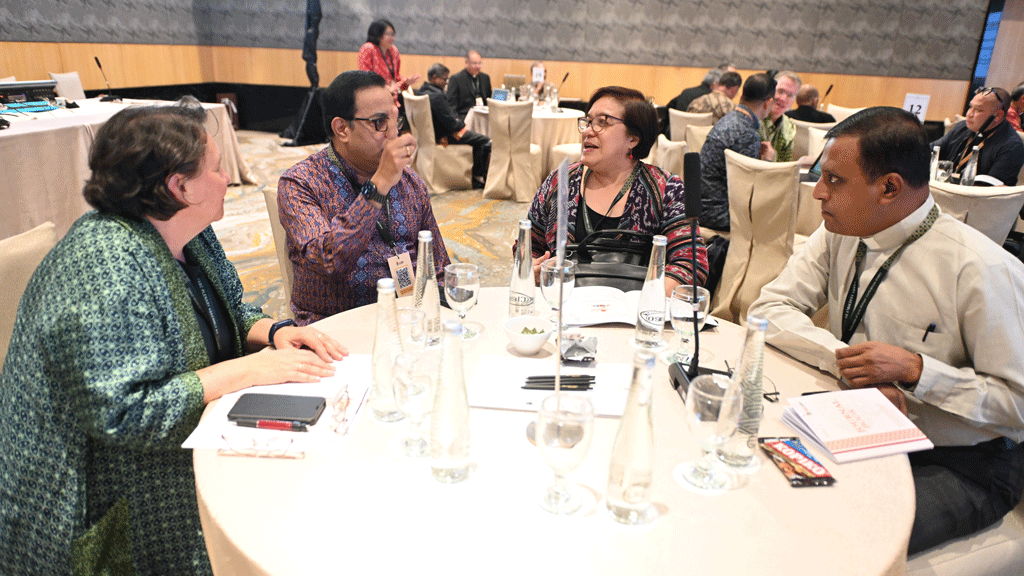
Cardinal David observed that the plenary “became an occasion for us to truly open the door for a rich exchange of gifts. So I am really very happy about this encounter. It’s one of a kind, and I think the first time that we really took seriously the invitation to exchange gifts together as local Churches within Asia.”
Regarding the way forward, it was noted that synodal conversion is ongoing, fostering servant leadership, shared discernment, renewed structures, and greater participation of the laity in the life and mission of the Church.
Father Devadass noted that the final statement had been approved and disseminated, and that a framework for a vademecum [guide] had been developed, but was considered a work in progress. He said that a committee—which will be meeting online from August 24—had been formed to work on the document and was targeting October for a first draft, to be reviewed by the different bishops’ conferences across Asia for feedback by November. A second draft is expected to be ready by January 2027, with final approval by the FABC Central Committee by February 2027.
Concerning the laity and women, the need for greater participation of laypeople in Church life was emphasised, especially as vocations decline. Father Devadass noted, “The necessity of the lay participation in the life of the Church… the Church has to depend on laypeople to help us move forward.”
The critical leadership of women was also noted, with Cardinal David pointing to the inspiration of Mary Magdalene and the first women leaders in the Christian community. Cardinal David said, “Mary Magdalene was chosen by the Lord personally to be an Apostle to the Apostles… Our Master is Jesus, who chose and treated women very seriously in the early Christian movement.”
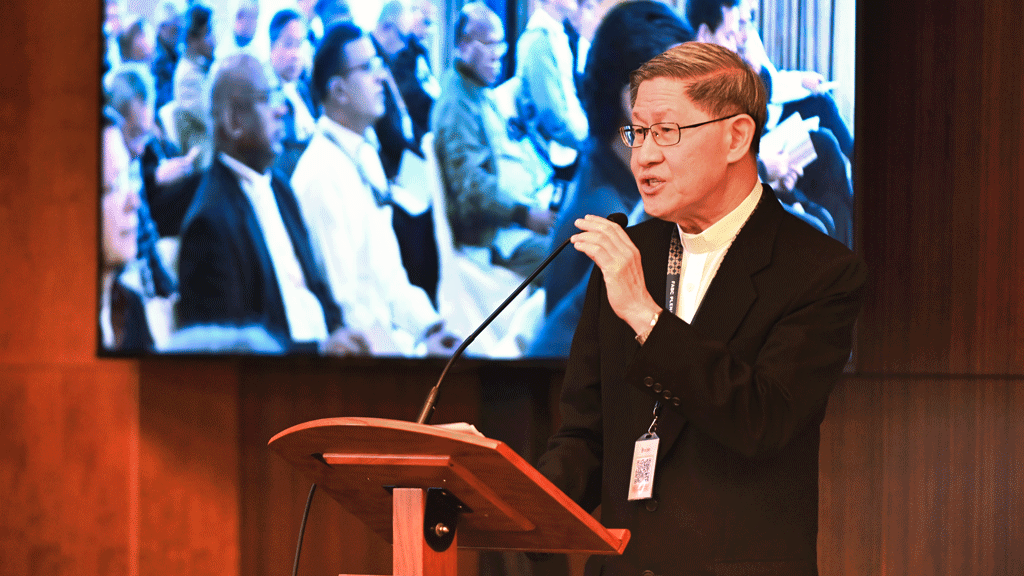
Young people were also a focus, given the rapid changes brought about by AI and social media. Cardinal David observed, “Our young people have to be accompanied… our young people must also accompany us in navigating our way through these developments in our society.”
During the previous day’s Regional Table Conversations, delegates—grouped into Southeast Asia, South Asia, and Central and East Asia—highlighted the increasing participation of laypeople in the Church and envisioned a more collaborative model, in which women, young people, families, and lay leaders played a fuller role in discernment and pastoral life.
Education and interreligious dialogue likewise emerged as enduring strengths that continue to foster peace and human development across the continent.
On artificial intelligence, the assembly recognised both its opportunities and risks. Cardinal David remarked on July 26, “I do not think we can ever replace natural human talent.” He noted, “We know there are no moral guardrails yet about the use of artificial intelligence. It can be used for the best, it can be used for the worst … And that’s where our young people have to be accompanied.”
It is my hope that the bonds of communion within and between the local Churches will be strengthened and become an ever greater sign of God’s presence in your various countries, which in turn will help you be bridge builders together throughout Asia
Pope Leo XIV
The cardinal noted that Pope Leo XIV, in Magnificat Humanitas, said that the focus should be on human dignity, not technology. “People forget that artificial intelligence is also human intelligence. It is a product of human intelligence, so we need not be threatened by it. We just have to learn how to use it properly,” the cardinal said.
“We just need how to use it more intelligently. We’re more intelligent than the machine. Let us not allow AI to make us dumb.,” he said.
“We acknowledge there is much work still lies ahead of us, but we leave Jakarta encouraged, united, and inspired,” Father Devadass said. “The conversations begun here will certainly continue in our local Churches, our regions, and throughout Asia. And we are also confident that the seeds planted during these days will bear fruit, fruits of conversion of hearts, minds, and also leading towards our mission.”
The previous day, on July 25, Pope Leo spoke via video message, expressing his spiritual closeness and noting that “as his disciples today, we know that Jesus is not only the source of our communion with God, but also with one another,” which finds its source in the Eucharist.
“It is my hope that the bonds of communion within and between the local Churches will be strengthened and become an ever greater sign of God’s presence in your various countries, which in turn will help you be bridge builders together throughout Asia,” the pope said.
The closing Mass of the week-long assembly was presided over by Ignatius Cardinal Suharyo, archbishop of Jakarta, and concelebrated by Bishop Bunjamin, Filipe Neri Cardinal Ferrão, president of the FABC, and bishops and priests from across the continent.
Cardinal Ferrão called on the Church to build bridges between generations by bringing together the wisdom of the elderly and the creativity of young people.