
HONG KONG (SE): As summer temperatures soared across Hong Kong, reaching 39.8°C in Sheung Shui on the afternoon of August 9, outdoor workers faced extreme conditions with minimal systemic protection. Despite these record temperatures, the government’s Heat Stress at Work Warning system remained on its lowest “amber” setting. The lack of higher alerts sparked criticism from former Hong Kong Observatory director, Lam Chiu-ying, and labour advocates, prompting a government review of the framework to better protect outdoor employees.
Samuel Wong Kit-yip, policy research officer at the Hong Kong Catholic Commission for Labour Affairs, pointed out that the problem lies in how heat stress is calculated and monitored. Wong highlighted that the current heat index originally relied on a single measurement point in King’s Park. Although monitoring has since expanded to nine regional stations, four must simultaneously reach threshold levels to trigger higher warnings. As a result, regional spikes—such as the red-level heat recorded at Wetland Park—failed to elevate the overall warning, leaving workers in localised hot spots exposed.
Wong said the Hong Kong Heat Index relies on a mathematical formula that heavily overweights humidity—assigning it an 80 per cent ratio—while drastically underestimating direct solar radiation. Wong questioned why Hong Kong uses a self-developed index that offers less protection to its most vulnerable outdoor workers.
Why a paper shield
Wong is also concerned that the Guidance Notes on Prevention of Heat Stress at Work, introduced in 2023, suffer from structural flaws that render their protections virtually useless on the ground. Even when a yellow warning is triggered, systemic loopholes allow employers to easily bypass mandatory rest breaks.
Under the guidelines, a medium-labour worker such as a street cleaner should receive a 15-minute break every hour. However, the system permits employers to offset this rest time if cooling devices are provided.
“Employers provide small portable fans and immediately deduct the worker’s rest time,” Wong explained. “In extreme heat, these tiny fans do nothing—they just blow hot air—yet the extra rest protection is completely erased.”
Furthermore, Wong emphasised that workload intensity remains entirely at the employer’s discretion. Routine cleaning can instantly turn into heavy physical labour after a typhoon, yet contractors rarely adjust workload classifications or grant additional rest.
Employers provide small portable fans and immediately deduct the worker’s rest time. In extreme heat, these tiny fans do nothing—they just blow hot air—yet the extra rest protection is completely erased
Samuel Wong
Beyond the formula and the loopholes, Wong highlighted that contract rigidities have also blocked practical solutions. While heat-relief apparel such as fan-assisted jackets and cooling vests are widely available on the market, many outsourced government workers are strictly forbidden from wearing them.
Outsourced contractors fear heavy fines if extra garments cover official uniform features like reflective strips, prioritising strict adherence to tender terms over worker’s health.
“Even when government departments design their own cooling vests, they fail to update procurement tender rules for their contractors,” Wong noted.
When heatstroke does occur, Wong observed that frontline workers face an uphill battle for compensation. Occupational injuries currently require a distinct “accidental event”, allowing insurers and employers to attribute heat-induced medical crises to pre-existing personal health conditions rather than hazardous environmental conditions.
This leaves most workers to rely on personal coping strategies, such as rushing their tasks to finish early, which increases their risk of heatstroke
Wong added that supervisors find it hard to manage the rest period of dozens of dispersed labourers. This leaves most workers to rely on personal coping strategies, such as rushing their tasks to finish early, which increases their risk of heatstroke. In remote areas near hillsides, a lack of sanitation facilities leads workers to restrict their water intake, directly impairing their body’s ability to dissipate heat.
Addressing structural shortcomings
Wong argued that effective heat prevention requires legislative reforms, technological integration, and community support. He recommends formally recognising heatstroke as an occupational disease under safety regulations, updating government tender requirements to explicitly permit certified cooling apparel, and modernising heat measurements with site-specific data or wearable devices such as smartwatches to track microclimates and vital signs in real time. Additionally, he urged the government to coordinate with contractors to establish more public drinking points and rest facilities.
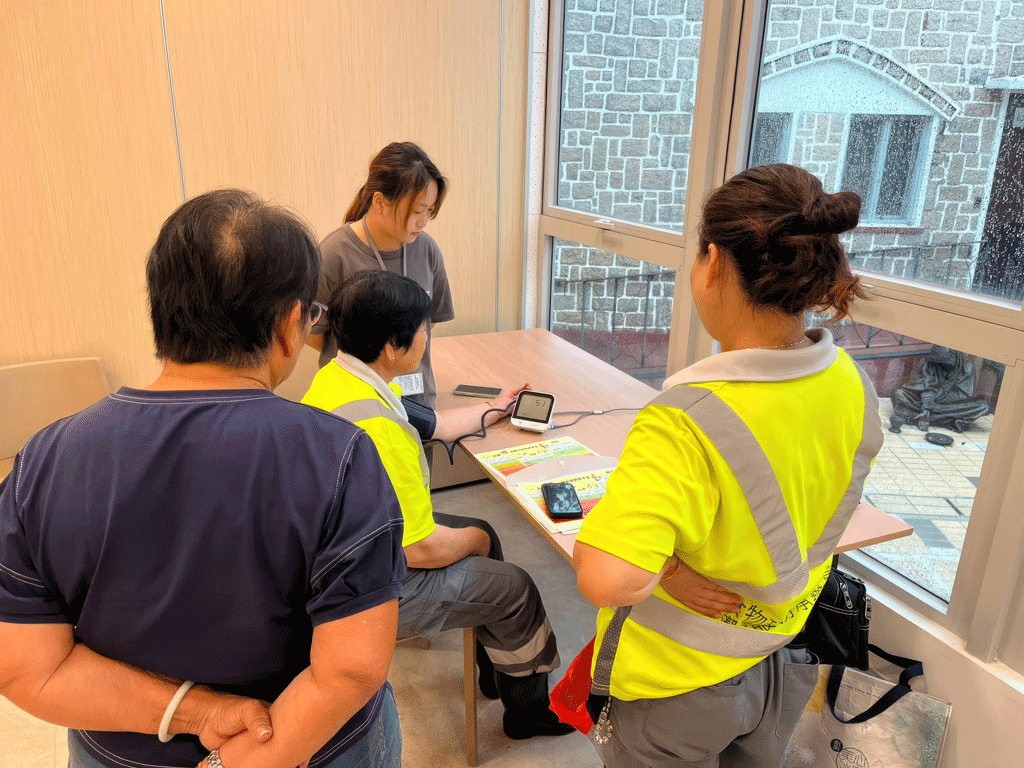
In the meantime, the commission has set up rest stations to offer shaded shelter, water, and relief to outdoor workers. While St. Jerome’s Church in Tin Shui Wai hosted an outreach event on August 14, other parishes or church organisations operate regularly across key districts. These include the Central rest station on the 17th floor of the Grand Building every Friday afternoon from noon to 2:30pm, St. Andrew’s Church in Tseung Kwan O every Thursday from 10:00am to noon, and St. Joseph’s Parish in Fanling on the first and third Fridays of each month from 3:00pm to 5:00pm.
As data over the past decade show a doubling in the number of extremely hot days, the commission emphasised that addressing extreme weather is both an immediate duty of care towards vulnerable workers and a vital social responsibility in adapting to climate change.