By Gabriel Abdi Susanto
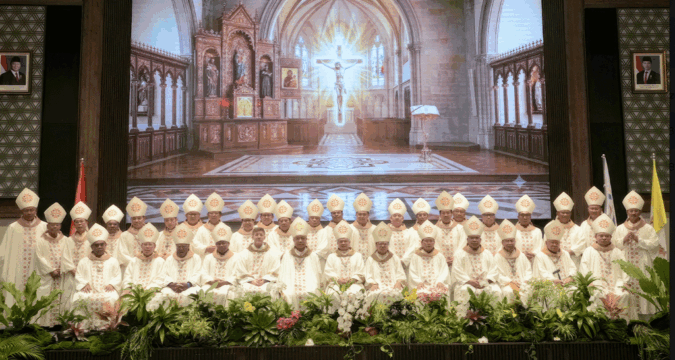
JAKARTA (SE): The Catholic Bishops’ Conference of Indonesia (KWI), in its 2026 Pastoral Note, dated July 31 and issued on August 17, urged the Church and society to unite in addressing Indonesia’s multidimensional crises.
The document,“A Path of Hope amid the Nation’s Dynamics: The Church Walking Together to Protect Public Civility and Strengthen Human Solidarity in Indonesia,” responds to the conclusions of the 5th National Socio-Pastoral Assembly [SAGKI V] held in Jakarta in November 2025.
The note aims to turn the assembly’s conclusions into pastoral action.
The document is structured around three major sections: thanksgiving for God’s work in the life of the nation and the Church; an examination of the multidimensional crises facing Indonesia; and the pastoral response of the Catholic Church, centred on journeying together as a nation, nurturing public civility, and strengthening human solidarity.
From the altar to the heart of society
The bishops expressed gratitude for Indonesia’s 81 years of independence and enduring societal values like cooperation, solidarity, dialogue, and community resilience. They also gave thanks for the Catholic Church’s long history in Indonesia, looking ahead to its 500th anniversary in 2034.
The bishops expressed gratitude for Indonesia’s 81 years of independence and enduring societal values like cooperation, solidarity, dialogue, and community resilience
From the beginning, the Church in Indonesia carried out its mission particularly through education, healthcare and social services. These included schools, universities, boarding houses, clinics, hospitals, social institutions, cooperatives, credit unions, farmers’ and fishermen’s groups, as well as assistance for migrant workers, women and children and community empowerment initiatives.
These efforts show that faith extends beyond worship into daily life and public advocacy, including ecological protection, safeguarding indigenous communities, combating human trafficking, conflict resolution, and peacebuilding.
Bishops warn of a multidimensional crisis
However, the bishops said that the Church must acknowledge the challenges that remain.
The Pastoral Note identified poverty, social and gender inequality, corruption, ecological disasters, social conflicts, violence in Papua, human rights violations, declining democratic quality and various forms of neglect and deprivation affecting vulnerable groups as major concerns facing the country.
They observed that Indonesia faces a multidimensional crisis affecting social life, technology, the economy, ecology, politics and the nation’s moral foundations.
They observed that Indonesia faces a multidimensional crisis affecting social life, technology, the economy, ecology, politics and the nation’s moral foundation
The crisis is reflected in fragile public ethics, the negative effects of digital disruption, a crisis of conscience, weakened leadership, gender inequality, and policies that may marginalise vulnerable groups, including women, persons with disabilities, children, and indigenous communities.
In the economic sphere, the bishops point to widening inequality, poverty and the exploitation of informal workers who often lack adequate social protection.
Ecologically, the weakening capacity of the environment, deforestation, agrarian conflicts and climate change are contributing to what the document describes as an acute ecological crisis.
It also speaks of a “moral fatigue” affecting the nation.
Pragmatism, secularism, and religious exclusivism, it says, can erode the noble values of Pancasila and undermine public civility.
The bishops further linked these challenges to a crisis of leadership and declining democratic quality. When politics is understood merely as procedures and numbers, without a moral foundation, public policies risk becoming disconnected from the needs and daily realities of ordinary people.
Ecologically, the weakening capacity of the environment, deforestation, agrarian conflicts and climate change are contributing to what the document describes as an acute ecological crisis
Church urged to embrace a prophetic mission
In response, the KWI called for a holistic and integrated approach to address the multidimensional crisis involving the government, civil society, academia, the media, religious institutions and other stakeholders, including the Church.
The Pastoral Note outlined four major directions for the Church.
Firstly, a reorientation of the Church’s mission, with renewed emphasis on its prophetic commitment to justice and human rights.
Secondly, social and technological advocacy, including the development of social safety nets and stronger safeguarding mechanisms for vulnerable groups.
The bishops also pointed to the establishment of the Papua Secretariat as a concrete step in responding to the humanitarian situation in Papua.
In the digital sphere, the Church is called to become a “field hospital” by providing critical digital literacy and helping create a safe digital ecosystem.
In the economic sphere, the bishops point to widening inequality, poverty and the exploitation of informal workers who often lack adequate social protection
Thirdly is economic self-reliance and ecological conversion.
The Church was encouraged to empower communities, strengthen public policy advocacy against injustice and begin ecological conversion from within. The note also called for resistance to the exploitation of nature, greater solidarity in disaster mitigation and support for the transition to renewable energy.
Fourth is political and character education.
The Church is called to encourage ethical, non-partisan political education and the formation of young leaders.
The KWI also called for the establishment of expert groups or think tanks to monitor and engage with public policy. At the same time, the family is reaffirmed as the first school of faith, supported by character formation rooted in Pancasila and stronger encounters across religious boundaries.
Church to be a critical partner of government
The bishops reiterated that God is present in the struggles and hopes of the world. The Church must nurture hope, justice, and a culture of peace.
To fulfil this mission, the Church cannot walk alone. The KWI called for cooperation with all people of goodwill while emphasising the Church’s role as a critical partner of the government.
The bishops reiterated that God is present in the struggles and hopes of the world. The Church must nurture hope, justice, and a culture of peace
The KWI encouraged Catholic communities across Indonesia to ensure that Christian values do not remain merely theological principles or pastoral documents, but become relevant and visible responses to the challenges facing the nation.
The Pastoral Note concluded with a call to continue walking together with hope and creative courage amid the changing dynamics of Indonesia, for the sake of the common good.
It was signed by the praesidium of the Catholic Bishops’ Conference of Indonesia: president Bishop Antonius Subianto Bunjamin, and secretary general Bishop Adrianus Sunarko.