By Father Paul Kam Po-wai
Since the 12th century, the Catholic Church has developed three major pilgrimage destinations: Rome, Jerusalem, and Santiago. For Catholics in Hong Kong, visiting Rome and Jerusalem on pilgrimage is common knowledge, but going to Santiago seems far less known. Known in Spanish as the “Camino de Santiago”, it is the Camino of St James. History traces its roots back to the 9th century, with tradition holding that the apostle St. James is buried there.
It is primarily a walking pilgrimage with several routes, including the French Way [Camino Francés, 800 km in total], the Portuguese Way [Camino Portugués, 616 km], and the Northern Way [Camino del Norte, 825 km].
This summer, I had the privilege of joining a St James’s Way pilgrimage organised by the Diocesan Youth Commission, led by Father Tito Martin. Six young people took part. Starting in Porto, Portugal, we walked to Santiago, Spain—a total of 280 km completed over 12 days.
I am deeply grateful to Father Tito for giving us a daily word for meditation. Combined with praying the Divine Office, daily Mass, and sharing sessions, the journey was enriched immensely.
What struck me most about this pilgrimage was “praying with one’s feet”. Walking an average of over 20 km a day took us through many places: along the coastline, up and down hills, through cities and villages, and into countless churches large and small. I witnessed God’s beautiful creation, endured bright sun and rain, met fellow pilgrims from all over the world, and suffered blisters, bedbug bites, swollen legs, and aching feet. Through it all, I found myself in a constant encounter with myself, with others, and with the Lord. I discovered my true self, discovered life, and discovered God.
Because of the vast distance, carrying a heavy rucksack was impractical, yet we needed sufficient supplies. When deciding what to let go of, I realised that what truly matters—and what needs to be released—is not inside a rucksack, but inside the human heart. This brought home the reality that a pilgrimage is about “denying oneself, taking up one’s cross, and following Jesus” [cf. Matthew 16:24]. It is a daily journey towards the Lord.
As this path was unfamiliar to everyone, every day, every stage, and every stretch was brand new and unknown—even with Google Maps. Equally, every day brought fresh discoveries. Finding the way, getting lost, taking a wrong turn, or walking a long way round are all part of life’s path. A path is forged by walking it, and you must walk it yourself; others may walk alongside you, but no one can physically step forward in your shoes. You simply have to keep going.
As I pressed on towards the destination [Santiago], I realised that I myself was the destination: the place I needed to reach was where I would meet the Lord. The phrase “The Way is the Goal” left a lasting impression on me. It can mean “the journey is the destination”, but I reflected that “Jesus is the destination”, for Jesus is “the way, the truth, and the life.” Walking a pilgrimage is walking towards Jesus, following Jesus, and walking alongside him.
I gained so much from this Way of St James, yet a pilgrimage cannot truly be explained in words—it must be experienced firsthand.
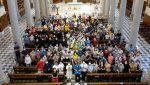
At our final stop, Santiago Cathedral, we attended the Sunday Mass for pilgrims. I was fortunate enough to concelebrate and even recite two paragraphs of the Eucharistic Prayer in Cantonese—a truly perfect ending to this pilgrimage.