CHHATTISGARH (SE): History shows that religious leaders have often become targets when governments and powerful forces fear the moral voice of faith. They may project strength, but persecution reveals insecurity. Herod feared a child; today, those who restrict the religious freedom of Christians and other minorities show fear of the values that Child brought into the world: truth, dignity, justice, and freedom.
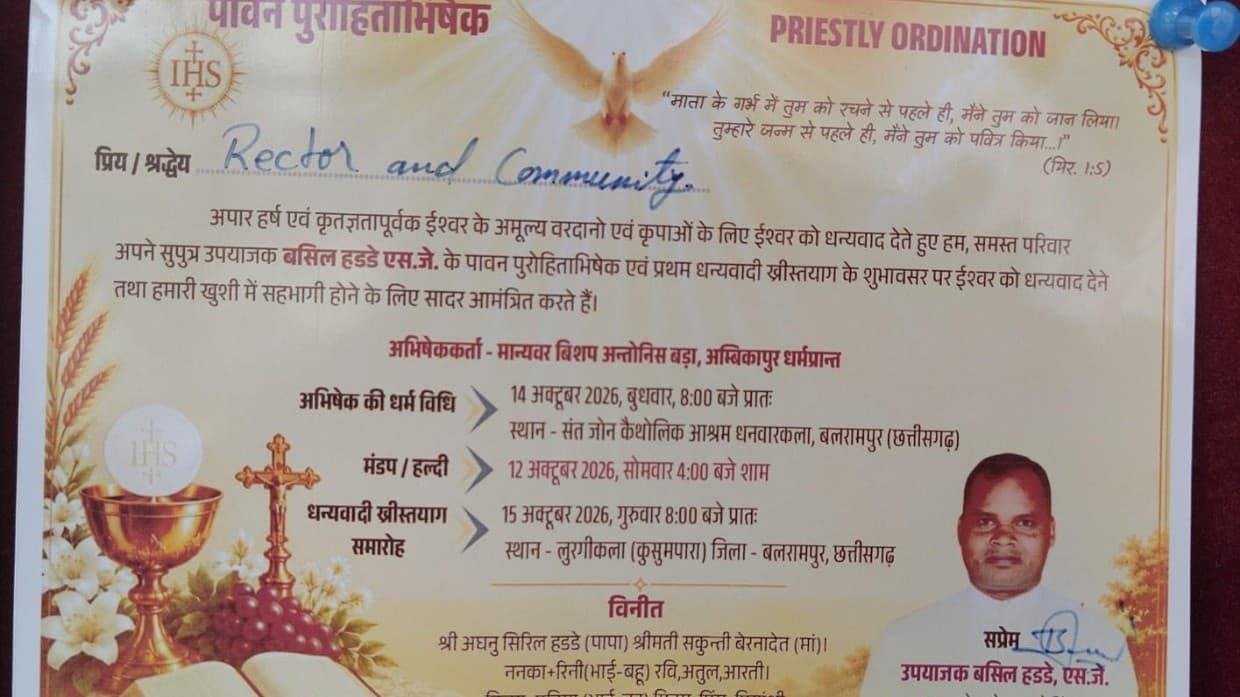
A troubling example has emerged from Chhattisgarh, India. The ordination of Deacon Basil Hade, a member of the tribal community and of the Society of Jesus, was reportedly stopped by local authorities. Although he presented his baptism certificate from 1995, officials demanded proof of a government permission that was not required at that time. His ordination had to be postponed, and he was moved to safety amid threats of possible unrest.
The postponement of Deacon Hadde’s ordination is not an internal Church concern alone, it raises a grave question about religious liberty and constitutional equality. Reports state that officials demanded documents concerning a 1995 conversion, even though the family’s baptism predated the state’s anti-conversion law.
Herod feared a child; today, those who restrict the religious freedom of Christians and other minorities show fear of the values that Child brought into the world: truth, dignity, justice, and freedom
Church leadership must respond with courage, unity, lawful action, and pastoral calm. Article 25 of India’s Constitution affirms freedom of conscience and the right to profess, practise, and propagate religion, subject to public order, morality, and health.
This is not merely an issue for Christians. It is a warning for every Indian who believes in the Constitution. Article 25 protects every person’s freedom of conscience and the right to profess, practise, and propagate religion. When citizens are asked to produce impossible documents, when worshippers are intimidated, and when minorities are treated as suspects, constitutional liberty is being weakened for everyone.
The pattern is deeply alarming: restrictions on religious conversion, attacks on places of worship, denial of burial rights, hate-filled speech, and administrative pressure placed upon minority communities. Such actions do not make a nation stronger. They poison society with suspicion and divide neighbours who should stand together as fellow citizens.
The ordination of Deacon Basil Hade, a member of the tribal community and of the Society of Jesus, was reportedly stopped by local authorities. Although he presented his baptism certificate from 1995, officials demanded proof of a government permission that was not required at that time
Silence is not neutrality when rights are being taken away. Christians, Hindus, Muslims, Sikhs, Buddhists, atheists, and all people of goodwill must stand together—not against one another, but for India’s constitutional promise: dignity, equality, religious freedom, democracy, and secular citizenship.
Let us respond without hatred, but also without fear. Let us speak truthfully, act peacefully, defend the vulnerable, support lawful action, and refuse to normalize injustice. When the freedom of one community is threatened, the freedom of every community is at risk.
India belongs to all its people. Its Constitution must not become a promise on paper while fear governs daily life. Religious freedom is not a privilege granted by the powerful. It is a constitutional right belonging to every person.