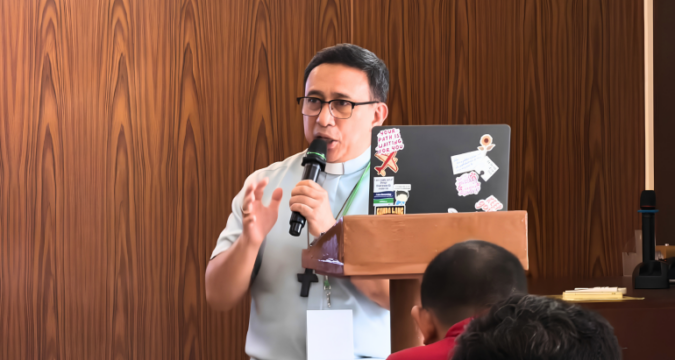
MACAU (RVA News): “The fundamental challenge of AI is not technological, but anthropological,” Bishop Marcelino Antonio “Junie” Maralit Jr. of the Diocese of San Pablo, Philippines, said, quoting Pope Leo XIV, during the FABC-OSC Assembly in Macau on October 29.
The chairperson of the FABC Office of Social Communication added, “God did not save us by sending information. He sent a Person with a face, a voice, and hands that touched the sick and broke bread.”
Delivering his address, “The Face Behind the Screen,” in the conference hall of St. Jose Villa in Macau, Bishop Maralit reminded Catholic communicators that true evangelisation requires authentic human presence rather than digital simulation.
Laying out a comprehensive pastoral vision, Bishop Maralit highlighted the sheer scale of Asia’s digital reality. While two-thirds of the world’s six billion Internet users live in Asia, the continent also hosts the world’s largest offline populations, creating a stark digital divide. With Catholics comprising just 11 per cent of Asia’s population, he noted that millions will first encounter the Church on a digital screen rather than inside a physical building.
The fundamental challenge of AI is not technological, but anthropological
Bishop Marcelino Antonio “Junie” Maralit Jr
“In Asia, the digital world is no longer a side room of our mission; it is the main square, the Areopagus of our time,” the bishop said, noting that Asia is leading global AI adoption.
However, he warned against severe digital “wounds” affecting Asian societies, including human trafficking in cyber-scam compounds, online child exploitation, state surveillance, deepfakes, and the loss of interior prayer life. He also cautioned clergy against “pastoral shortcuts,” explicitly urging ministers never to pass off AI-generated homilies as their own or hand over spiritual care to algorithms.
Outlining pastoral guidelines for Asian bishops’ conferences, Bishop Maralit urged leaders to prioritise transparency, data privacy, and the formation of Asian seminarians, who represent nearly 29 per cent of the world’s total. He also called for digital solidarity with marginalised data workers and interreligious partnerships to combat digital abuse.
“Behind every screen in Asia, there is a face,” Bishop Maralit concluded. “Machines can carry words across Asia faster than ever, but only persons can carry presence, and only a community can offer the Bread of Life.”
Bishop Maralit highlighted the sheer scale of Asia’s digital reality. While two-thirds of the world’s six billion Internet users live in Asia, the continent also hosts the world’s largest offline populations, creating a stark digital divide
The October 27–31 regional assembly brought together Asian bishops, priests, religious, and lay media leaders under the theme, “Magnifica Humanitas and the Synodal Ways of Evangelisation in Asia: Communicating Christ in the Age of Artificial Intelligence.”
The gathering coincided with historic preparations for the 450th anniversary of the Diocese of Macau, the oldest diocese in the Far East and an enduring bridge for Gospel proclamation in Asia.
Related posts:

Edgy locals patrol streets in wake of devastating refugee camp blaze

Interreligious prayer initiative on May 14 for end to Covid-19

MercyHK to open new drug treatment centre in Sha Tau Kok