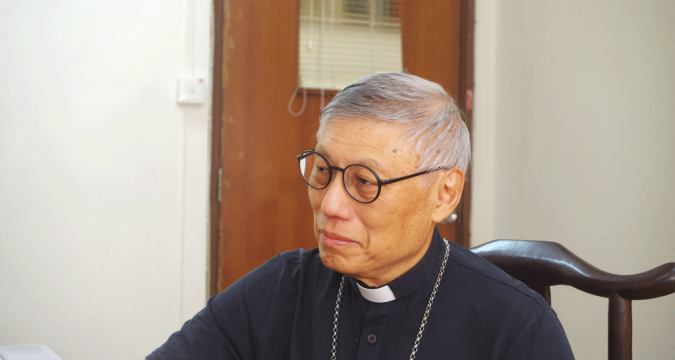
HONG KONG (SE): “Interculturality is actually the encountering of two cultures,” Cardinal Stephen Chow S.J. observed in a November 9 interview with the Sunday Examiner and the Kung Kao Po, Hong Kong’s English- and Chinese-language Catholic newspapers. “There must be some kind of impact when we have dialogue, true encountering dialogue, that you and I will be changed.”
Cardinal Stephen was speaking following his presentation at a November 6 symposium at the Pontifical Urbaniana University in Rome on “The Face of the Universal Church in China: 100 Years Since the Consecration of the First Chinese Bishops,” to mark the centenary of the historic event of 1926, advocated by Pope Pius XI [see page 12].
The cardinal put forward the option of “interculturality” as a bridge, saying, “Interculturality is actually the encountering of two cultures… there must be some kind of impact when we have dialogue, true encountering dialogue, that you and I will be changed.”
In the ongoing dialogue between the Vatican and China, Cardinal Stephen points out that the process must be one of mutual encounter, not a clash or simple adaptation.
When I talk to my friends in the Mainland, I can share honestly, and they come back to me honestly, their situation, that I can understand, and they understand me
He said that everyone involved in the Sino-Vatican dialogue is in a process of learning, becoming aware of our own blind spots, biases, limitations, misunderstandings, needs and possibilities, etc.
“We’re learning, we’re all learning on having the intercultural part,” he acknowledged. Describing his own experience, he shared, “When I talk to my friends in the Mainland, I can share honestly, and they come back to me honestly, their situation, that I can understand, and they understand me.”
He added that the process requires commitment on the part of all concerned, noting that the real bridge in the relationship is built by discerning and responding to the genuine needs of both parties. The goal, he explained, is “to find out the needs of both sides… we come to understand each other’s needs and concerns, and we try to work from there.”
Cardinal Stephen noted a parallel between interculturality and synodality. “This interculturality bears great resemblance to synodality. It’s always about really genuine talking and then really deep, in-depth, respectful listening with empathy.” In current Vatican-China processes, such as agreements on episcopal ordinations, Cardinal Stephen maintains, “all parties need to learn.”
This interculturality bears great resemblance to synodality. It’s always about really genuine talking and then really deep, in-depth, respectful listening with empathy
Highlighting the examples of Venerable Matteo Ricci and Paul Xu Guangqi, the cardinal said, “Ricci wasn’t there just to evangelise China, but also… he changed himself,” while “Xu Guangqi certainly changed a lot because of his encounter with Matteo Ricci.”
Cardinal Stephen said, “The real story is one of building bridges, understanding needs, and creating space for honest dialogue between cultures and values. All parties need to learn.”
Interculturality as encounter presents a hopeful path forward for Sino-Vatican relations—one rooted in mutual learning, contextual sensitivity, and the ongoing discernment of common ground for the common or greater good.