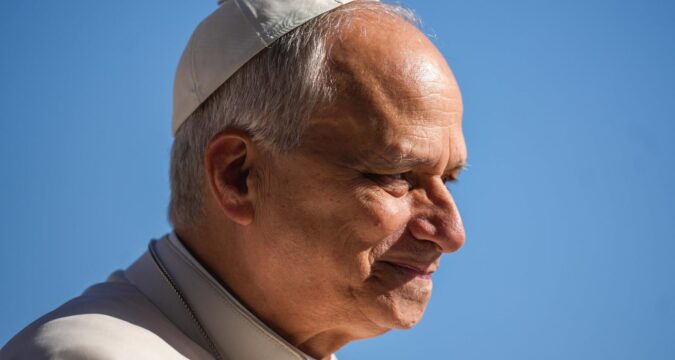
VATICAN (CNS): Marking one year since greeting the world from St. Peter’s Basilica with “May peace be with you all,” Pope Leo XIV has established himself as a pontiff focused on dialogue and peace amid global and ecclesial tensions.
Despite criticism—even from the US president, Donald Trump, who called him “weak” on crime—Pope Leo has been steadfast, making reconciliation and human dignity the pillars of his papacy.
On his first anniversary, the pope travelled to Pompeii to pray for peace, asking for an “overflowing outpouring of mercy” through Mary’s intercession.
Defined by Augustinian ideals of listening and communion, Leo’s first year has been marked less by confrontation and more by direct calls for justice, peace, and dignity.
Father Arthur Purcaro, a close friend, describes Pope Leo as “a man of prayer, a listener first and foremost,” whose leadership aims not to divide, but to unite. He notes the pope’s growth, saying, “he’s grown in the role of the ministry, which he has assumed.”
Pope Leo XIV has established himself as a pontiff focused on dialogue and peace amid global and ecclesial tensions
Unity has defined Pope Leo’s first year. Before his election, he warned, “The lack of unity is a wound that the Church suffers, a very painful one.” Cardinals saw him as someone who could continue Francis’s reforms, but in a more unifying manner.
After the Jubilee Year, the pope began shaping the Church with his vision, emphasising synodality—shared responsibility and discernment.
Pietro Cardinal Parolin, Vatican secretary of state, said, “Listening is an act of great ecclesial significance.” Theologian, Jaisy Joseph, called synodality “an antidote to the deep polarisations of our times.”
Pope Leo’s Augustinian identity means he leads as a source of unity, not as the protagonist, preferring dialogue over debate.
Despite ongoing debates over tradition and reform, Pope Leo is praised for listening to all sides. Father Purcaro said, “He’ll listen to somebody… and I hope you can also see the need that I’m trying to present to you on the other side of the coin.” Both progressive and traditionalist leaders have felt genuinely heard by the pope.
The pope’s global outlook comes from decades in the United States, Peru, and Rome. His missionary work in Peru and support for migrants reflect his commitment to justice and human dignity.
He’ll listen to somebody… and I hope you can also see the need that I’m trying to present to you on the other side of the coin
Father Purcaro
“Migration has always been an issue close to Pope Leo’s heart,” said Father Lydon. The pope has clarified that the Church’s priorities are justice, equality, and freedom—insisting, “there are much greater and more important issues… that would all take priority” over divisive debates.
On his 11-day tour of Algeria, Cameroon, Angola and Equatorial Guinea in April, Pope Leo delivered some of his strongest speeches yet, condemning war, corruption and exploitation.
At a peace gathering in Cameroon, he declared, “The masters of war pretend not to know that it takes only a moment to destroy, yet often a lifetime is not enough to rebuild.”
In Angola, he attacked economic systems that put profit above people, asking, “How much suffering, how many deaths, how many social and environmental disasters are brought about by this logic of extractivism!”
Despite calls for clear-cut directives, Pope Leo’s leadership is rooted in dialogue and nuance. Father Purcaro explains, “The process is the goal. It’s listening to one another, respecting one another, being aware that everybody has something to offer.”
He expects the pope to soon release a major social teaching document, following the tradition of Rerum Novarum. He concludes, “He’s slowly winning people over or challenging them to grow.”