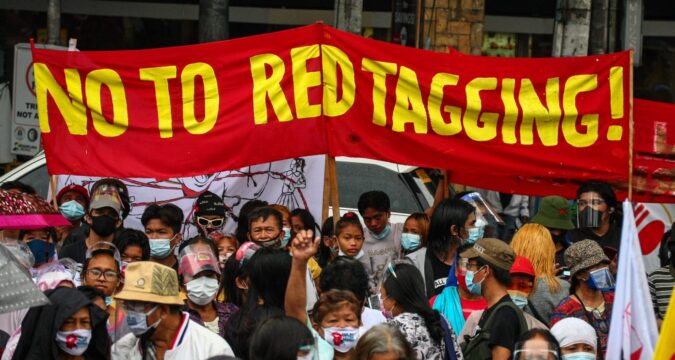
MANILA (LiCAS News): The Philippine Commission on Human Rights [CHR] has urged Congress to criminalise red-tagging [labelling as communist or terrorists without evidence or due process] after a national inquiry linked the practice to killings, enforced disappearances, and the shrinking of civic space in the country.
In a statement released alongside its National Inquiry on the Current Situation of Human Rights Defenders in the Philippines with a Focus on Incidents of Red-Tagging, the Commission said the practice continues to endanger journalists, church workers, Indigenous Peoples, labour organisers, lawyers, students, and other sectors engaged in advocacy and dissent.
“The CHR underscores that red-tagging is not a harmless label,” the commission said in its statement. “It creates a real and well-founded risk of harm. It exposes individuals to threats, harassment, and violence, and may serve as a precursor to grave human rights violations, including arbitrary detention, enforced disappearances, and extrajudicial killings.”
The inquiry documented recurring cases in which activists, journalists, religious workers, students, lawyers and humanitarian advocates were accused of links to communist insurgents or terrorist groups in the context of the government’s counterinsurgency and counterterrorism campaigns.
The CHR underscores that red-tagging is not a harmless label. It creates a real and well-founded risk of harm
The Philippine Commission on Human Rights
Among those identified as frequent targets were “religious leaders and Church workers engaged in social justice missions,” as well as “journalists and media practitioners,” particularly those whose reports were perceived as critical of government policies.
The commission said the campaign has contributed to fear, intimidation and restrictions on democratic participation.
“The inquiry further shows that red-tagging undermines the rights to life, liberty, security, expression, and association,” the CHR statement said. “It creates a chilling effect on dissent and weakens democratic participation.”
The report also noted that red-tagging has been disseminated through speeches, posters, streamers, radio programs, public forums, and social media platforms.
According to the inquiry, the practice “appears to incriminate an individual or a group for the mere holding of ‘leftist’ ideologies,” while associating them with armed insurgency or terrorism.
As we celebrate the 500 years of Christianity in the Philippines. The Chaplaincy to Filipino Migrants organises an on-line talk every Tuesday at 9.00pm. You can join us at:
https://www.Facebook.com/CFM-Gifted-to-give-101039001847033
Addressing red-tagging requires sustained, coordinated, and rights-based action across all branches of government, as well as meaningful participation from civil society and other stakeholders,
The Philippine Commission on Human Rights
The CHR said existing legal remedies remain inadequate because there is no specific law defining or penalising red-tagging as a distinct offence.
In response, it urged Congress to pass legislation criminalising red-tagging and to review existing counterterrorism laws, including the Anti-Terrorism Act [2020].
The inquiry also recommended that the Executive Department adopt “a comprehensive policy prohibiting the practice of red-tagging” and strengthen mechanisms for investigating violations against human rights defenders.
The commission further called on the judiciary to strengthen protective remedies such as the writs of amparo [remedy for the protection of constitutional rights] and habeas data [access, update, rectify, or delete personal data] and ensure faster resolution of cases involving human rights defenders.
“Addressing red-tagging requires sustained, coordinated, and rights-based action across all branches of government, as well as meaningful participation from civil society and other stakeholders,” the CHR said.
“Ultimately, upholding the dignity, safety, and freedom of human rights defenders is integral to strengthening democratic space and the rule of law.”
The inquiry concluded that ending red-tagging is essential to protecting civic freedoms and democratic participation in the Philippines.