(Vatican News and OSV News): Speaking to journalists outside his residence in Castel Gandolfo on the evening of May 26, Pope Leo XIV again called on the international community to assist the people of Gaza.
“We must renew our appeal for the respect of the human rights” of every person, Pope Leo said in response to a question about activists involved in the Gaza-bound Global Sumud Flotilla, following reports that some had been handcuffed and blindfolded on May 19 when Israeli forces intercepted them attempting to challenge Israel’s naval blockade of Gaza.
The flotilla is an international, grassroots maritime movement formed to break the 241 kilometre Israeli blockade of the Gaza Strip, in place since January 2009, and deliver what organisers say is urgently needed humanitarian aid. “Sumud” is Arabic for “steadfastness” or “resilience.” The Associated Press said the flotilla was carrying “a symbolic amount of humanitarian aid.”
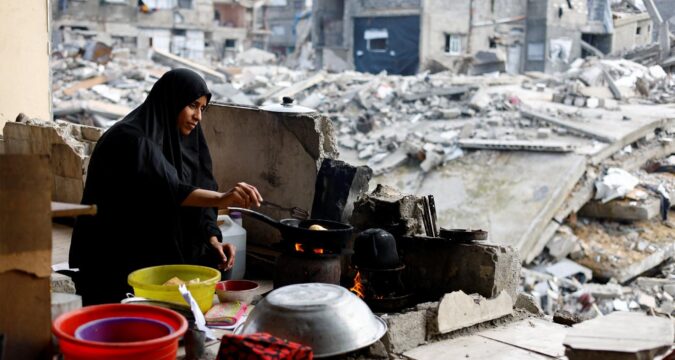
Pope Leo lamented the continued suffering of civilians in Gaza, noting that “unfortunately, the people of Gaza are still not receiving humanitarian aid.”
According to the UN Office for the Coordination of Humanitarian Affairs, “nearly all of Gaza’s current population of 2.1 million people has been displaced, lacking access to sufficient shelter, food, lifesaving medical services.”
We must renew our appeal for the respect of the human rights
Pope Leo XIV
The pope noted that this situation “is provoking protests,” like the flotilla.
“I would also like to renew this not only as an invitation, but truly as an appeal,” he continued, urging “all authorities to assist and accompany the people of Gaza, and to help begin reconstruction.”
“The people are truly suffering,” the pope said.
Commenting on the mistreatment of the flotilla activists, described by flotilla organisers as “unarmed civilians conducting peaceful, humanitarian missions,” Pope Leo warned of the danger of fuelling further hatred.
“We are provoking more and more hatred,” he said, adding that “violence does not help. From any side.”
AP reported both the activists’ claims that they were beaten and tasered by Israeli soldiers and a statement from a spokesperson for the Israeli Prison Service that the allegations were “false and entirely without factual basis.”
The pope stressed the need “to return to negotiations” and “seek, through dialogue, to resolve problems,” always “respecting the human rights of everyone.”
He also commented on the growing role of artificial intelligence in modern warfare, warning against technologies that distance decision-making from the value of human life
He also commented on the growing role of artificial intelligence in modern warfare, warning against technologies that distance decision-making from the value of human life.
In his encyclical, Magnifica Humanitas, released on May 25, Pope Leo called for “the most rigorous ethical constraints” on the use of AI in warfare, as weaponry itself evolves with deadly efficiency.
In Castel Gandolfo, referring to recent conflicts, including in Lebanon, the pope noted that today “war is being waged with AI, without thinking about human lives, [who] are truly victims of all this.” He renewed his appeal for peace and spoke of the need to pursue what he described as a “disarmed artificial intelligence.”
Addressing how the Vatican intends to continue engaging with major AI companies after the release of the encyclical, the pope said that dialogue is already in progress.
He described the ongoing collaboration between the Dicastery for Promoting Integral Human Development and the AI company Anthropic. “There was a kind of joint work,” he explained, “and the invitation was expressed yesterday by both sides.”
Pope Leo said he thinks it “is very important to continue the dialogue and truly seek a disarmed artificial intelligence.”
The launch of the document featured Anthropic co-founder Christopher Olah among the speakers, and the pope thanked him for his presence at the presentation and “accepting our invitation in turn in the name of the Church.”
In his remarks, Olah said, “Today is just the beginning, the start of a long collaboration between those of us who are building this and those who can see what we, from inside, cannot.”