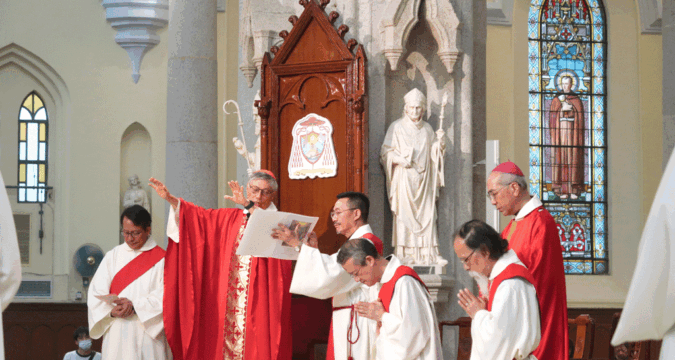
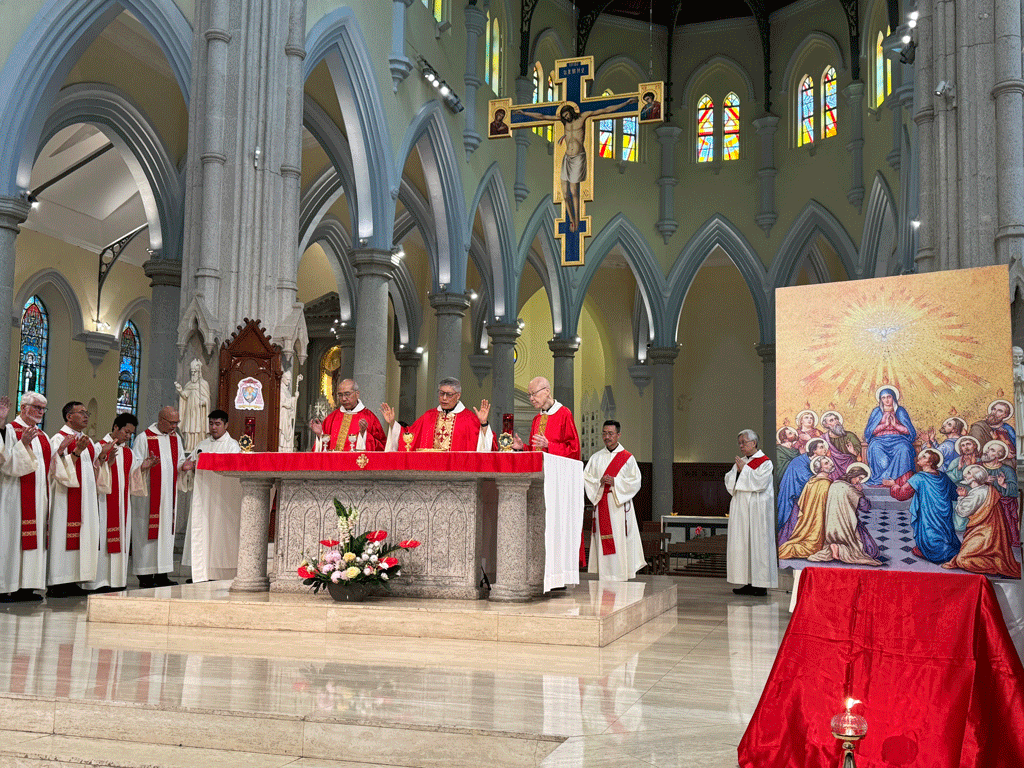
HONG KONG (SE): During a Mass to pray for the Church in China at the Cathedral of the Immaculate Conception on Caine Road, on May 24, Pentecost Sunday, Cardinal Stephen Chow S.J. urged Catholic communities to pursue the courage to overcome fear and to seek mutual understanding and forgiveness through the Holy Spirit. He also reminded those present of recent progress in Vatican-China episcopal appointments, crediting improved mutual understanding.
In 2007, Pope Benedict XVI designated May 24, the feast of Mary Help of Christians, as the World Day of Prayer for the Church in China. As the feast coincided with Pentecost Sunday this year, Cardinal Stephen began the service by inviting the congregation to pray for the Church in China on this special feast day, which marks the Church’s birthday and renewal by the Holy Spirit.
The Mass was concelebrated by John Cardinal Tong Hon, bishop emeritus of Hong Kong, Auxiliary Bishop Joseph Ha Chi-shing, and Monsignor Jose Luis Diaz-Mariblanca Sanchez, the head of the Holy See Study Mission, alongside more than 10 other priests. The service was co-organised by the Diocesan Liturgical Commission and the Holy Spirit Study Centre.
The ‘invisible cage’ of fear
In his Chinese homily, Cardinal Stephen addressed the psychological pressures facing the faithful today. He described an “invisible cage” built from fear, which often leaves Christians hesitant to speak out or act on their faith.
However, the cardinal offered a message of hope, comparing the Holy Spirit to a fire that can transform anxiety into genuine courage. He warned that such power could sometimes be misused, turning religion into an aggressive, divisive ideology.
“Our Christian faith should bring us peace from the Risen Lord, and to understand and forgive one another more deeply,” Cardinal Stephen said. “What do we gain from mutual understanding and forgiveness? We gain freedom—a true, authentic freedom.”
Progress in episcopal appointments
Specifically addressing the provisional agreement on the appointment of bishops between the Holy See and Beijing, Cardinal Stephen emphasised that building trust requires open and respectful dialogue between religious groups and the government.
Our Christian faith should bring us peace from the Risen Lord, and to understand and forgive one another more deeply. What do we gain from mutual understanding and forgiveness? We gain freedom—a true, authentic freedom
Cardinal Stephen
Reflecting on the agreement, which began in October 2018, the cardinal admitted that progress has been slow. Between 2018 and 2023, only six bishops were appointed. During this period, the Chinese government appointed two unofficial bishops as auxiliary bishops for the official Church. However, many dioceses are still waiting for a bishop.
“The provisional agreement has not achieved very ideal results,” Cardinal Stephen noted, “but it can be said that mutual understanding between both sides is increasing. Combined with frequent cooperation, experience, and mutual adaptation between the two places, efficiency has already shown signs of improvement.” He highlighted a major shift in recent years, as between 2024 and 2025, 10 bishops have been appointed or recognised.
Despite the progress, the cardinal reminded the faithful that many dioceses are still waiting for leaders and that much work remains.
In January 2024, breaking years of stagnation, three new bishops were consecrated in Shandong, Henan, and Fujian. Notably, in August 2024, the Chinese government officially recognised the 90-year-old Bishop Melchior Shi Hongzhen of the unofficial community in Tianjin.
Let us also pray for the efforts made by the Holy See and the Chinese government for the Church in China. That the Holy Spirit would guide them closely along the arduous process of collaboration for the greater and common good of our country
Cardinal Stephen
Forgiveness and the common good
In his English homily, Cardinal Stephen focused on how the Holy Spirit brings truth, unity, and the freedom that comes from forgiveness. He touched upon the difficult nature of reconciliation, acknowledging that many are not yet ready to forgive. Crucially, he urged the community not to judge others or try to decide who is truly repentant, stating that judgment belongs to God alone.
The cardinal ended his homily by asking for continued prayers for the Church in China. “Let us pray that the Catholic Church in China as a whole will endeavour to obtain an authentic understanding of the Christian faith and in driving for Christian communion that brings hope to our people,” he said.
For the ongoing talks between the Vatican and Beijing, he prayed that the Holy Spirit would guide both sides through their complex collaboration.
“Let us also pray for the efforts made by the Holy See and the Chinese government for the Church in China. That the Holy Spirit would guide them closely along the arduous process of collaboration for the greater and common good of our country,” he concluded.