Father Shay Cullen
Chaos has engulfed the Philippine Senate, once revered for upholding the rule of law, following a dramatic incident in mid-May. Shots were reportedly fired inside the chamber as Ronald “Bato” dela Rosa—a senator, former national police chief and chief implementer of ex-president Rodrigo Duterte’s bloody war on drugs—allegedly sought sanctuary to avoid arrest on an International Criminal Court [ICC] warrant for crimes against humanity. According to reports, he eventually exited the Senate on May 13, allegedly with assistance from several Senate allies.
Courageous Filipinos who witnessed countless killings, many of them relatives of victims, have come forward to seek justice and testify. They have found the bravery to speak out despite threats from allies of the former president, who faces trial at the ICC in The Hague, the Netherlands. His daughter, vice president, Sara Duterte, has been impeached again and is also set to face trial in the Senate.
Further investigations into alleged corruption involving politicians and their associates are ongoing in Congress, after billions of pesos were allocated to flood-control projects that were subsequently found to be non-existent.
A former district engineer of the Department of Public Works and Highways in Bulacan has testified, and a former public works undersecretary has agreed to serve as a state witness. A former Bulacan assistant district engineer has admitted that many projects were either overpriced or non-existent. Private contractors involved in flood-control operations have delivered explosive testimonies, naming numerous lawmakers and public officials who allegedly sought payoffs. A whistleblower has provided crucial evidence, including reports of cash-filled suitcases delivered to top political figures.
Courageous Filipinos who witnessed countless killings, many of them relatives of victims, have come forward to seek justice and testify. They have found the bravery to speak out despite threats from allies of the former president, who faces trial at the ICC in The Hague, the Netherlands
Together, their testimonies reveal the extent of corruption in Philippine politics, where most legislators hail from families belonging to the ruling elite. This wealthy oligarchy enjoys lives of luxury in a country with between 12 and 15 US dollar billionaires and over 12,800 US dollar millionaires.
They could help transform the country’s poverty statistics if they chose to share their wealth to improve lives, alleviate suffering and injustice, and protect the environment and human rights. They could also provide decency and social development to the hundreds of thousands employed in their companies.
In the Gospel of Matthew, there is a story about a rich young man who came to Jesus and asked him how he could gain eternal life. Jesus told him to live a virtuous life and obey the commandments, which the man claimed he did. Then Jesus saw he was a wealthy man and did not condemn him for being so, but advised him to “sell his possessions and give to the poor, and you will have treasure in heaven; and come, follow me” [Matthew 19:21].
Jesus wants all people to have good food and adequate homes, education, and prosperity. That no one should live in poverty and go hungry is a vital message of his. To help them is to be one with Jesus himself, he said [Matthew 25:31–46].
Do the wealthy families comprising the oligarchy possess a conscience—distinguishing right from wrong—and do they consistently choose what is good? With 58.62 million Filipinos going hungry each day, they appear to be ignoring this dire situation
Poor, hungry Filipinos
The oligarchy has created a nation with many poor and hungry families. The official poverty rate stands at 15.5 per cent, or approximately 17.54 million Filipinos living in poverty. However, as many as 58.62 million Filipinos self-identify as poor, according to recent surveys.
Many of these families live in slums and shanty towns, struggling to feed their children. This inequality represents a grave social injustice and demonstrates a failure both by the ruling elites who control government and by the Church, which has not sufficiently challenged the structural causes of poverty in the nation.
Do the wealthy families comprising the oligarchy possess a conscience—distinguishing right from wrong—and do they consistently choose what is good? With 58.62 million Filipinos going hungry each day, they appear to be ignoring this dire situation.
Jesus taught that unless the rich share their wealth with the poor, it will be extremely difficult for them to enter the Kingdom of God. This sharing must go beyond mere handouts, requiring collaboration with honest individuals and social movements to address structural injustice, inequality, and the corruption that allows the wealthy to further enrich themselves.
According to Jesus, it is nearly impossible for the wealthy to change, likened to a camel passing through the eye of a needle. Such transformation would require miracles. However, faith in God and in Jesus calls us to work for good, oppose evil, and seek justice. As St James wrote: “faith without action is dead.”
The oligarchy has created a nation with many poor and hungry families. The official poverty rate stands at 15.5 per cent, or approximately 17.54 million Filipinos living in poverty.
Dedicated Christians are taking action—undertaking great deeds and protecting both the environment and people from exploitation. The Haribon Foundation and World Wide Fund for Nature-Philippines have planted many native trees. These non-governmental organisations [NGOs] work directly with Indigenous communities to secure land stewardship and sustainably map forests.
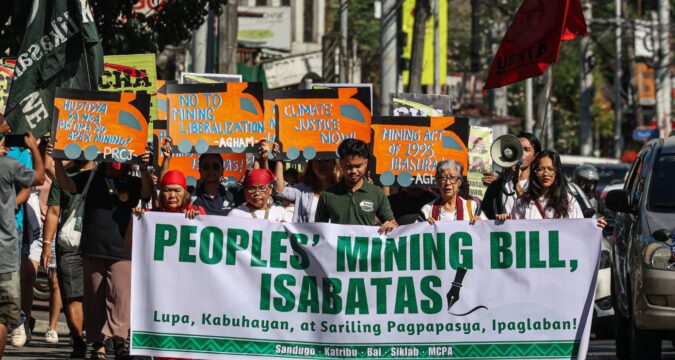
Brave and committed Filipinos in these NGOs—including Alyansa Tigil Mina and Climate Rights International—document corporate violations, organise protests, and call for a halt to mining in key biodiversity areas and island ecosystems. They risk their safety to oppose large-scale nickel, gold, and copper mining in ecologically sensitive regions such as Palawan and Caraga, which cause massive soil erosion, severe river siltation, and toxic acid mine drainage. May their voices be heard and heeded.
Climate action networks, including Aksyon Klima Pilipinas and the Centre for Environmental Concerns, strongly protest the government’s 2026 environmental budget cuts and push back against new fossil fuel plants. These NGOs deploy decentralised, off-grid solar and micro-hydro microgrids to remote island communities, offering them a new lease of life.
They also run educational campaigns to accelerate the transition to localised renewable energy. Some install solar panels on buildings to help mitigate climate change. Coalitions such as the EcoWaste Coalition and Greenpeace Philippines campaign vigorously against the construction of incinerators and advocate for a total ban on single-use plastics. We are all challenged to become involved to end poverty and injustice, and to make the Philippines a happier, more just, and prosperous nation for its people.

Related posts:
Gaza pastor says little is left after ‘tsunami’ of destruction
Indonesian leader honours country’s Catholics

Bishop expresses solidarity with victims, families of Indonesian football tragedy