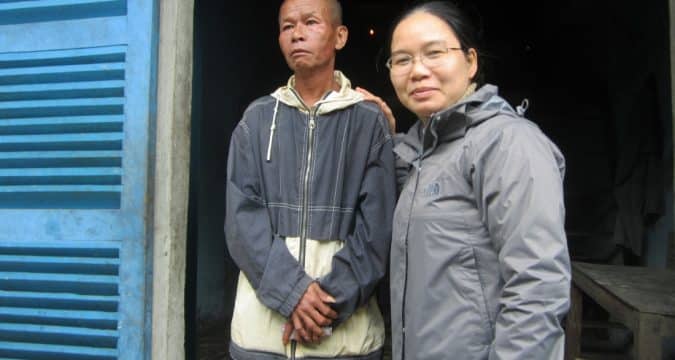
“My health is improving gradually thanks to the Catholic nuns who care for me,” Le Van Hoat recounts. In his old T-shirt and shorts, with a pensive expression on his face, the 50-year-old from Hue, the capital of Thua Thien Hue province, Vietnam, rarely speaks except to say “thanks” to those who visit and offer him food and gifts.
Le, whose parents died years ago, has no siblings and has suffered from a mental disability for the past 20 years. He cleans his house and does the washing on a daily basis, simple tasks he could not perform for many years in the past.
Social worker, Sister Mary Le Thi Thu Huong of Daughters of Our Lady of the Visitation, recalled meeting Le in December 2022 when she, along with some lay volunteers, was offering Christmas gifts to local people in need.
He bowed to them with his hands folded and asked for cigarettes.
Sister Le and two other nuns from her congregation began visiting him regularly, even helping to reconnect the power supply to his house.
“We try to do something useful for his physical and mental health, like talking to him daily besides giving him food, medicines, and clothes, and also teaching him to do the housework,” the nun said.
She is happy that Le’s behaviour is gradually returning to normal and that he has learned basic tasks like cleaning and washing.
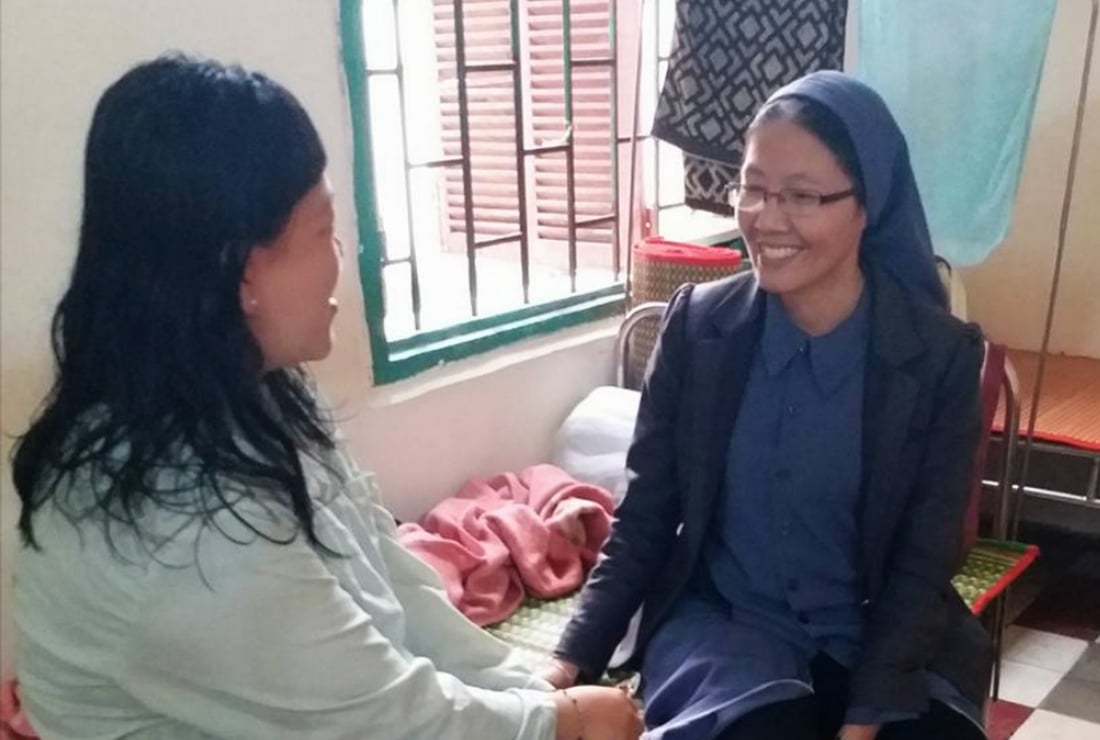
Previously, the neighbours would avoid him for fear of being attacked but they now treat him with respect and also help.
Le’s relatives explained that he was diagnosed with a mental problem in 2003 after suffering severe brain trauma in a road accident. Since they could not afford his medical care he was left to fend for himself.
He used to catch fish in the river for a living, but he began to wander aimlessly on the streets and eat leftovers from the local bistros. He would sleep in the market, and whenever he had a seizure would shout at people, and tear at his clothes. As a result, no one dared to go near him.
In 2022, the province of Thua Thien Hue recorded 4,895 cases of schizophrenia, epilepsy, and depression, of which 450 patients were kept at a centre for homeless people.
The Health Ministry reported last year that cases of mental disorder were on the rise and the country recorded nearly 15 million patients, accounting for 15 per cent of its population.
Sister Le said that her congregation gives allowances of one million dong [$334] per month to 17 psychiatric patients as a way to stave off hunger and undernourishment.
Most of them develop mental disorders after losing loved ones, or due to a brain injury or because of genetic reasons. Some live with their relatives while many are abandoned by their families and wander the streets alone.
We also encourage their relatives to spend time tending, listening to, being with, and comforting them because they will only be healed if they get affection from their family members
Sister Mary Le Thi Thu Huong
“We also encourage their relatives to spend time tending, listening to, being with, and comforting them because they will only be healed if they get affection from their family members,” the nun said.
Lovers of the Holy Cross Sister Marie Truong Thao, from Caritas in the Archdiocese of Hue, said workers, including five nuns from three congregations, help 50 mentally ill patients on a monthly basis in Thua Thien Hue province.
Many of them are former prisoners, drug abusers, and in the case of women, have had abortions and suffered domestic abuse.
Sister Truong, who has a degree in social work, said many live alone and those living with relatives have their legs chained inside the home.
It is mostly out of fear that the mentally disadvantaged may cause physical harm. Hence, Caritas workers teach family members how to care for them.
The nun recalled her first meeting with 24-year-old Do Thi Oanh at her home in Hue in 2018.
Do stared at her in anger from inside her four-metre-square room, which emitted a foul odor. She was disheveled and in bad shape.
Her parents, who are Confucians, assumed she was under demonic possession and paid 50 million dong [$16,695] to a local shaman to heal her. But her illness only got worse.
“I smiled at her, touched her hands, and talked with her for a short while. Then I washed her hair and changed her clothes. She’d not been attended to for nearly a year,” Sister Truong, who looks after Do on a weekly basis, recalled.
It took several months to change her behaviour. “She slowly became friendly to me but is still very quiet,” the sister said.
However, Do has learned to wash and arrange her hair, sweep the floor, be gentle with others, and no longer screams in fear.
Meanwhile, in another part of the city, Le is showing remarkable progress. He calls the nuns and others who regularly visit him by their names. He expresses his gratitude to the nuns.
“I wish the worst is over soon and I can do something for a living,” he said while sitting and sipping tea in front of his modest house. UCAN