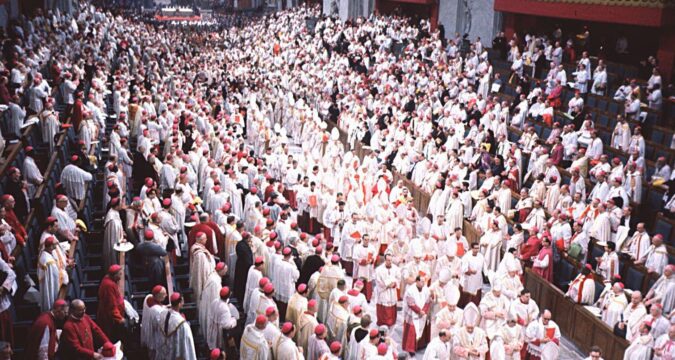
(OSV News): The Second Vatican Council, which after three years of dialogue and document drafting closed on 8 December 1965, changed the face of the Church, and opened it to the modern world.
The council, opened under Pope St. John XXIII and closed under his successor, Pope St. Paul VI, initiated a comprehensive renewal, with major council texts released on hot-button Church issues.
As the Church commemorates 60 years since the closing of Vatican II, here are seven key issues and documents that serve as its legacy for future generations.
Understanding of the Church
Lumen Gentium [1964], one of the four primary constitutions of the council, sets out the new self-understanding of the Roman Catholic Church. It defines the Church as a community of believers, as the “people of God” on their journey through time. In this constantly reforming church, a “common priesthood” of all believers is emphasized—something realised in different forms with clergy and laity.
The constitution emphasises the role of the college of bishops who lead the Church “with Peter and under Peter,” as Joseph Cardinal Ratzinger, later Pope Benedict XVI, reminded years later.
In a joint declaration on the penultimate day of the council, Pope Paul VI and the Ecumenical Patriarch of Constantinople, Athenagoras I, cancelled the mutual excommunication sanctioned by their predecessors in 1054
In several decrees, the council drafted guidelines for a contemporary form of Christian life and service in spiritual vocations for priests, religious and laity. The importance of the vocation of the laity is emphasised by the council fathers and the training of priests was reorganised.
The Church’s missionary activity was given a new theological foundation in the decree Ad gentes. In the decree, Christus Dominus [1965], on the episcopal pastoral office in the Church, the leadership function of the bishop in his diocese was strengthened.
Liturgy
The constitution, Sacrosanctum Concilium [1963], calls for more use of the respective national languages in church services. While “the liturgy is considered as an exercise of the priestly office of Jesus Christ,” the constitution says that the faithful should be actively involved in the liturgy as a congregation.
The council fathers emphasised the value of Bible preaching and church music in the service. The new Roman Missal of 1969 goes further and replaces the old Tridentine Mass, in which the priests celebrate the sacrifice of the Mass with their backs to the congregation.
Religious freedom
The declaration, Dignitatis Humanae [1965], refers to the unbreakable human dignity of each individual and recognises the civil right of all people to choose their religion freely according to their own conscience. Nevertheless, the council emphasises the conviction that the “one true religion subsists in the Catholic and Apostolic Church.”
Ecumenism
The council fathers carried out a fundamental theological opening toward Orthodox Christians and Protestants. The decree, Unitatis Redintegratio, [1964] is a milestone in the Roman Church’s willingness to engage in ecumenical dialogue.
The document emphasises the links with other religions without diminishing its own claim to truth. The Catholic Church, it says, rejects nothing that is “true and holy” in the religions. Christians, Jews and Muslims are encouraged to clear up mutual misunderstandings in dialogue
In a joint declaration on the penultimate day of the council, Pope Paul VI and the Ecumenical Patriarch of Constantinople, Athenagoras I, cancelled the mutual excommunication sanctioned by their predecessors in 1054.
Judaism and other non-Christian religions
The declaration, Nostra Aetate, [1965] clarifies the relationship between the Roman Church and other religions. A landmark Catholic document, credited with greatly advancing Catholic-Jewish relations in the decades that followed, it clearly rejects anti-Semitism.
The text was the Catholic Church’s first formal denunciation of “hatred, persecutions, displays of anti-Semitism, directed against Jews at any time and by anyone,” while affirming the “spiritual patrimony common to Christians and Jews.”
The document emphasises the links with other religions without diminishing its own claim to truth. The Catholic Church, it says, rejects nothing that is “true and holy” in the religions. Christians, Jews and Muslims are encouraged to clear up mutual misunderstandings in dialogue.
Church and the world
The constitution, Gaudium et Spes [1965], attempts a comprehensive definition of the position of the “Church in the modern world,” presenting her as the gateway through which society receives life in Christ. Its drafting led to heated discussions among the council fathers.
Nostra Aetate, [1965] clarifies the relationship between the Roman Church and other religions
Important topics included the relationship between armament, war of aggression and self-defense, a condemnation of communist atheism, and a combination of scientific and economic progress with lived solidarity.
In another timely document, Inter Mirifica [1963], the council fathers encouraged Catholics to acquire media skills, pass them on and thus make Christian positions heard in society via the media.
Bible and divine revelation
The dogmatic constitution on divine revelation, Dei Verbum [1965], paved the way for a new scientific approach to the Bible by authorising historical-critical interpretation. The document attempts to create a balanced relationship among Holy Scripture, Church tradition and the teaching authority of the Church.
Revelation is understood as God’s self-communication in words and deeds. Meeting on the eve of the 60th anniversary of the document, Pope Leo asked members of the group to reflect on how they individually and as a federation respond to the call “to hear the Word of God with reverence and to proclaim it with faith.”