HONG KONG (SE): In a city often marked by division and polarisation, the visible friendship and collaboration between the Catholic and Anglican communities offers a quiet yet powerful witness to the prayer of Jesus “that they may all be one” [John 17:21].
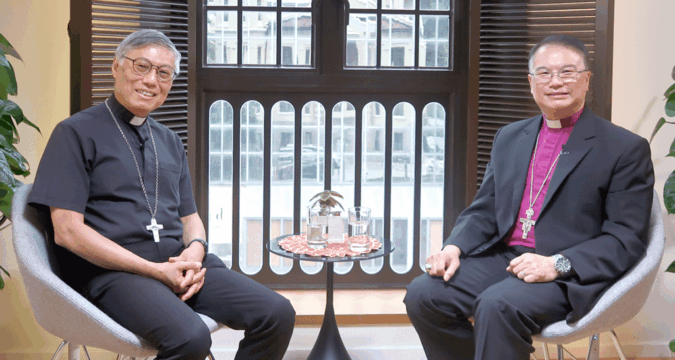
In an interview conducted during Holy Week on April 1 at the Bishop’s House of Hong Kong Sheng Kung Hui in Central, Cardinal Stephen Chow, S.J., bishop of Hong Kong, and Bishop Matthias Clement Der Tze-wo of the Hong Kong Island Diocese of Sheng Kung Hui, reflected on the work of the International Anglican–Roman Catholic Commission for Unity and Mission [IARCCUM] and the meaning of ecumenical friendship for the faithful in Hong Kong.
What is IARCCUM?
Bishop Der began by outlining the origins of IARCCUM. The commission traces its roots to the historic 1966 meeting between Archbishop Michael Ramsey of Canterbury and Pope Paul VI in Rome, which initiated formal theological dialogue between the Anglican Communion and the Roman Catholic Church.
For the first three decades, this dialogue focused primarily on doctrinal issues. In 2001, IARCCUM was established to move beyond theological discussion towards lived communion, translating the substantial agreements already achieved into practical cooperation and shared mission at the local level.
When we appreciate and learn from one another, we can build a spirituality rooted in shared love and offer a more credible witness to the Christian faith in our community.
Bishop Der
Key milestones in this journey include the first IARCCUM bishops’ summit in 2016, which gathered bishops from 19 regions in Canterbury and Rome. The second summit, held in January 2024 under the theme “Growing Together,” brought together 27 pairs of Anglican and Catholic bishops. The programme began in Rome and continued in Canterbury.
Both Cardinal Stephen and Bishop Der participated, describing the encounters as deeply moving experiences of prayer, dialogue and fraternity. Cardinal Stephen also preached at the Sunday Choral Eucharist in Canterbury Cathedral on 28 January 2024, marking a historic pulpit exchange.
Gift for the people of Hong Kong
Reflecting on what Anglican-Catholic unity and common mission mean for ordinary believers in Hong Kong, Bishop Der emphasised the importance of mutual recognition and appreciation.
“Each Church carries unique gifts,” he said. “When we appreciate and learn from one another, we can build a spirituality rooted in shared love and offer a more credible witness to the Christian faith in our community.”
Cardinal Stephen echoed this perspective, stressing that Christians are called to live the unity for which Christ prayed.
“The Christian faith is not an ideology,” he said. “Jesus came to reveal the love of God. It is in that love that we unite and bring to the world the true meaning of the gospel.”
The Christian faith is not an ideology. Jesus came to reveal the love of God. It is in that love that we unite and bring to the world the true meaning of the gospel
Cardinal Stephen
He further emphasised that unity does not imply uniformity. Acknowledging the historical differences that have shaped various traditions, he described them as expressions of legitimate pluralism.
“We must learn to appreciate these differences. What matters most is recognising what we share—our common calling and mission,” he said.
Concrete steps: learning to walk together
In recent years, IARCCUM Hong Kong has organised a range of joint initiatives, including clergy gatherings, youth programmes, pulpit exchanges, Passover [Seder] meals, retreats and seminars.
Two initiatives were highlighted as particularly fruitful. The joint Passover meal, held for the third time this year, has been hosted alternately by Anglican and Catholic communities at Caritas Hall and the Holy Trinity Cathedral, bringing together 120 Anglicans and 120 Catholics.
Participants were intentionally seated in mixed groups, encouraging interaction and dialogue. Lay faithful took an active role, and the evening provided space for conversation and shared experiences. Many participants noted how much they had in common and found the encounter enriching.
During the Covid-19 pandemic, both Churches opened their facilities to support the homeless migrant workers and the displaced, offering a tangible expression of Christian charity
As Bishop Der recalled with a smile, photographs were taken freely, with participants unconcerned about denominational distinctions.
Another significant initiative was a one-day retreat for Anglican and Catholic clergy. Participants shared the joys, struggles and hopes of ordained ministry. A particularly moving moment occurred at the conclusion, when Anglican priests approached Catholic bishops for blessings, and Catholic priests did the same with Anglican bishops. “That is a very powerful witness,” Bishop Der remarked.
These events demonstrate that ecumenism is both possible and spiritually enriching.
Cardinal Stephen also pointed to broader collaborative efforts, particularly in outreach. He noted that his visits to 31 Catholic parishes often included encouraging them to engage with nearby Anglican communities. During the Covid-19 pandemic, both Churches opened their facilities to support the homeless migrant workers and the displaced, offering a tangible expression of Christian charity.
Bishop Der highlighted a youth ecological retreat that fostered meaningful exchange, as well as growing cooperation between specific parishes, including of Hong Kong Sheng Kung Hui St. Paul’s Church and the Cathedral of the Immaculate Conception in Central, alongside other communities in Causeway Bay and West Kowloon.
The joint Passover meal, held for the third time this year, has been hosted alternately by Anglican and Catholic communities at Caritas Hall and the Holy Trinity Cathedral, bringing together 120 Anglicans and 120 Catholics
Cardinal Stephen expressed hope that, one day, theological differences might be overcome to allow shared Eucharistic communion.
Facing the obstacles with open hearts
Both leaders acknowledged that challenges remain. However, both agreed that the greatest obstacle lies not in doctrine but in the human heart—often marked by suspicion, comfort with familiarity, and inherited misunderstandings.
Cardinal Stephen recounted hearing a young Catholic describe other Christians as belonging to “heretical churches,” while Bishop Der noted that similar attitudes can also be found among Anglicans. “Our differences are not deficiencies,” the cardinal said. “They are forms of richness that we are called to appreciate and embrace.”
Another challenge is the busyness of Church life, which can push ecumenical efforts to the margins. Yet both leaders affirmed that such engagement ultimately enriches spiritual life and strengthens parish communities.
The recent Synod on Synodality in Rome has further underscored the importance of fostering relationships beyond one’s own ecclesial boundaries.
The recent Synod on Synodality in Rome has further underscored the importance of fostering relationships beyond one’s own ecclesial boundaries
A message of hope and love
In their concluding remarks, both leaders offered words of encouragement to the faithful.
Bishop Der invited all Christians to begin with Christ’s commandment: “Love one another.” “By loving one another within the Christian family, we begin to see Christ in others—and Christ within ourselves,” he said.
Cardinal Stephen reflected on the widespread sense of despair in today’s world. “We are called to be messengers of hope,” he said. “Our hope is grounded in the truth that we are loved—loved by the same God. It is this love that gives us the courage to hope.”
He added that this shared faith enables Christians to become “witnesses to God’s unifying love in the world.”
Becoming instruments of fraternity
The encounter with Cardinal Stephen and Bishop Matthias Der serves as a reminder that ecumenism is not merely a concern for specialists, but a concrete expression of the gospel in contemporary Hong Kong—a society in need of reconciliation and hope.
The faithful are encouraged to take simple yet meaningful steps: visiting a neighbouring Anglican church, praying for unity, or extending gestures of friendship. In doing so, they become, as the interview suggests, “instruments of fraternity and collective witness” to the love of Christ.